On this page
Identify a changing spacetime geometry
Gravitational waves are propagating disturbances of spacetime associated with changing mass-energy configurations. Compact-object mergers can produce signals measurable far from the source. The disturbance is not a pressure wave requiring air to travel through interstellar space.
A sound played from a gravitational-wave event is a representation of a measured time-varying signal shifted or presented for hearing. It is not a microphone recording of ordinary sound crossing the vacuum from the merging bodies.
THE BIG IDEAS
- Gravitational waves are not ordinary sound waves in air.
- Strain expresses a relative detector response.
- Independent detectors and noise analysis support an astrophysical interpretation.
Use strain to express a relative change
Strain is dimensionless and describes a fractional length response. A useful scale illustration is h≈ΔL/L. For a 4 km reference length and a strain of 10⁻²¹, the corresponding length-change scale is about 4×10⁻¹⁸ m.
This arithmetic illustrates why interferometers require extraordinary sensitivity. Actual detector response depends on wave direction, polarisation and instrument geometry, so the simple product is not a complete analysis of a particular measured event.
Follow the interferometer’s comparison
In a simplified Michelson arrangement a laser beam is split along two perpendicular arms and the returning beams are recombined. Changes in relative optical path affect their phase relationship and the detected light signal. LIGO uses additional optical systems far beyond this teaching sketch.
The instrument is comparing light propagation through changing geometry, not stretching a ruler once and reading tiny marks by eye. Control systems, calibration and optical cavities are part of converting detector output into an estimated strain time series with a known response.
Distinguish a candidate from an isolated disturbance
Ground motion, instrument behaviour and environmental effects can disturb one detector. Independent detectors, timing consistency, signal modelling and statistical analysis help distinguish an astrophysical signal from local noise. Agreement is important, but a broad claim still needs the detailed checks appropriate to the data.
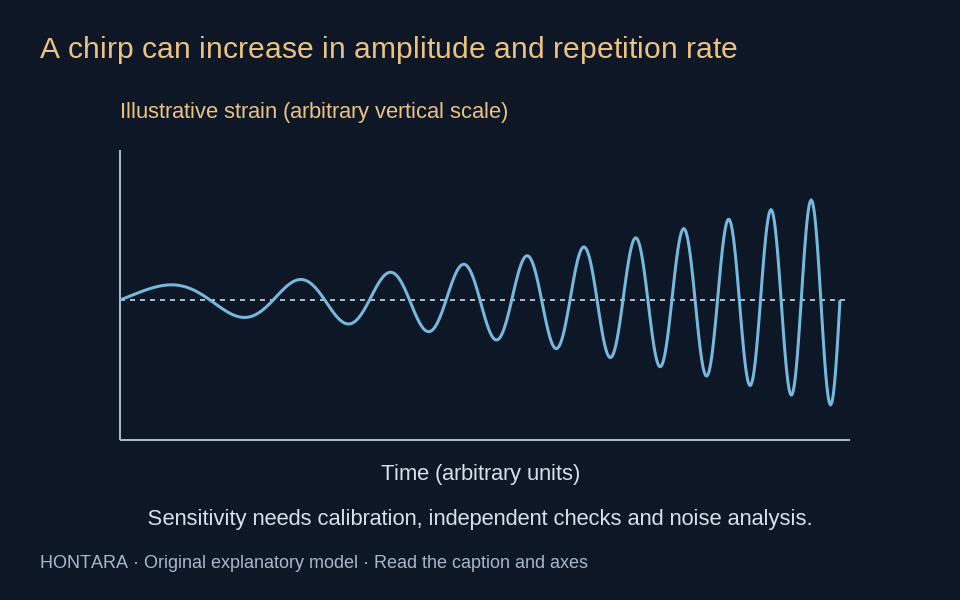
A compact-binary chirp typically rises in frequency as the orbit evolves toward merger. A schematic rising-frequency waveform can illustrate this pattern without being the actual record of a named event. Preserve the source and calibration information when using real data.
Connect a new messenger with its limitations
Waveforms can constrain masses, spins and source distance through physical models, with uncertainties and parameter degeneracies. Some events may also have electromagnetic counterparts, while others need not. Gravitational-wave observations complement light rather than replacing every other astronomical method.
For an evidence exercise, label strain and time axes, identify a candidate chirp and list the independent checks needed before interpreting it. Separate the recorded data, the fitted waveform and the inferred source properties. This keeps a dramatic discovery grounded in measurement rather than an unqualified cartoon of colliding objects.
Changing the illustrative strain to 10⁻²² at the same four-kilometre reference length lowers the simple length-change scale tenfold to 4×10⁻¹⁹ m. Keep the quantity dimensionless until multiplying by the reference length. This arithmetic is a scale check, not a substitute for the detector’s full calibrated response.
PAUSE AND THINK
Why does a consistent signal at separated detectors help assess a candidate event?
Explore the answer
It can distinguish a propagating signal with compatible timing and waveform from many local instrumental or environmental disturbances, alongside the other required analyses.