On this page
What are the bright ring and dark centre?
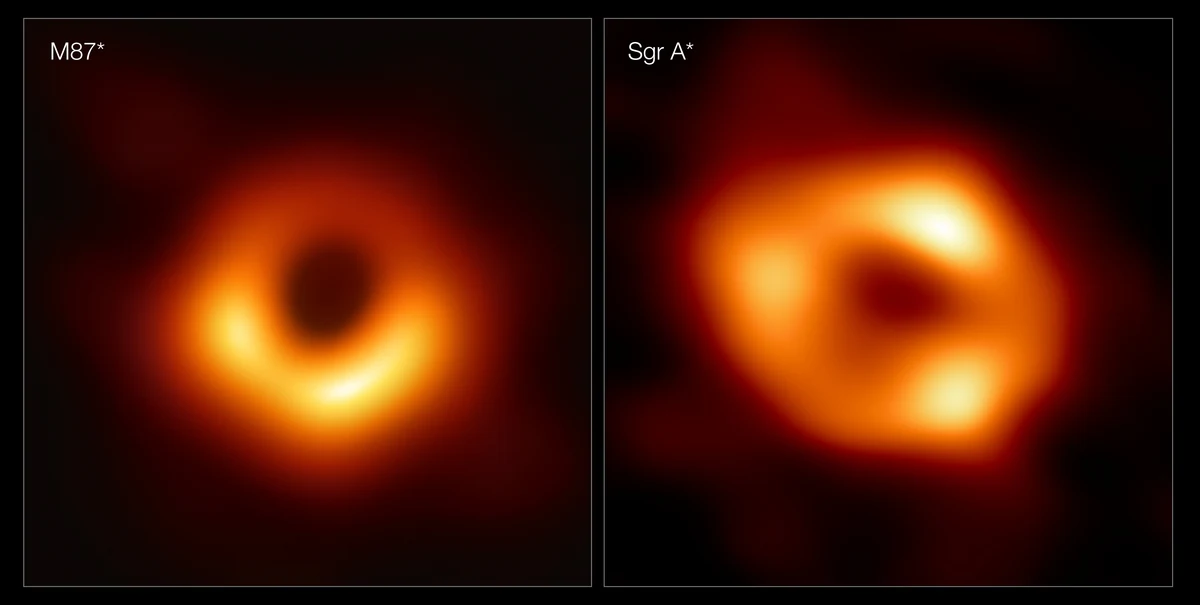
The bright ring shows radio emission from hot gas close to the black hole. Its gravity bends some of that light around it. The orange and yellow are colours assigned to show the strength of the radio signal. Brighter colours show stronger emission.
The dark centre is the black hole’s shadow. Some light from the gas is captured by the black hole, leaving a darker patch in the image. The shadow appears larger than the event horizon, the boundary beyond which light cannot escape.
Why do the two rings look about the same size?
M87* is more than a thousand times as massive as Sagittarius A*. Its ring is also physically much larger. But M87* is about 2,000 times as far away, so the two rings take up a similar amount of space in our view of the sky.
| Detail | M87* | Sagittarius A* |
|---|---|---|
| Galaxy | Messier 87 | Milky Way |
| Distance | 55 million light-years | 27,000 light-years |
| Mass | 6.5 billion Suns | 4 million Suns |
| Image | Released in 2019 | Released in 2022 |
How radio telescopes made the images
The Event Horizon Telescope is a network of radio observatories. Atomic clocks let telescopes on different continents record signals with precise timing. Combining those measurements gave astronomers the ability to resolve tiny details, similar to what a telescope as wide as Earth could distinguish. They used software to reconstruct images from the combined radio data.
Sagittarius A* was the harder target even though it is closer. The gas around it changed noticeably over minutes while the telescopes gathered data over hours. The published image combines multiple reconstructions to show the ring structure that persisted across them.