On this page
THE BIG IDEAS
- Read the caption before inferring physical properties.
- Display colour can encode measurements beyond human vision.
- An observation and an artist’s illustration serve different purposes.
Learning objectives and preparation
Students will distinguish observation from interpretation and explain why a scientific image needs a caption. Select two publicly accessible NASA image pages with clear descriptions of instruments and colour treatment. Keep their source links beside the images and check reuse credits before making handouts. The activity can be taught from a shared screen or a teacher’s spoken description if printing is unavailable.
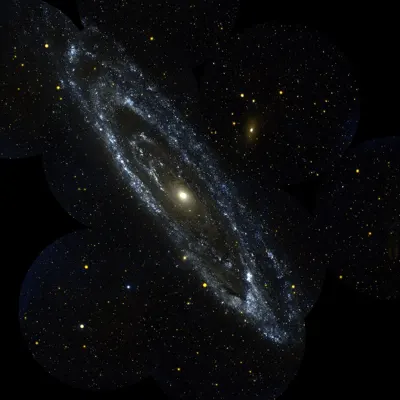
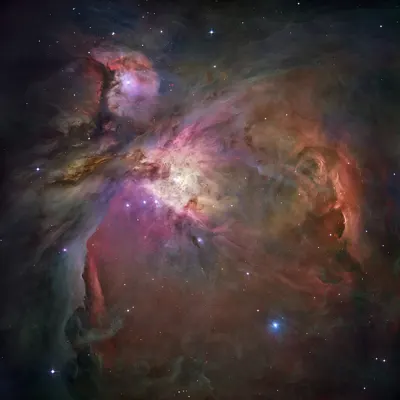
The linked Orion Nebula and Andromeda examples show different objects. Use them to practise reading captions, not to claim that wavelength alone explains their different appearances. For a wavelength comparison, choose images of the same target and match the field, orientation and scale using the source captions.
Lesson outline
- Minutes 0-8: Show one image without its caption. Students write only visible features such as bright knots, curved bands or an uneven edge.
- Minutes 8-18: Reveal the caption and ask which new claims came from measurement or expert interpretation rather than appearance alone.
- Minutes 18-30: Compare two image descriptions that use different wavelength bands or colour assignments.
- Minutes 30-40: Groups write a short replacement caption that preserves the key scientific context.
- Minutes 40-50: Each learner identifies one conclusion the image supports and one that needs additional evidence.
Student reading checklist
- 1. What object or region is shown and which observatory recorded it?
- 2. Which wavelengths or filters contributed to the image?
- 3. Do the displayed colours approximate a human-eye view or represent another mapping?
- 4. Is the picture an observation, a composite, a simulation or an artist’s illustration?
- 5. What scale, date or orientation information would help interpret it?
Answer guide and discussion
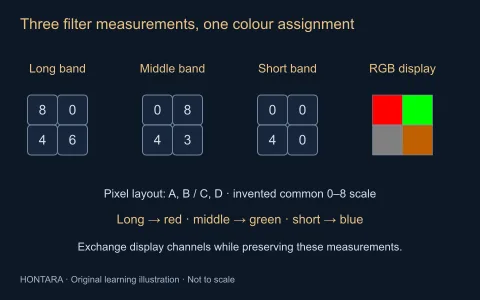
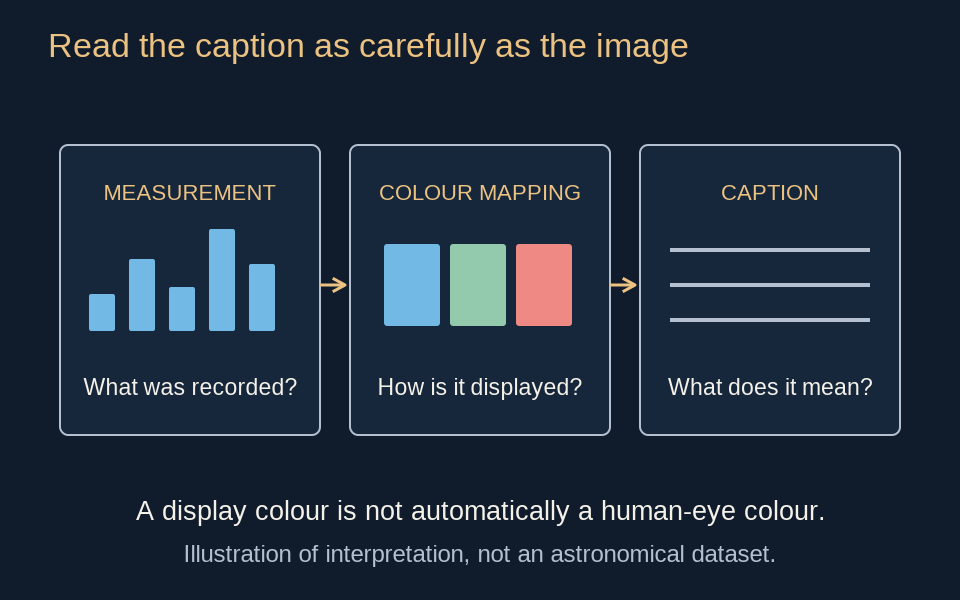
A coloured image is not automatically a direct record of the colours a person would see through an eyepiece. Detector measurements from selected bands can be assigned display colours and combined. This can reveal real structures or wavelength differences while translating information into a form our eyes can interpret.
Processing does not automatically make an image fictitious, but the processing choices matter. Students should use the supplied caption rather than guess at temperatures, chemical composition or physical size solely from the displayed colour. An artist’s illustration can explain an idea but should not be presented as a photograph of the actual scene.
Differentiate and assess
Provide a vocabulary box for detector, filter, composite and illustration. Allow students to use shape or brightness descriptions instead of colour alone. For extension, compare what changes when a region is viewed in visible and infrared light. Evaluate captions for source attribution, correct image type and one clear limitation. The strongest responses explain what the evidence allows while keeping uncertainty visible; they do not simply describe a picture as real or fake.
PAUSE AND THINK
Does a colour-mapped infrared image show invented structures?
Explore the answer
Not necessarily. Measured infrared differences can be assigned visible colours so people can inspect them. The caption must explain the mapping and the nature of the underlying data.
RECORD YOUR OWN EVIDENCE
Your activity sheet
You need: Two source-credited astronomical images and their full captions, paper and pencil.
Record visible features first. Then read each caption and identify the evidence it adds.
Name or group: Date:
| Image + source | Instrument / wavelengths | Image type / colours | Evidence and limits |
|---|---|---|---|
Which statements came from your eyes and which came from the caption?
Write a two-sentence caption that states an observation and one limitation.
Record what happened, including uncertain results. Use the answer guidance in this resource to discuss your explanation.