On this page
Stars belong to larger systems
A galaxy is a vast system held together by gravity. Its visible contents include stars and their planets along with gas and dust. Most galaxies are also inferred to contain substantial dark matter. Our Sun belongs to the Milky Way.
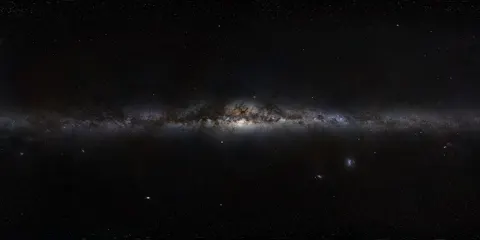
The pale band visible across a dark sky is our view through part of our own galaxy, not a separate luminous cloud sitting outside it. We are looking from within the system rather than viewing it face-on from a distant vantage point.
THE BIG IDEAS
- The Sun is part of the Milky Way galaxy.
- Galaxies contain more than just visible stars.
- Interactions can reshape galaxies over immense timescales.
Different shapes tell different stories
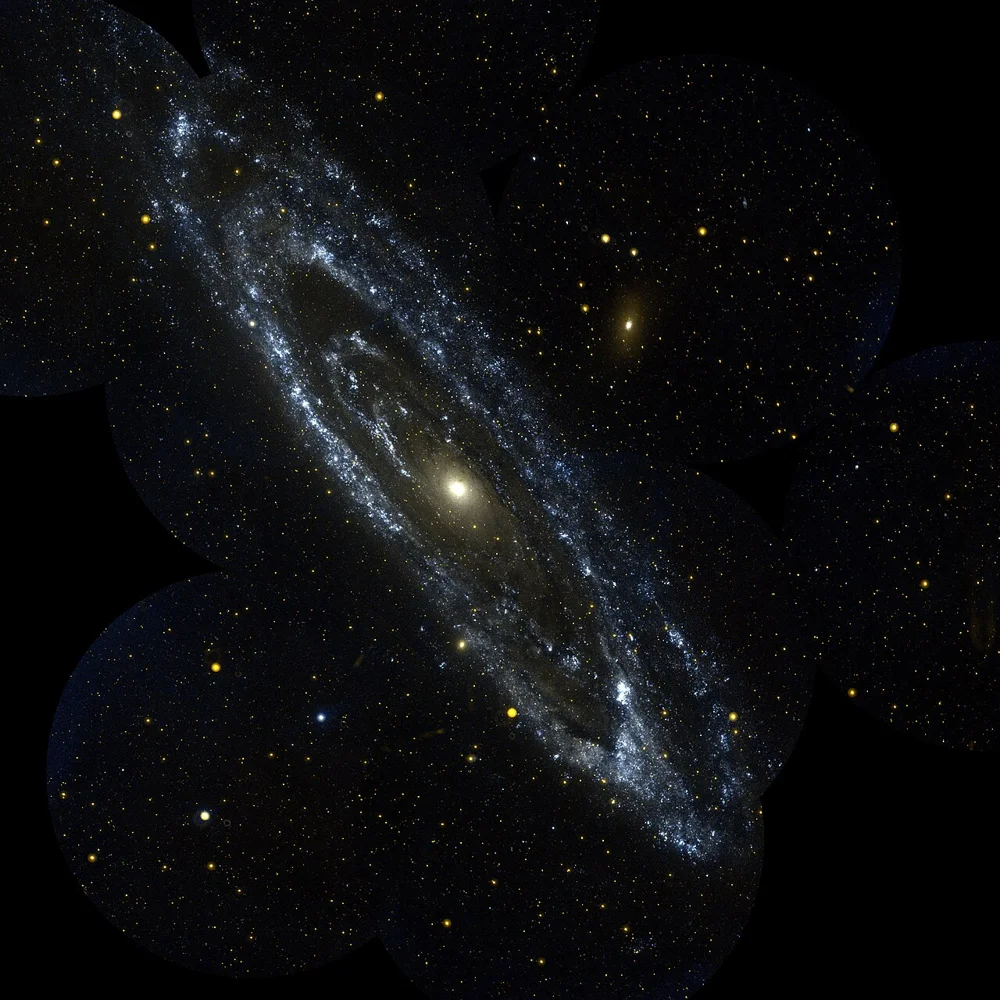
Spiral galaxies have disks with patterns of arms, often containing young stars and clouds where new stars form. Elliptical galaxies have smoother rounded shapes and generally older stellar populations. Irregular galaxies lack a simple symmetric form. These categories are useful descriptions rather than rigid boxes. A galaxy’s structure can reflect its history of star formation, gas supply and interactions with other galaxies over very long periods.
What holds the system together
The visible stars are only part of a galaxy’s mass. Measurements of motion show that additional unseen matter is needed in the standard explanation of many galactic systems. This is called dark matter because it does not emit or absorb light in the usual observable way. It is not the same thing as dark clouds of ordinary dust. Astronomers infer its influence through gravity while investigating its physical nature.
Galaxies can interact
Galaxies move within groups and clusters. Close encounters can stretch them into tidal features, disturb their gas and sometimes lead to mergers. Individual stars are separated by so much space that direct stellar collisions are uncommon during a galaxy encounter. The gravitational effects on whole populations and clouds are nevertheless enormous. A dramatic image of interacting galaxies records a process unfolding over hundreds of millions of years, not a collision completed in an afternoon.
Observing a galaxy honestly
Most distant galaxies appear as faint patches through small telescopes, often without the colourful detail seen in long-exposure images. A dark sky and patient viewing matter. A photograph can combine many exposures and wavelengths to reveal structure too faint for the eye. Both observations are valuable when described correctly. Knowing that a small grey patch contains a vast stellar population can make the modest visual view more meaningful rather than disappointing.
PAUSE AND THINK
Why is the Milky Way seen as a band rather than a complete spiral in our sky?
Explore the answer
We observe from inside its disk. Looking along the disk brings many stars into the same lines of sight.