On this page
THE BIG IDEAS
- M42 is a bright star-forming nebula in Orion’s sword.
- A wide field helps locate its surrounding pattern.
- Visual views are usually much subtler than long-exposure images.
Look for a cloud among stars
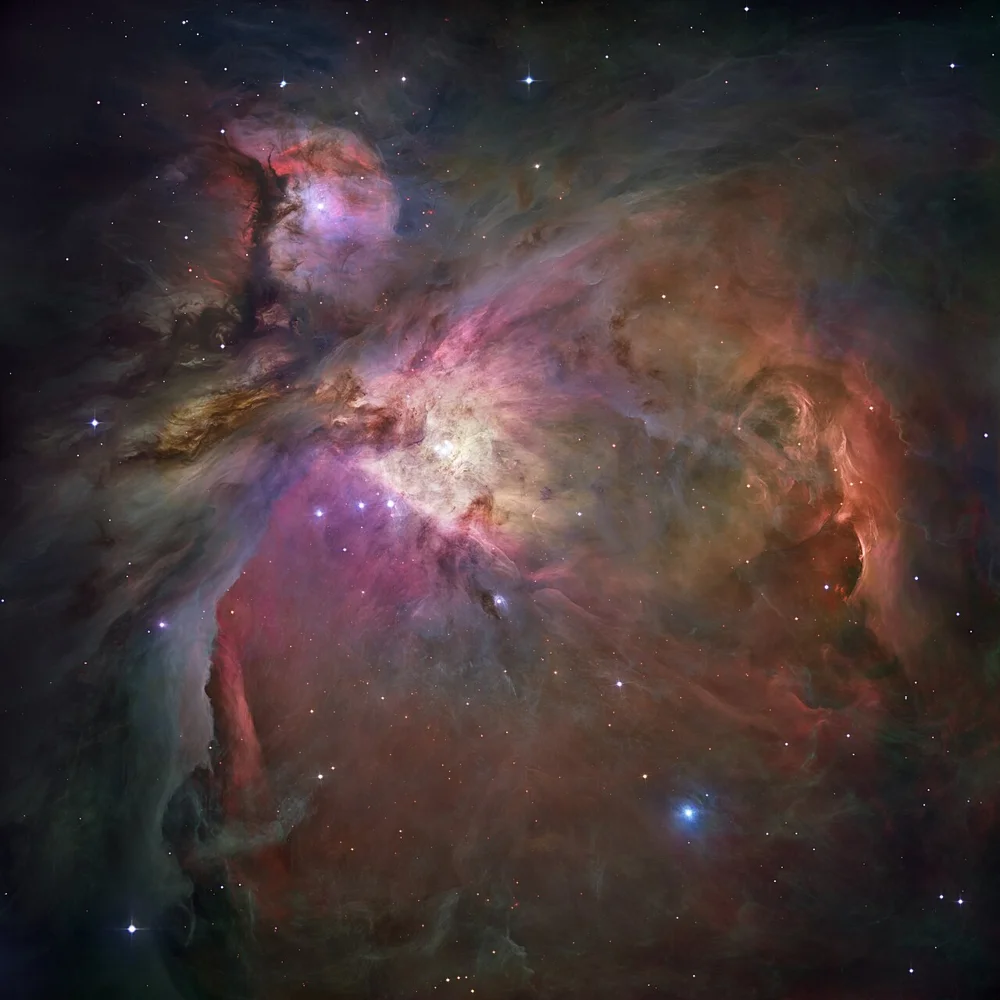
The Orion Nebula, also called Messier 42 or M42, is a region where stars are forming within a much larger cloud. It sits in Orion’s sword below the three belt stars in the familiar upright drawing. It is one of the more accessible bright nebulae for beginners, but the local sky still determines how much you see.
Under a dark sky, the sword can appear slightly misty to the unaided eye. In a brighter town, you may need binoculars to distinguish that softness. Failing to see it with your eyes is not evidence that it has disappeared.
Find Orion before narrowing the view
Use a chart set to your location, date and time. Orion is a good northern-winter evening target, but its exact direction changes throughout the night. Identify the belt and sword with the naked eye first. Then use binoculars or the telescope’s low-power eyepiece to search the sword region.
Avoid beginning at high magnification. A wider field makes it easier to compare the stars you see with the chart and gives the nebula room around its brighter centre.
Separate the stars from the glow
At first you may notice a small bright central region with a faint fan of light around it. Let your eyes adapt away from nearby lamps. Look slightly beside the faintest edges and compare whether they become easier to notice. Be patient without staring so long that the view becomes uncomfortable.
A telescope can reveal a compact central group called the Trapezium. Resolving its stars depends on the instrument and conditions. Recognising the surrounding cloud is already a successful observation; counting every central star is a different challenge.
Do not expect the photograph
Published nebula images combine the light collected over long exposures and sometimes different wavelength bands. Your eye works differently, especially at low brightness. Many beginners see pale grey or a subdued tint rather than a vivid pink cloud. Larger equipment does not automatically reproduce a processed image.
Make a sketch using only the areas you can reliably distinguish. Leave uncertain edges dashed or lightly shaded. This preserves your actual observation and makes later comparisons more meaningful.
Try a controlled comparison
Observe once while the Moon is bright and again on a clear moonless evening, keeping the telescope and location the same. Compare the outer glow rather than just the brightest centre. Record cloud, haze and nearby lighting because these can change between sessions too. The result demonstrates contrast, not merely telescope power. Never travel to an unfamiliar dark site alone; plan access and supervision in daylight.
PAUSE AND THINK
Why might the bright centre remain visible while the outer cloud disappears in moonlight?
Explore the answer
Moonlight brightens the sky background, reducing the contrast of the faint outer nebula.