On this page
THE BIG IDEAS
- M31 is a separate galaxy roughly 2.5 million light-years away.
- Its light is spread across a large apparent area.
- A faint oval can be a successful first observation.
Meet a galaxy beyond our own
The Andromeda Galaxy, also called M31, is a large spiral galaxy outside the Milky Way. It is roughly 2.5 million light-years away. The faint light you try to detect has travelled across that enormous distance before reaching your eyes.
A small telescope does not resolve the galaxy into a field of individual ordinary stars. Most visual observers first notice its combined light as a soft elongated patch with a brighter middle. Recognising that patch is the starting achievement.
Use a chart with local geometry
M31 is in Andromeda and can be a useful northern-autumn evening target when it is above your horizon in darkness. Set a planetarium to your observing location and time before choosing the session. Buildings, trees, haze and local light can still obstruct the view.
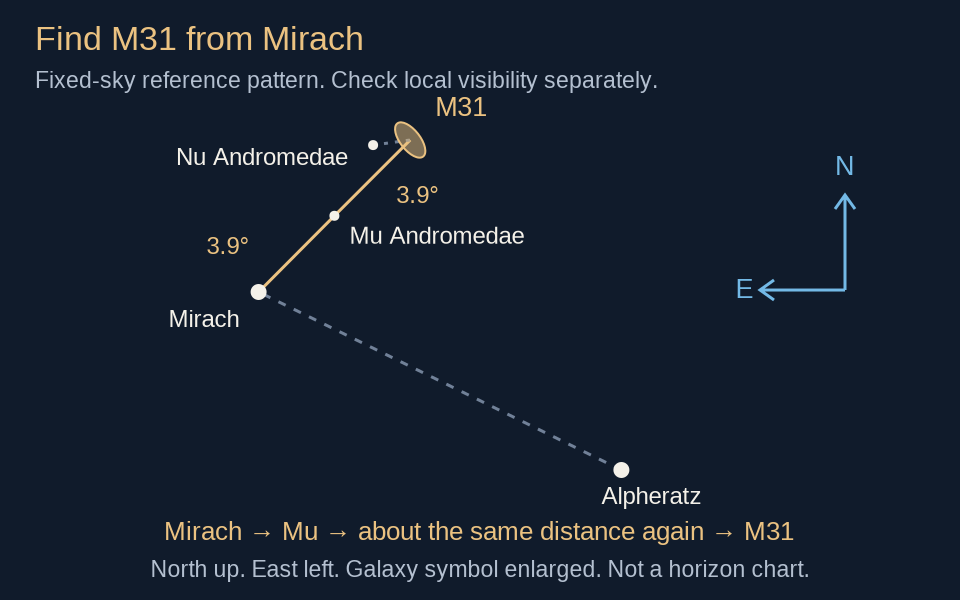
Identify Mirach in the chain of stars extending away from Alpheratz, a corner of the Great Square of Pegasus. From Mirach, move about four degrees toward the fainter star Mu Andromedae. Continue roughly the same direction for another four degrees to look for M31’s faint elongated glow.
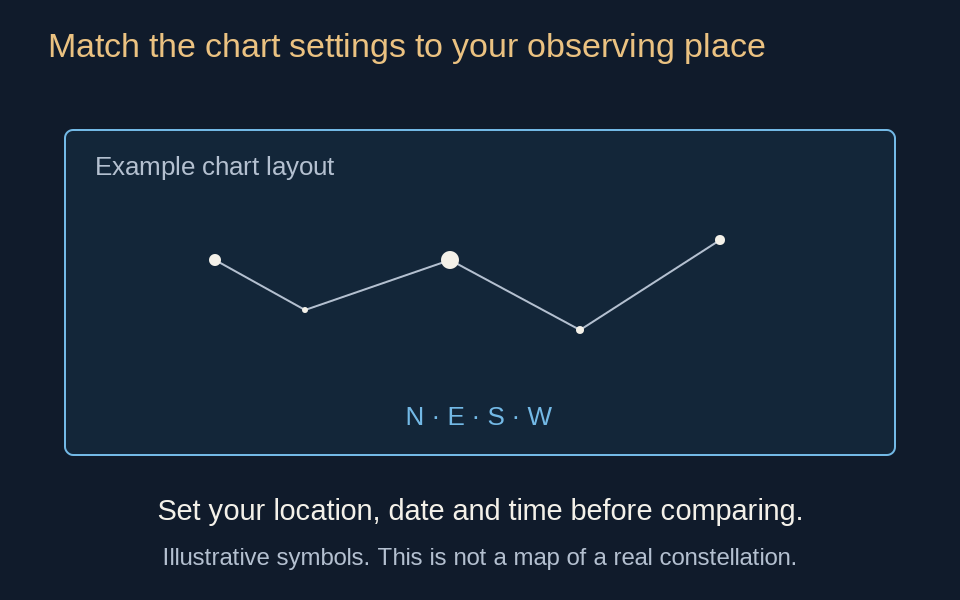
Nu Andromedae lies about one degree to the east of the galaxy and can help confirm the field. Use the labelled finder diagram to match the direction rather than assuming north is straight up in your eyepiece.
Alpheratz and Mirach are about 14.5 degrees apart, so they are wide-field orientation landmarks rather than one ordinary binocular field. Mu and Nu are fainter than Mirach and may need binoculars under a bright sky. A telescope can rotate or mirror this pattern; begin with a wide view and check the orientation rather than sweeping at random.
The whole galaxy is larger than the obvious core
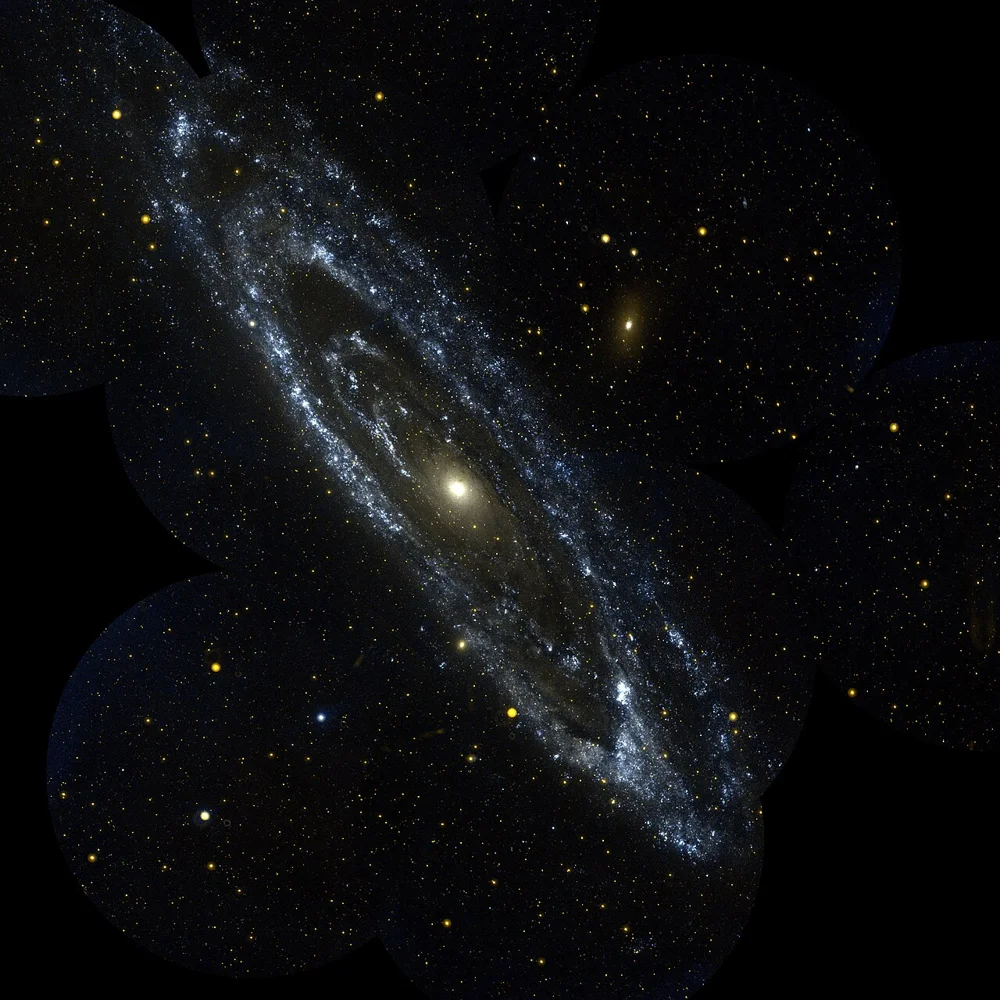
Photographs show a broad disk extending much farther than the bright centre visible from a town. The galaxy’s light is spread over a large area, so a catalogue’s combined magnitude does not mean it behaves like a star of that magnitude.
Binoculars or a telescope with a wide field can be useful. A high-power eyepiece may enlarge the central glow while excluding much of the surrounding disk. More magnification is not automatically the answer to a faint extended object.
Build confidence in a subtle detection
Observe on a clear night with little moonlight. Shield nearby lamps and give your eyes time to adapt. Look slightly beside the suspected patch and compare whether it becomes easier to notice. Then move away and return using the same star-hop.
A repeatable patch in the correct location is stronger evidence than a momentary impression found by expectation. Thin cloud, dew and a dirty eyepiece can also create diffuse glows, so check whether unrelated stars have similar halos.
Sketch the view you actually get
Draw the brightest nearby stars and a lightly shaded oval for the galaxy. Mark which way the oval stretches and whether its centre seems concentrated. Record the equipment, sky conditions and time. Do not add spiral arms because a photograph contains them. A second session from a darker site can reveal more extent and makes an excellent comparison, but it should be planned with safe access and company rather than an improvised late-night journey.
PAUSE AND THINK
Why can a galaxy with a bright combined magnitude still be difficult to see?
Explore the answer
Its light is spread over an extended area, giving much less contrast per small patch than a concentrated star.