On this page
One name covers different mechanisms
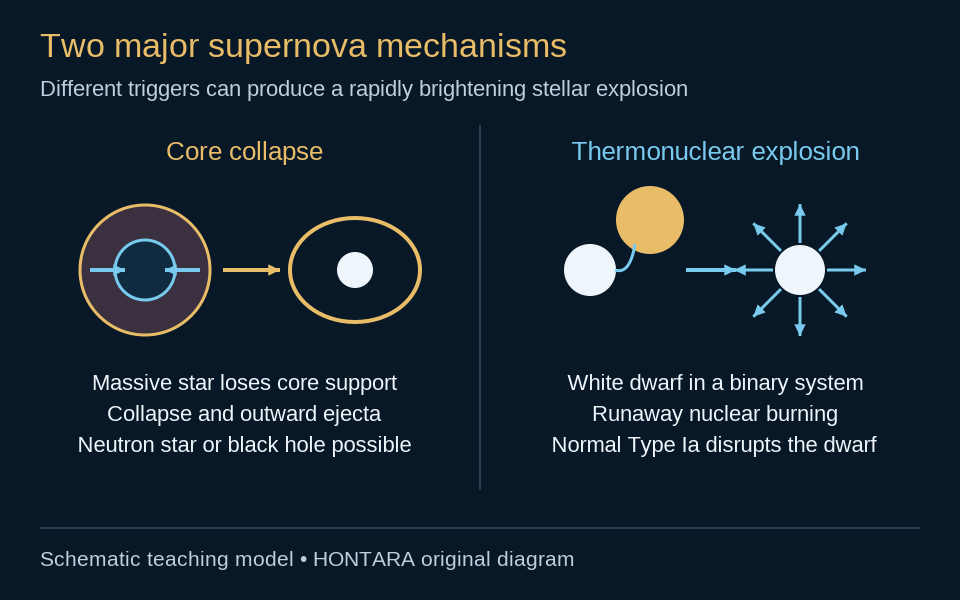
A supernova is a powerful stellar explosion whose brightness changes dramatically over days and months. The word does not identify a single physical mechanism. Two major routes are the collapse of a massive star’s core and runaway nuclear burning involving a white dwarf. The Sun is not massive enough to follow the ordinary core-collapse route.
The observational names developed before astronomers understood these mechanisms. Type II spectra show hydrogen. Types Ib and Ic lack prominent hydrogen and also arise from core collapse in stars that lost outer material. Type Ia is associated with thermonuclear white-dwarf explosions. A missing hydrogen line alone is therefore insufficient to identify a white-dwarf explosion.
THE BIG IDEAS
- Core collapse and thermonuclear burning are distinct explosion mechanisms.
- Types Ib and Ic are also core-collapse supernovae.
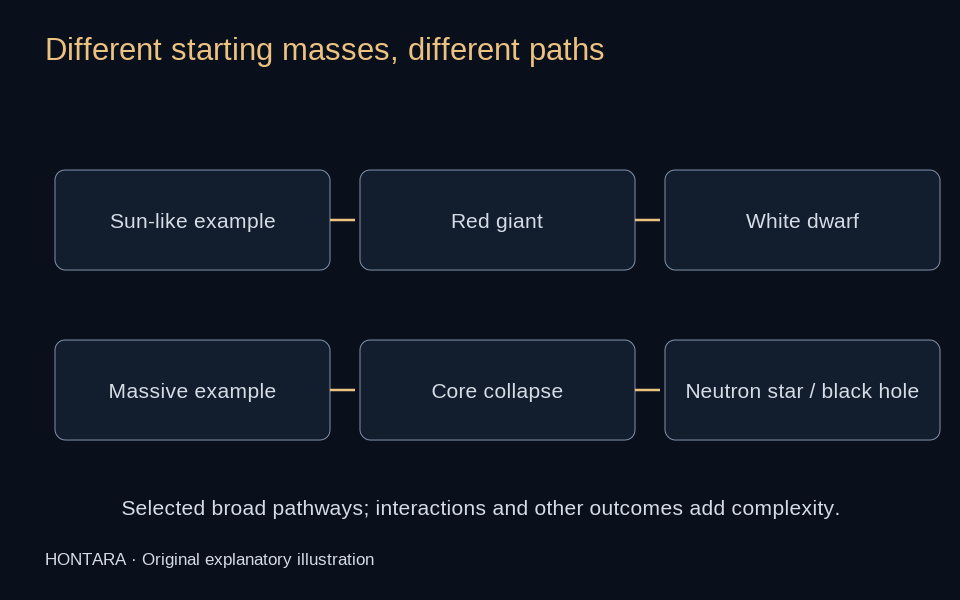
- Starting mass alone does not determine every remnant.
The collapsing-core route
A massive star can build a core whose composition and conditions no longer provide adequate support against gravity. Collapse produces extreme densities and a flood of neutrinos. Reviving the outward shock involves complicated interactions including neutrino heating. The resulting explosion can eject surrounding layers while leaving a neutron star or a black hole.
This is a broad pathway rather than a promise for every star above one sharply defined starting mass. Mass loss, chemical composition and interaction with a companion affect the result. Some collapsing stars may form black holes without a bright ordinary supernova. A simple classroom sequence should leave room for these different outcomes instead of giving every massive star an identical ending.
The white-dwarf route
A carbon-oxygen white dwarf can undergo runaway thermonuclear burning in certain binary systems. Proposed and observed pathways involve transfer from a companion or interaction and merger with another white dwarf. The detailed mix of routes remains an active research question. It is misleading to say every Type Ia begins when exactly 1.4 solar masses are reached.
The energy source here is rapid nuclear burning. In a normal Type Ia explosion the white dwarf is disrupted rather than leaving the neutron star expected in many core-collapse events. Some related weaker thermonuclear events are more complicated. A nova is different again: it usually involves burning in accumulated surface material and can leave the white dwarf able to erupt again.
Use more than a bright dot
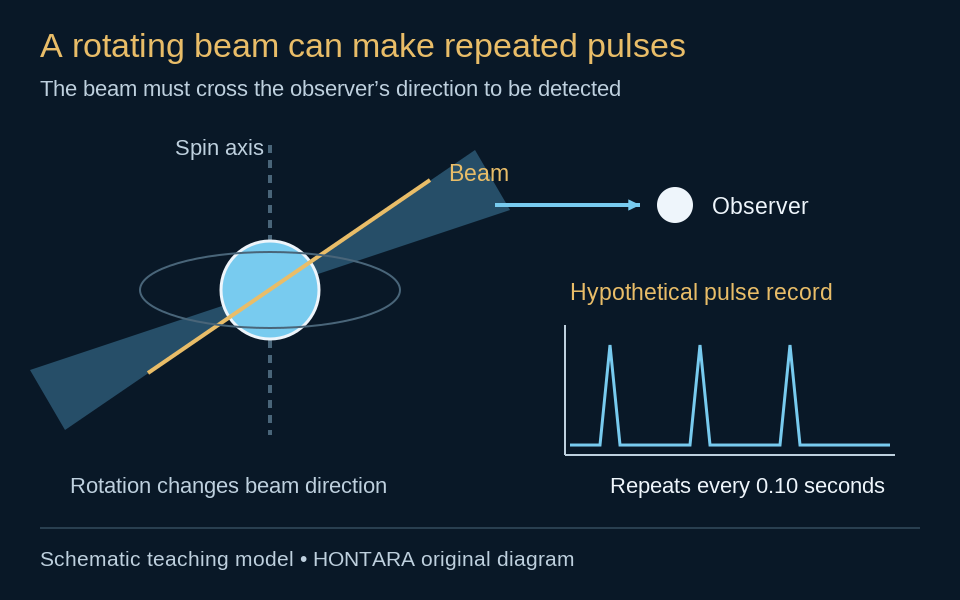
Consider two hypothetical discoveries. Object A has hydrogen features in its spectrum and an expanding remnant containing a pulsar. Object B has the characteristic spectral evolution of a normal Type Ia. A supports a core-collapse interpretation. B supports thermonuclear disruption. Brightness alone would not establish either explanation because distance and obscuring dust also affect the measured light.
Astronomers combine spectra, light curves, neutrinos when available and remnant observations. They compare these with physical models rather than identifying the mechanism from one colourful photograph. A supernova remnant can remain visible long after the original bright event fades. Its hot gas and changing expansion help connect a brief explosion to a much longer history.
PAUSE AND THINK
Why does an absence of hydrogen not prove a Type Ia mechanism?
Explore the answer
A massive star may lose hydrogen-rich outer layers before core collapse. Types Ib and Ic therefore lack strong hydrogen without being white-dwarf explosions.