On this page
THE BIG IDEAS
- Ask for physical reasons behind card order.
- Keep Sun-like evolution separate from core collapse.
- Initial mass alone does not specify every remnant.
Goals and preparation
Learners should construct two defensible sequences while rejecting a universal supernova ending. Prepare the ten labelled cards from the paired activity, paper and pencils. Learners can write letter sequences instead of cutting or handling cards. No downloaded image set or specialist equipment is needed.
The cases are invented teaching selections of initially 1 and 20 solar masses. They represent broad single-star routes. Tell learners that detailed histories depend on more than initial mass and that the card spacing does not encode time. The N card intentionally contains conditional alternatives.
Minutes 0-10: elicit the proposed life story
Invite learners to sketch a star’s possible future without correcting the sketch immediately. Ask which evidence could distinguish an expanding envelope from a compact remnant. Retain early claims for comparison with the final explanation.
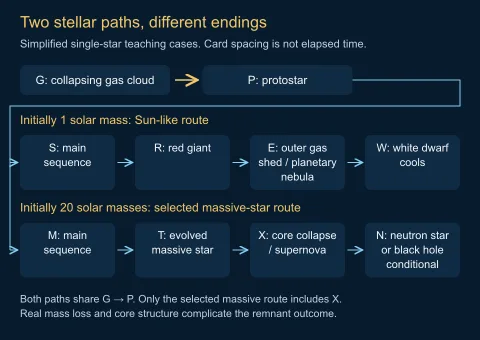
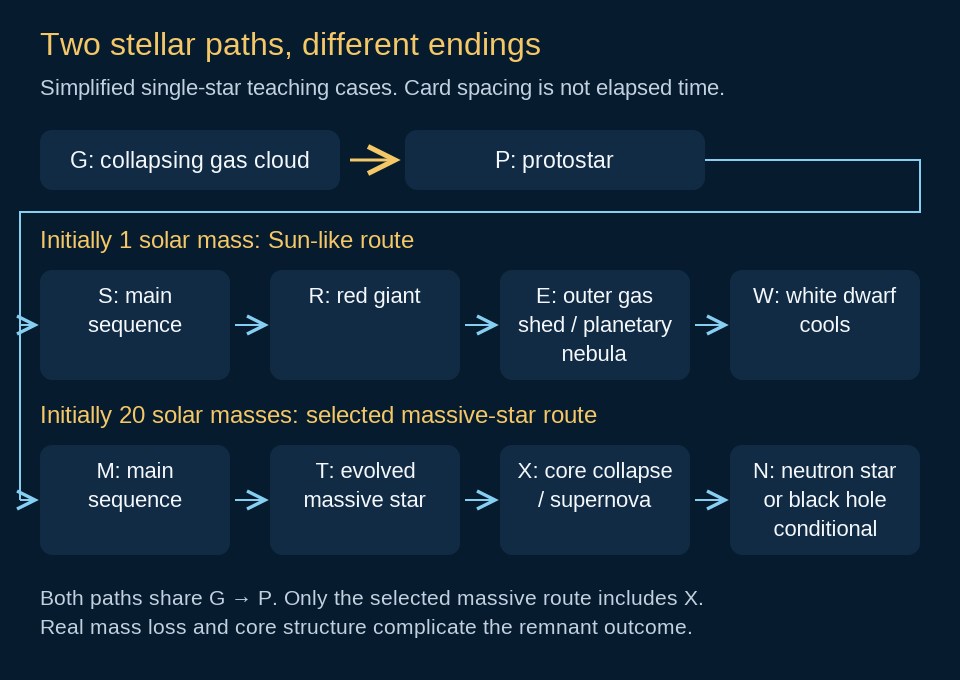
Introduce G as a collapsing gas cloud and P as a protostar. Both supplied routes begin with contraction before sustained core hydrogen fusion. The separate main-sequence cards S and M carry the initial-mass information that anchors the later branch choices.
Minutes 10-25: require reasons for links
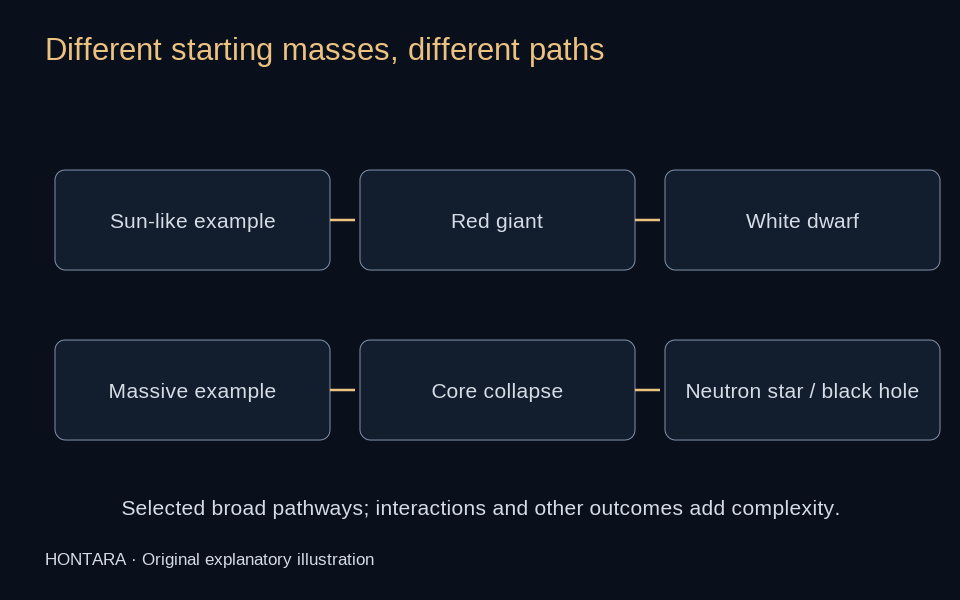
Groups build paths and write one physical reason for each arrow. The intended Sun-like sequence is G → P → S → R → E → W. The selected massive sequence is G → P → M → T → X → N. Sharing G and P is permitted; make duplicate copies if groups want two complete lines.
Do not accept an order justified only by the letters or a remembered coloured poster. Ask which card describes material leaving the star and which describes the remaining core. E is expelled outer gas while W is a compact cooling white dwarf.
Minutes 25-40: probe the branch distinctions
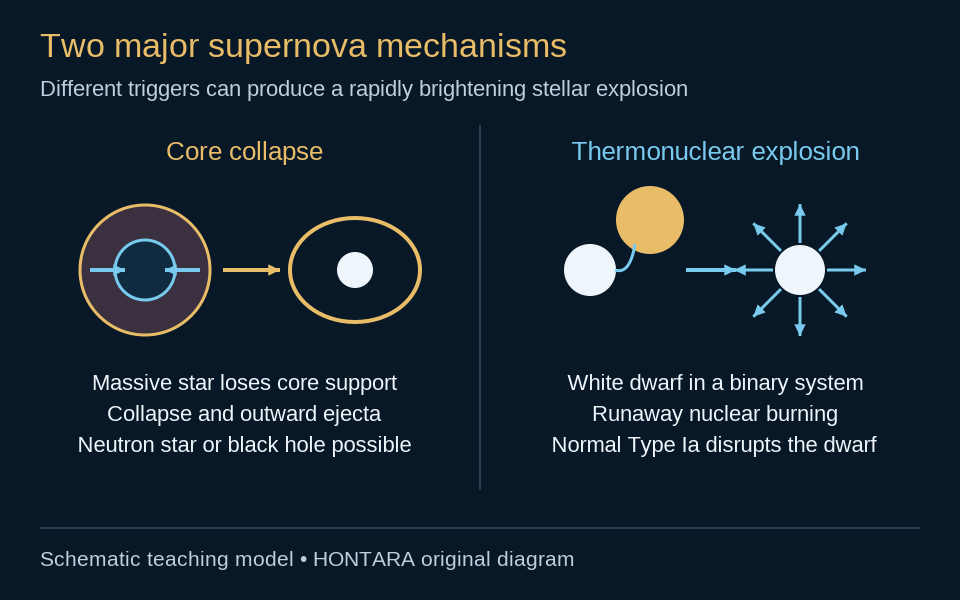
Present the wrong sequence S → X → W. A good correction explains that the stated Sun-like single-star route sheds its envelope and leaves a white dwarf without a core-collapse supernova. This lesson does not model explosive processes involving white dwarfs in interacting systems.
For the massive case, card X represents a simplified core-collapse supernova route. Card N offers neutron star or black hole without claiming that 20 initial solar masses guarantees one remnant. Ask groups to name missing information such as mass lost before collapse or the final core structure.
Minutes 40-50: connect sequence with evidence
Ask whether an astronomer watched a single star traverse every card during one career. Learners should describe comparing different stars and remnants with physical models. A static diagram is a synthesis of evidence and theory rather than a time-lapse observation.
Challenge an equal-duration assumption by noting that the cards provide no time data. Very low-mass red dwarfs can have predicted lifetimes exceeding the universe’s present age. Their full future evolution cannot be presented as an already observed complete sequence.
Minutes 50-55: assess and adapt
The worksheet has two correct broad orders but many valid arrow explanations. Assess shared formation, correct branch selection, gas-versus-core distinction and conditional treatment of N. Require one stated limitation. A correct sequence with “every star explodes” in the conclusion needs revision.
For support, give G and P already placed and provide two branch headings. For extension, ask which extra evidence would test one arrow rather than adding unsupported exact lifetimes. Keep speculative answers labelled and do not imply this lesson has been trialled with HONTARA learners.
PAUSE AND THINK
Can “neutron star or black hole” be marked wrong because it is not one answer?
Explore the answer
No. The supplied massive-star case leaves that outcome conditional. Choosing one without further evidence would claim more than the packet supports.
RECORD YOUR OWN EVIDENCE
Your activity sheet
You need: Paper or index cards, pencil and optional scissors used with supervision.
Copy these supplied cards: G = collapsing gas cloud; P = protostar; S = Sun-like main-sequence star, 1 solar mass initially; R = red giant; E = shed outer layers / planetary nebula; W = cooling white dwarf; M = massive main-sequence star, 20 solar masses initially; T = evolved massive star with layered burning; X = core collapse / supernova in this simplified case; N = neutron star or black hole, outcome conditional. Build two paths sharing G and P.
Name or group: Date:
| Path | Ordered card letters | Evidence for one link | Limit of the path |
|---|---|---|---|
| Sun-like, initially 1 solar mass | |||
| Massive, initially 20 solar masses |
Why does the Sun-like path end at W rather than X?
Does card N let you choose a definite remnant for every 20-solar-mass star? Explain.
Record what happened, including uncertain results. Use the answer guidance in this resource to discuss your explanation.