On this page
Ask two different brightness questions
Apparent magnitude describes the flux received by an observer in a specified band. Absolute magnitude asks what apparent magnitude the source would have at a standard distance of 10 parsecs, without intervening extinction. The standardisation allows comparisons that apparent brightness alone cannot provide.
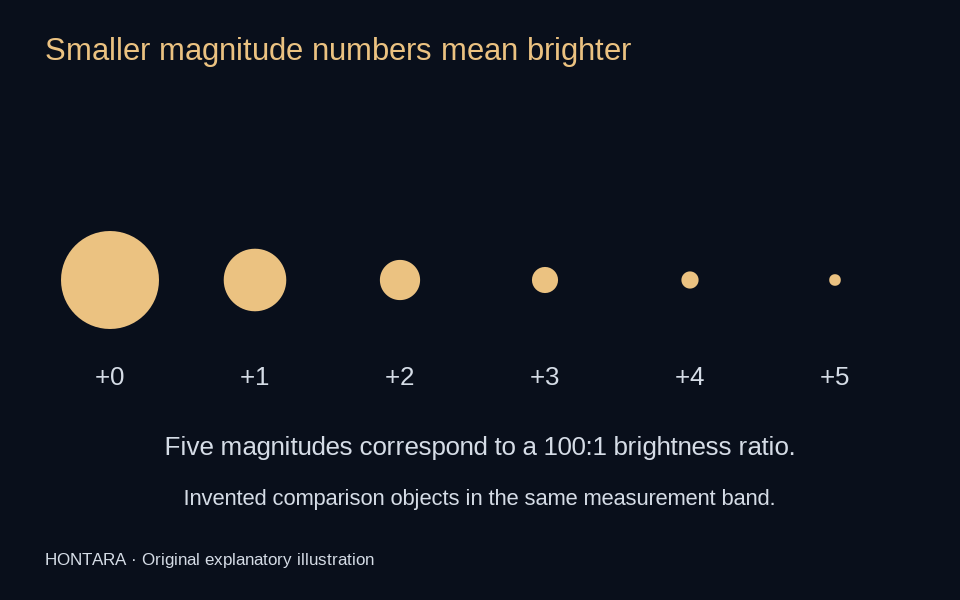
A nearby modest star may appear brighter than a much more luminous distant one. Neither apparent nor absolute magnitude is a physical diameter. Keep the familiar reversed magnitude direction: a smaller numerical magnitude corresponds to greater brightness in the stated system.
THE BIG IDEAS
- Absolute magnitude uses a common 10-parsec reference.
- Both magnitudes and extinction must refer to the same band.
- Dust dimming and distance dimming are not interchangeable causes.
Match the measurement band
An absolute visual magnitude compares output in a visual band, while a bolometric magnitude concerns radiation integrated over all wavelengths. Mixing an apparent magnitude from one band with an absolute magnitude from another does not give an ordinary distance modulus.
Write the band beside both values before calculating. A blue star and a cool red star can distribute their radiation differently across filters, so a comparison in one band need not rank their total luminosities in the same way.
Work a transparent distance example
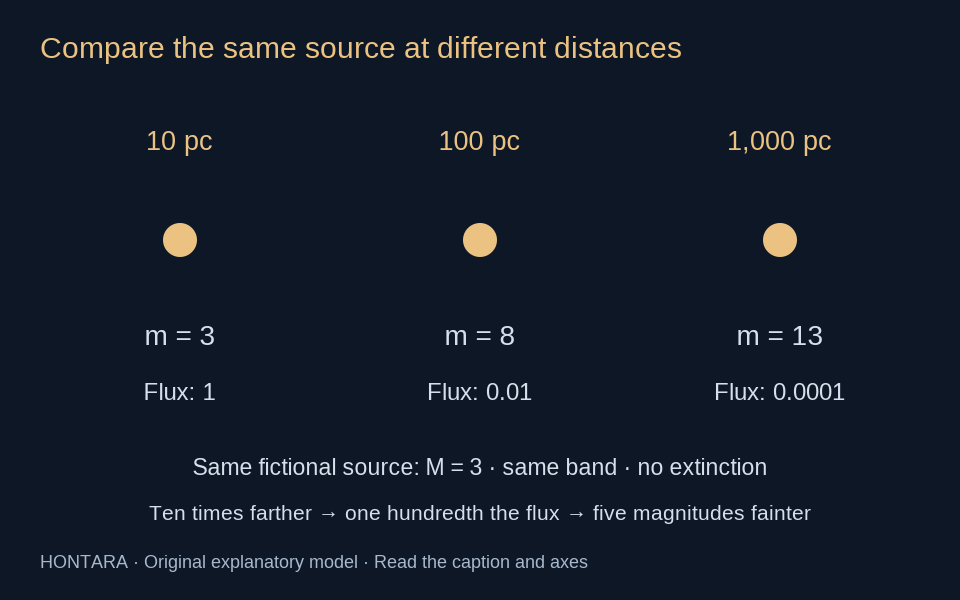
Without extinction, m−M = 5 log₁₀(d/10 pc). A fictional star with m=8 and M=3 has a distance modulus of five. Its distance is 100 parsecs. At 10 parsecs the same source would have m=M, because the logarithmic distance term would be zero.
Moving that source from 10 to 100 parsecs reduces received flux by a factor of 100 in the inverse-square model. The magnitude increases by five. This compares the same source at different model distances, not two stars assumed identical from their colours.
Account for light lost along the way
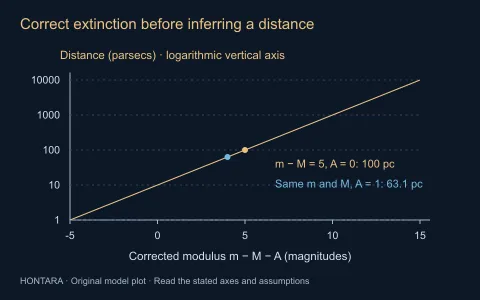
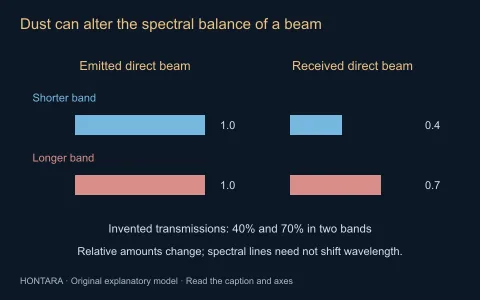
With extinction A in the same band, m−M = 5 log₁₀(d/10 pc)+A. Dust can make an object fainter than distance alone predicts. Ignoring that extra dimming can overestimate a distance inferred from a known absolute magnitude.
In the fictional m=8, M=3 example, adding A=1 magnitude gives a corrected distance near 63.1 parsecs rather than 100. The extinction must come from independent evidence or a justified model; it cannot simply be chosen to obtain an attractive answer.
Keep calibration and uncertainty visible
An inferred absolute magnitude may depend on a calibrated class of stars, a parallax measurement or an atmosphere model. A calculator does not establish that calibration for you. Preserve uncertainty in the brightness, extinction and intrinsic-brightness estimate when using the result scientifically.
To check understanding, compare an apparent-brightness ranking with a common-distance ranking. Explain which information makes the change possible. If distance or extinction is unknown, state that missing evidence instead of turning a single bright point into an unsupported luminosity claim.
As a cross-check, a distance of 1,000 parsecs with zero extinction has a distance modulus of ten. State that result alongside the same-band requirement. A discrepancy can then be traced to the adopted intrinsic magnitude, dust correction or distance rather than hidden in one unexplained final number.
PAUSE AND THINK
If m equals M and extinction is zero, what distance follows?
Explore the answer
Ten parsecs. The distance-modulus term is then zero by the definition of absolute magnitude.