On this page
The numbers run toward the faint end
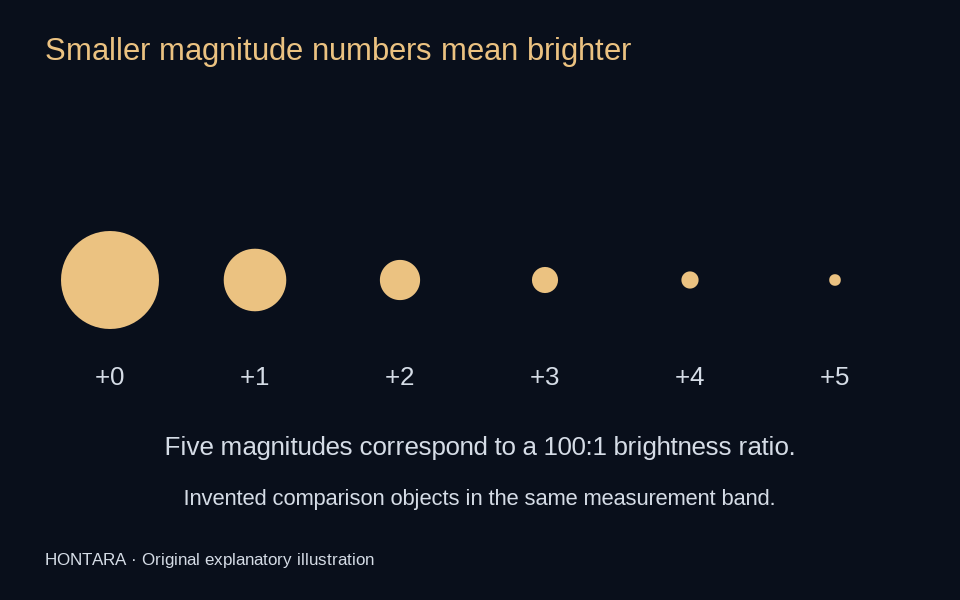
Apparent magnitude describes how bright an object appears to an observer in a specified measurement band. A smaller numerical value means a brighter appearance. Negative values are allowed. A star at magnitude −1 is brighter than a star at +1 in the same band. The sign does not describe its colour or physical size.
Always state whether you mean apparent or absolute magnitude. Absolute magnitude describes an agreed reference-distance comparison. A nearby modest star can look bright while a much more luminous distant star looks faint. Dust along the line of sight can also reduce the light reaching us.
THE BIG IDEAS
- Lower apparent magnitude means brighter in the specified band.
- Five magnitudes represent a brightness ratio of 100.
- Magnitude alone does not determine visibility of an extended object.
It is a ratio scale
A difference of five magnitudes corresponds to a brightness ratio of 100. One magnitude corresponds to about 2.512 times. It does not mean adding the same fixed amount of light at each step. For two measurements in the same band, the ratio is 10 raised to the power 0.4 times the magnitude difference.
For example, compare an invented star at +3 with one at +5. The difference is two magnitudes. The +3 object is about 2.512 × 2.512, or 6.31 times, as bright. It is not two times as bright. Label the stars invented if using these numbers in an exercise.
Check a larger difference
Now compare practice objects at +0 and +5. A five-step difference gives a factor of 100. Two five-step differences give 100 × 100, or 10,000. This multiplication is a useful way to check the direction and approximate size of a calculator result.
If an answer claims that +5 is 100 times brighter than +0, the direction has been reversed. Write the brighter object first in a sentence before reporting the ratio. Keep the magnitude band the same; comparing a visual measurement with an infrared measurement introduces a different question about the spectrum.
A magnitude is not a visibility guarantee
A catalogue magnitude cannot tell you by itself whether an object will be easy to see. An extended object spreads light over an area. A galaxy and a star with similar integrated magnitudes can therefore present very different visual challenges. Sky brightness, haze, adaptation and optical equipment also matter.
This is why a list of targets should include angular size and realistic observing notes rather than just sorting by magnitude. Do not interpret a telescope’s advertised limiting magnitude as a promise that every object above that number will be visible on every night.
Use comparison stars carefully
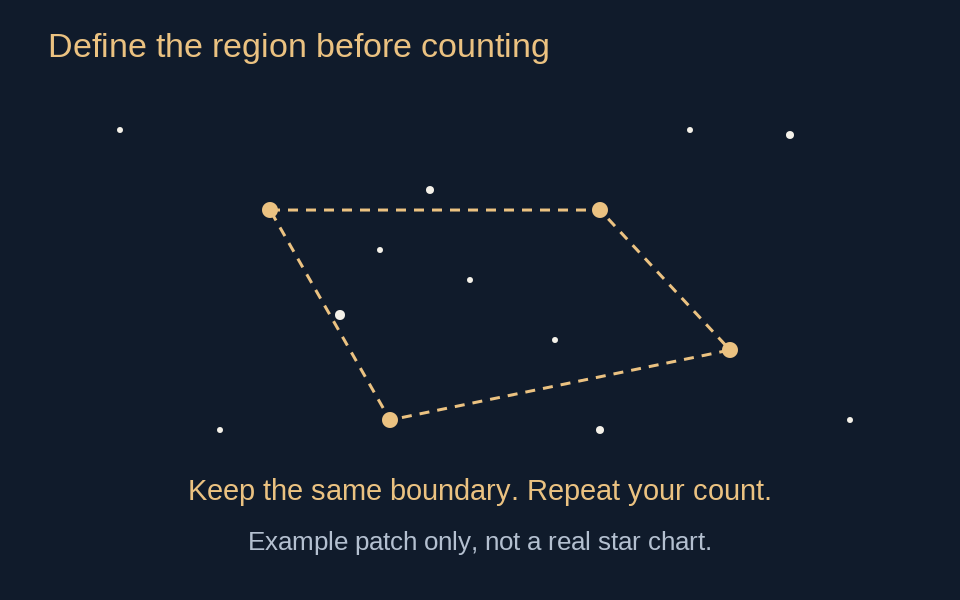
To practise estimation, use a reliable finder chart with comparison-star magnitudes in a specified band. First confirm the star pattern. Compare objects at similar altitudes when possible and note cloud or glare. Record an estimate with uncertainty rather than inventing extra decimal places.
Then explain which part of the exercise was a visual judgement and which was a numerical calculation. The magnitude scale organises measurements, but a quick glance is not automatically calibrated photometry. A useful notebook entry preserves those limits while still allowing observations on different nights to be compared.
PAUSE AND THINK
Two practice stars have magnitudes +1 and +4. Which is brighter and by about how much?
Explore the answer
The +1 star is brighter. The difference is three magnitudes, giving 10^(0.4 × 3), or about 15.85 times, in the same measurement band.