On this page
THE BIG IDEAS
- A fixed boundary makes repeat counts easier.
- Weather, moonlight and eyesight influence star visibility.
- One sky patch cannot be multiplied into an accurate all-sky count.
Make the question smaller
Counting every visible star is difficult because you can lose track as your eyes move. Instead, choose one recognisable small sky patch and ask how consistently you can count its visible stars. This is a practice investigation, not an official estimate of all stars above your location or a calibrated measure of sky brightness.
Plan a safe session
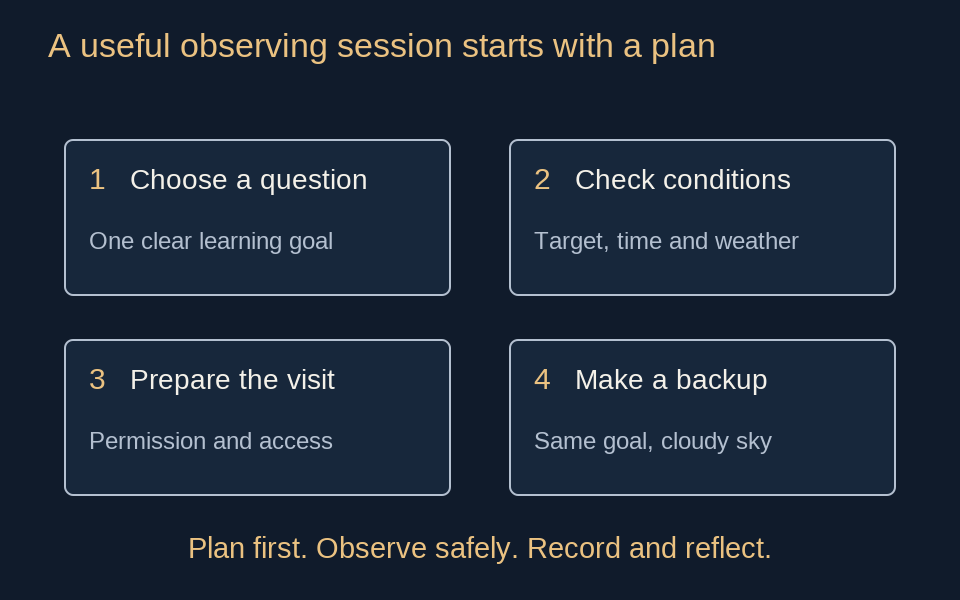
Work with an adult from a familiar ground-level space away from traffic and unprotected edges. Bring paper, pencil and a dim light used only when needed. No binoculars are required. Choose a clear evening with a recognisable pattern well above nearby roofs. Record whether the Moon is visible, how much cloud is present and whether lamps shine directly toward you.
Repeat the count
- 1. Allow about 15-20 minutes for your eyes to adjust while an adult keeps the observing place safe. Record how long you waited and use a similar wait when comparing sessions. Avoid bright phone screens between counts.
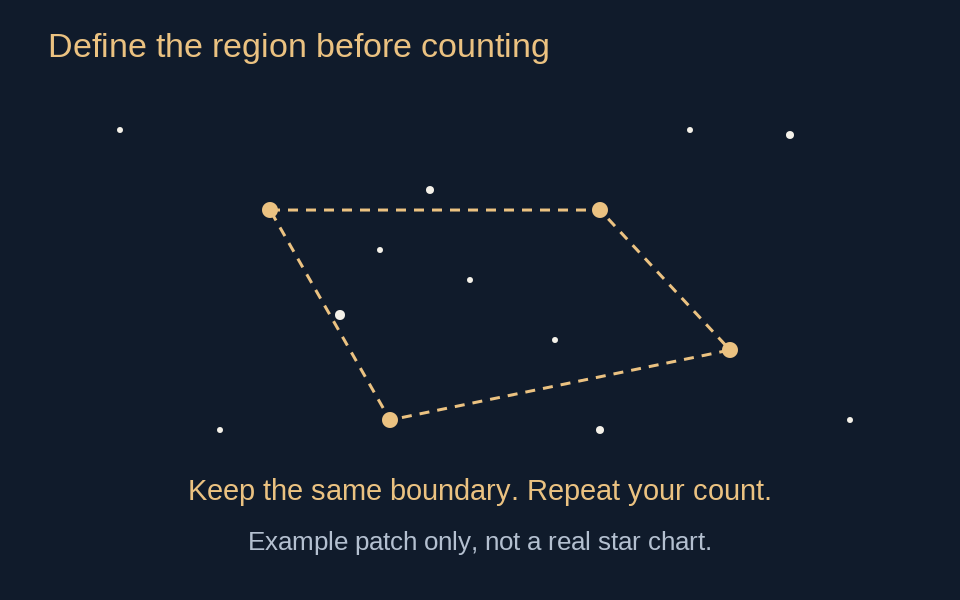
- 2. Choose three or four obvious stars that form the boundary of a small region. Sketch those boundary stars first.
- 3. Count stars inside the boundary using the same convention each time, such as excluding stars directly on its edges.
- 4. Look away briefly, then repeat twice. Write down all counts rather than replacing earlier numbers.
- 5. Ask a partner to count independently. Compare the observations and any stars about which you disagreed.
Understand the differences
Faint stars can appear intermittently as you change your gaze. Cloud, haze, moonlight and artificial sky brightness can reduce contrast. Individual eyesight and how long your eyes have adjusted also affect what you detect. A larger count does not automatically mean that someone counted more carefully.
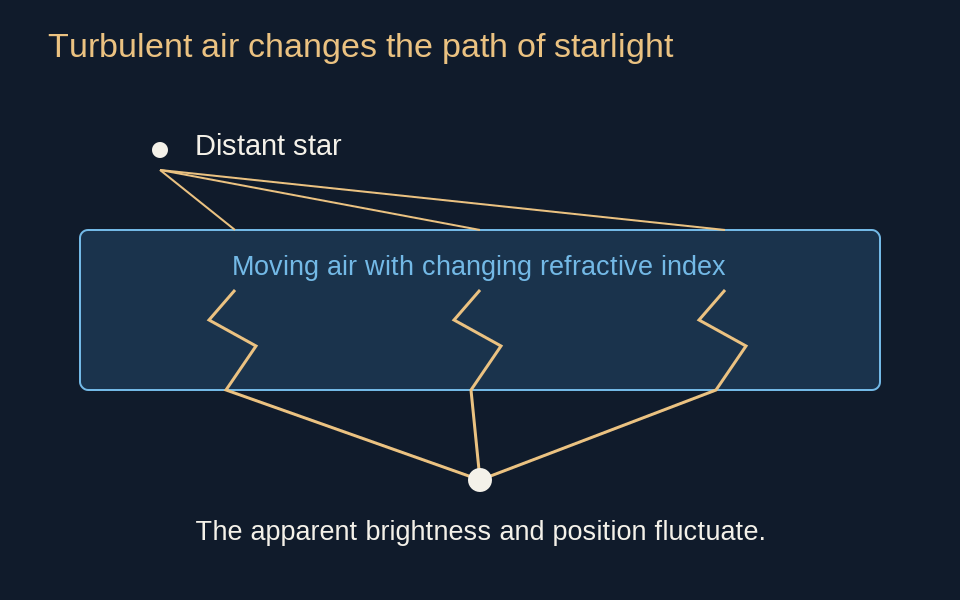
The same patch changes its position through the night. When repeating on another evening, record both clock time and where the patch appears relative to your horizon. Observing through more atmosphere near the horizon can make a comparison less fair.
Report a range, not false precision
If the counts are 8, 9 and 8, report that you found about eight or nine stars under the recorded conditions. Do not multiply the result across the whole sky: stars are not distributed evenly and one small patch is not representative. Propose a better comparison by controlling Moon conditions, approximate sky position and the observing location. Keeping those notes makes a modest result more useful than a confident but unsupported total.
PAUSE AND THINK
Why might two classmates disagree by one faint star?
Explore the answer
Their eyesight, gaze direction and dark adaptation may differ and the star may sit close to the visibility threshold. Repeated independent counts reveal that uncertainty.
RECORD YOUR OWN EVIDENCE
Your activity sheet
You need: Paper, pencil, dim light and a familiar safe observing place. Adult supervision.
Allow about 15-20 minutes for dark adaptation and record the wait. Mark a fixed patch and count it three times using the same boundary rule.
Name or group: Date:
| Start time (IST) | Stars counted | Cloud / Moon / glare | Breaks or uncertainty |
|---|---|---|---|
Report a range for your counts. What could explain the differences?
Why should you not multiply one small patch’s count across the entire sky?
Record what happened, including uncertain results. Use the answer guidance in this resource to discuss your explanation.