On this page
THE BIG IDEAS
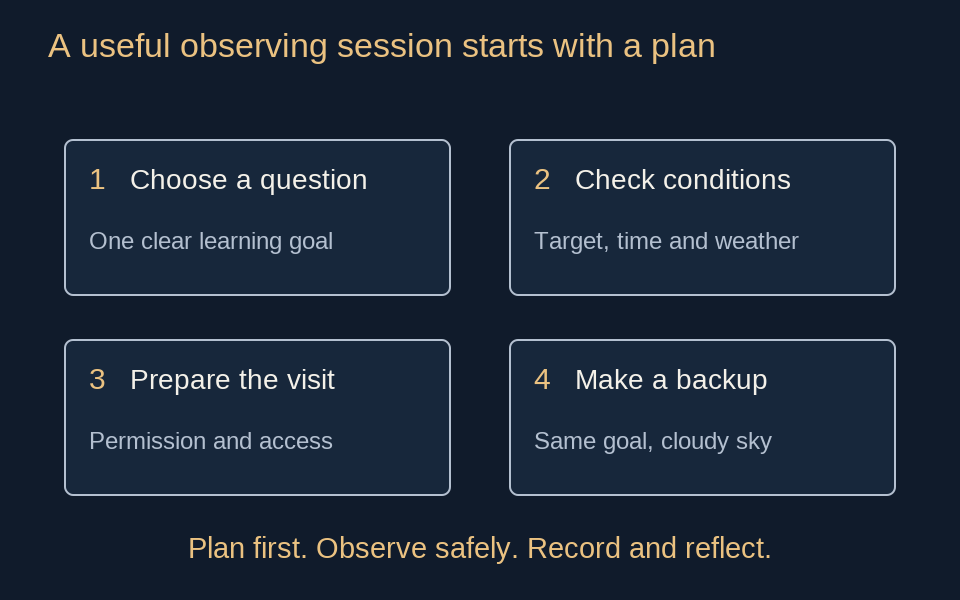
- Plan around one observable learning outcome.
- Verify the target for the actual place and time.
- A weather alternative and accessible participation belong in the original plan.
Choose one learning outcome
Begin with something learners can demonstrate, such as locating one pattern, describing the Moon’s lit shape or keeping an observation record. A long target list can make a first session confusing. For this planning workshop, gather paper, pencils, a site plan, a chart configurable for location and time and a local weather forecast. Confirm venue availability and supervision arrangements before organising an actual session.
Fifty-minute planning workshop
- Minutes 0-10: Groups choose one observable learning outcome and explain how they will know whether it was achieved.
- Minutes 10-20: List the site, adult supervision, permissions, accessible routes and weather information needed before an evening event.
- Minutes 20-30: Design a short observation record and a simple turn-taking plan.
- Minutes 30-40: Prepare a cloudy-weather alternative using a model, printed chart or previous observation record.
- Minutes 40-50: Present the plan to another group and answer its practical questions.
Planning prompts for students
- 1. What will participants look for, draw, compare or explain?
- 2. How will you verify that the target is visible at the chosen place and time?
- 3. What happens while one participant uses a telescope, if a telescope is available?
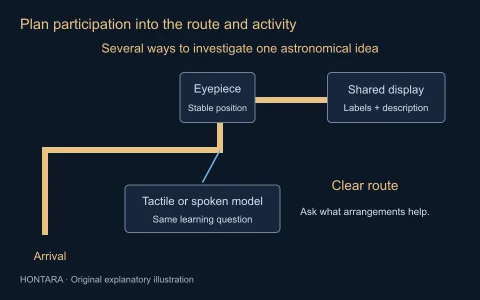
- 4. How will someone participate without climbing steps or standing for a long time?
- 5. What will you do if cloud, rain or an unsafe site makes observation unsuitable?
Teacher planning guide
Prefer a familiar ground-level location with permission, clear boundaries and a safe arrival and departure plan. Adult supervision, safeguarding arrangements and emergency access should follow the school’s own procedures. Avoid roadside observing, unprotected rooftops and unfamiliar dark terrain. Use dim lighting where practical while keeping walking routes safe.
Check target visibility using a reliable chart configured for the location and date. Do not guarantee a planet simply because it appeared in an old photograph. Daytime solar observing requires specialist arrangements and is outside this beginner plan. Ordinary telescopes and binoculars must never be pointed at the Sun.
Assess learning after the session
Ask learners to distinguish what they saw from what a guide told them. Compare a first sketch with a later careful observation and discuss conditions that affected the view. For support, offer a record with large drawing spaces and spoken responses.
For extension, have students explain why a photograph differs from their eyepiece view. Assess the plan’s clear outcome, realistic logistics, accessibility and workable alternative. A cancelled sky session can still lead to useful learning when the alternative addresses the same question.
PAUSE AND THINK
What makes a cloudy-weather alternative worthwhile?
Explore the answer
It investigates the same learning question using a model or evidence record, so the session remains purposeful even when direct viewing is impossible.
PLAN A LEARNING SESSION
Your session planning sheet
You need: Paper, a location/time-based chart, a safe-site plan and a weather alternative.
Plan one learning question with an achievable observing task and a cloudy-weather activity.
Name or group: Date:
| Time | Learning task | Equipment / access | Weather alternative |
|---|---|---|---|
Which checks must be completed before the session can go ahead?
How will you tell whether learners met the goal?
Record your proposed arrangements and the checks still needed. Use the answer guidance in this resource to discuss your plan.