On this page
The air is part of the view
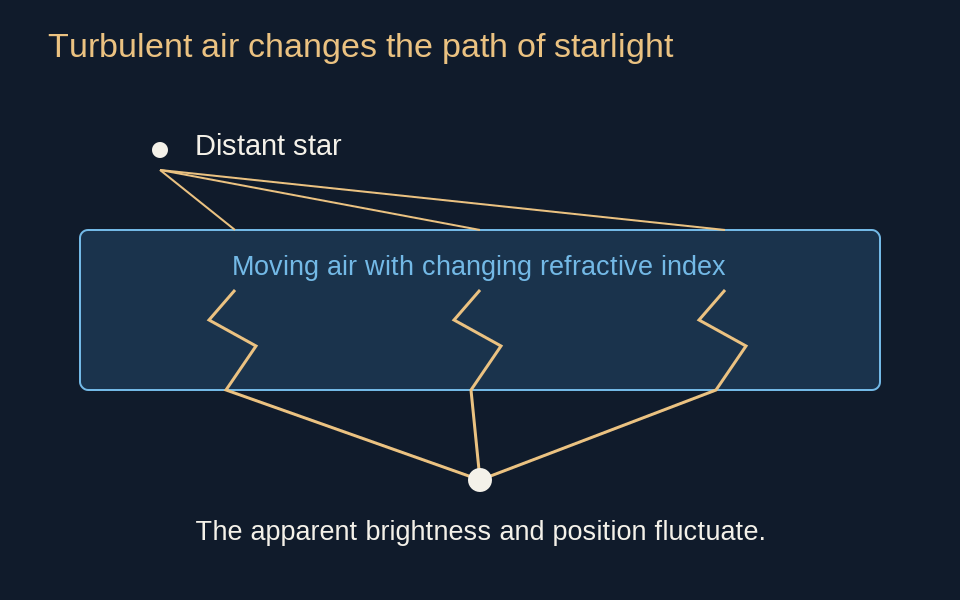
Starlight travels an enormous distance before reaching Earth, but its final passage through the atmosphere can noticeably change its appearance. Air with different temperatures and densities bends light by different amounts. Moving patches of air continually change the route taken by light from a star. From the ground this can make the star’s brightness and apparent position fluctuate. Astronomers call these rapid brightness variations scintillation.
THE BIG IDEAS
- Moving air changes the path of starlight.
- Stars usually twinkle more than the apparent disks of planets.
- Seeing and transparency describe different observing conditions.
Why point-like stars are affected
Even a powerful amateur telescope sees most stars as unresolved points. Their light arrives from a very small apparent area, so atmospheric changes can strongly affect the whole image. Planets present tiny disks instead. Light from different parts of a planetary disk passes through slightly different atmospheric paths, partly averaging out the fluctuations. Planets often appear steadier than stars, although a planet low in a turbulent sky can still twinkle.
Low altitude makes a difference
An object near the horizon is seen through a longer path in the atmosphere than an object high overhead. Its light encounters more opportunities for distortion and colour changes. A bright star low down can flash red, blue or white in a way that surprises first-time observers. That is not evidence that the star itself is rapidly changing temperature. Comparing it with a higher star can reveal the role of the air.
Twinkling and telescope detail
Astronomers use the word seeing for atmospheric steadiness and its effect on image sharpness. Poor seeing can make a planet’s edge shimmer or blur fine lunar detail. Transparency is a different property: it describes how well the atmosphere transmits light without haze or cloud. A sky can be dark and transparent but unsteady, or relatively steady yet hazy. Good observing notes separate these conditions rather than describing every limitation as bad weather.
A simple observation to try
From a safe location, compare a bright star near the horizon with one higher in the sky. Give your eyes time to adjust and note whether the brightness appears steady or flickering. If you can confidently identify a visible planet, compare that too. Repeat on another night rather than expecting a universal result from one comparison. The pattern is evidence about the atmosphere above you as much as about the distant objects themselves.
PAUSE AND THINK
Would the familiar atmospheric twinkling persist for an observer outside Earth’s atmosphere?
Explore the answer
No. Without Earth’s turbulent air in the light path, that source of twinkling disappears, although stars can vary intrinsically for other reasons.