On this page
THE BIG IDEAS
- Locate sign errors by asking which view is fainter.
- A relative difference does not assign a real magnitude zero point.
- Use a new distance ratio to test transfer.
Establish a controlled question
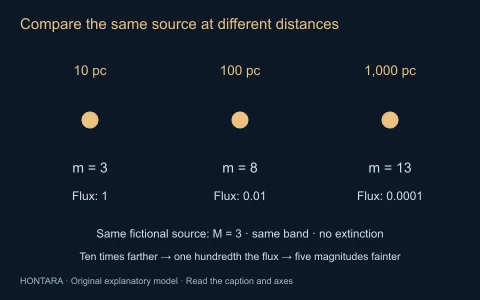
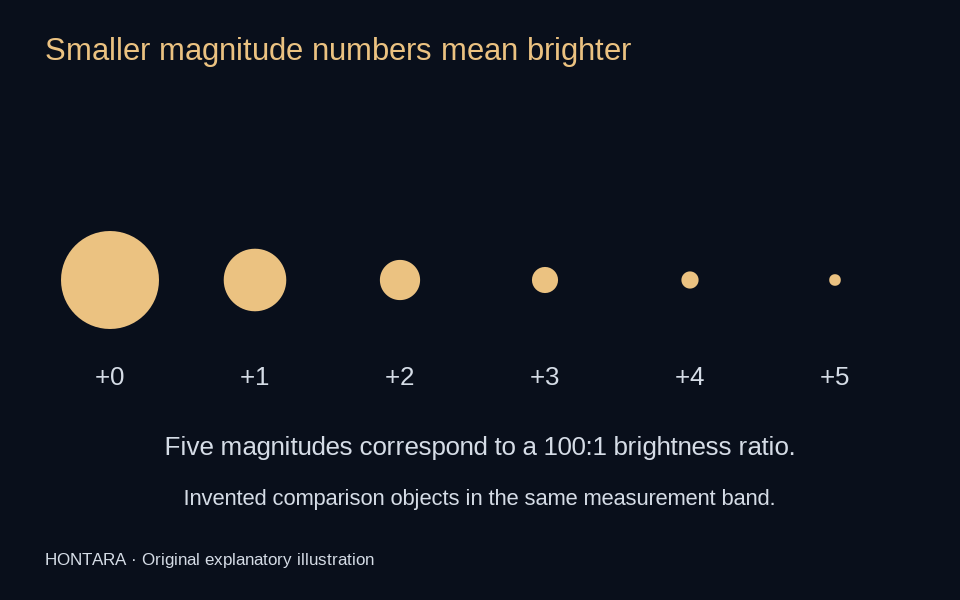
The lesson asks how one fixed source would appear from different model distances. Learners should distinguish a received-flux ratio from a magnitude difference and explain why larger magnitude means fainter flux. The task is not a ranking of several real stars by distance.
Prepare the paired table and calculators with a base-10 logarithm function. Offer a table of the four magnitude results for learners who need a calculation scaffold. They should still explain the sign and compare equal ratios rather than only copying numerical answers.
Use a 45-minute sequence
Use five minutes for a prediction, ten for inverse-square flux calculations, ten for magnitude conversion, ten for comparing the two doubling steps and ten for a transfer explanation. Keep the same reference flux and measurement band on the board throughout.
Ask groups to state what remains fixed before calculating. The source luminosity, its steady behaviour, the band and the absence of extinction are assumptions of the comparison. Changing any of those while claiming a distance-only experiment would undermine the intended inference.
Check the numerical pattern
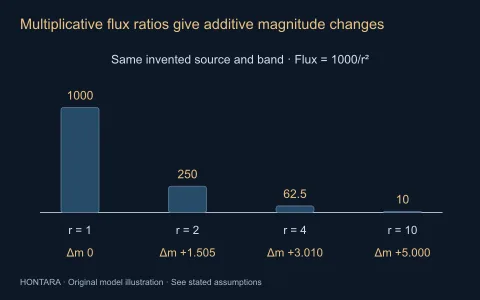
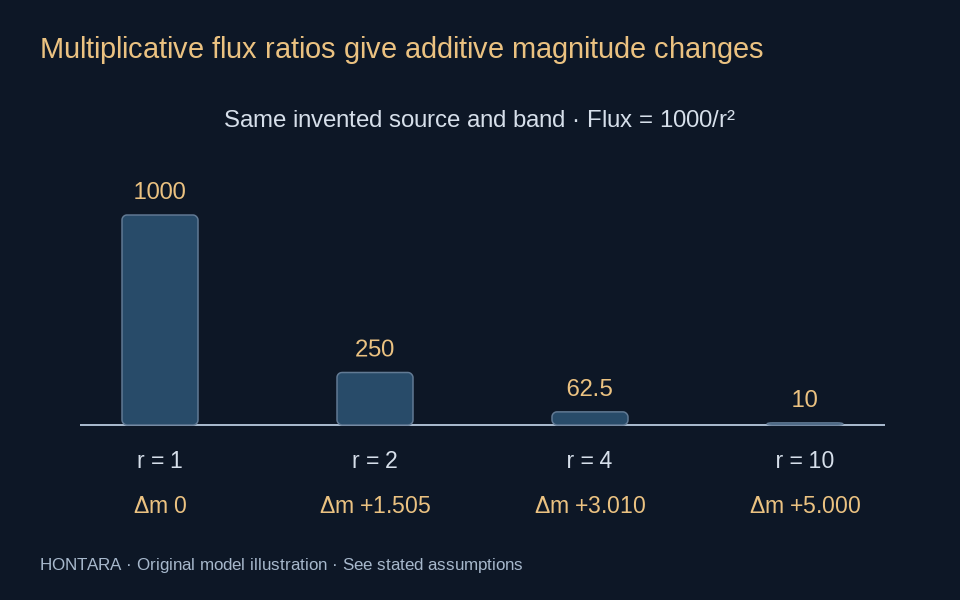
The relative distances 1, 2, 4 and 10 give fluxes 1000, 250, 62.5 and 10 units. Their differences from the first row are approximately 0, +1.505, +3.010 and +5 magnitudes. Compare unrounded ratios before assessing a last-digit discrepancy.
If a learner gets −1.505 for the first doubling, have them say whether the new source view is brighter or fainter, then inspect ratio order and the negative sign. If they predict half the flux, return to area increasing with squared distance rather than treating the error as a logarithm problem.
Distinguish relative change from a zero point
The activity calculates magnitude differences, so it does not need an absolute photometric zero point. The reference row is assigned Δm=0, not declared to be an actual zero-magnitude star. A difference should also compare compatible bands and conventions.
Use the two equal doubling steps to contrast additive and multiplicative descriptions. The same +1.505-magnitude increment corresponds to quartering the flux each time. Equal added magnitude is not an equal subtraction of flux units.
Ask why a fixed +5 difference corresponds to a hundredfold flux ratio rather than five added flux units.
Assess transfer and a justified limit
For the exit task compare distances 2 and 8 for the same source. The distance increases fourfold, flux falls to one sixteenth and magnitude increases about 3.010. Require the pair of ratios and an explanation, not only the final magnitude difference.
Then ask whether two unrelated stars with the same apparent magnitude must have the same distance. Expect no, with intrinsic luminosity and extinction identified as possible missing information. This connects the controlled exercise to the distinction between apparent and absolute magnitude without pretending that the model table measures either for a real star.
PAUSE AND THINK
What does Δm=0 in the first worksheet row mean?
Explore the answer
It is the selected reference for differences. It does not state that the invented source has actual apparent magnitude zero.
RECORD YOUR OWN EVIDENCE
Your activity sheet
You need: Paper, ruler, pencil and calculator with base-10 logarithms, or the supplied magnitude checks.
Check all flux ratios and magnitude differences, then prepare an explanation for the 2-to-8 distance transfer case.
Name or group: Date:
| Relative distance | Flux units | Δm from r=1 | Prediction/check |
|---|---|---|---|
| 1 | |||
| 2 | |||
| 4 | |||
| 10 |
Describe the fixed-source assumptions needed for the comparison.
Explain why the two distance doublings add equal magnitude changes.
State why equal apparent magnitude does not uniquely identify distance.
Invented same-source values in one measurement band. Relative distances and flux units are model quantities, not a named star catalogue.