On this page
THE BIG IDEAS
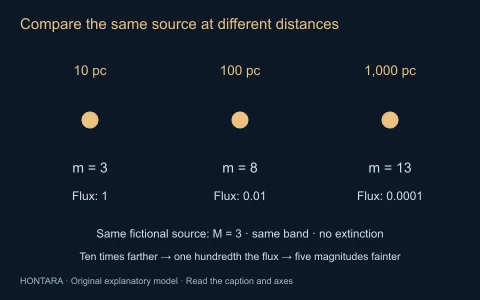
- Double distance gives one quarter of the flux for this fixed source.
- Fainter flux corresponds to a larger magnitude.
- Magnitude differences describe flux ratios rather than equal added flux amounts.
Keep the source and band fixed
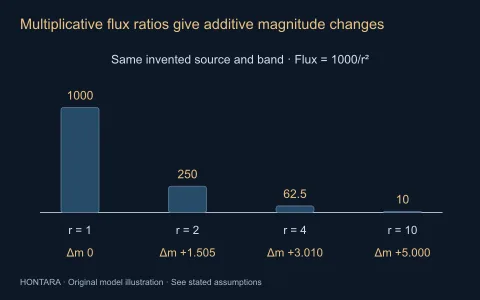
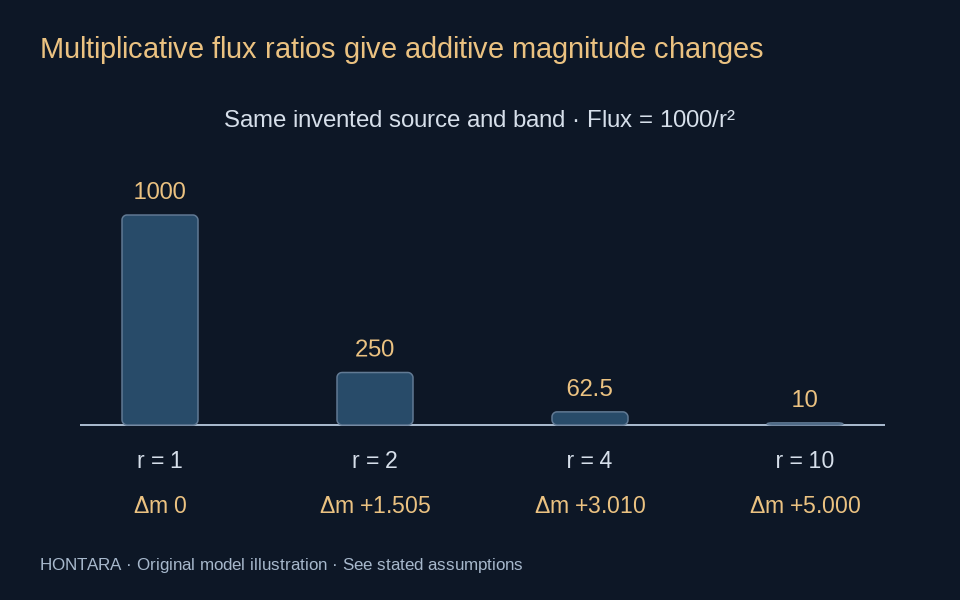
Imagine observing the same steady, unobscured source from four relative distances. Its emitted luminosity and the measurement band stay unchanged. Use model distance r=1, 2, 4 and 10. At r=1 assign a received flux of 1,000 arbitrary units.
The numbers are invented to isolate geometry. They are not observations of four different stars with unknown intrinsic properties. Here brightness means received flux in the specified band, not the subjective appearance of a point to a particular observer’s eye.
Predict the flux ratios
For this ideal setup flux scales as 1/r². Predict what happens when distance doubles before entering any values into a calculator. Then calculate F=1000/r² for all four rows of your worksheet.
The expected model fluxes are 1,000, 250, 62.5 and 10 units. Keep the fractional 62.5 rather than rounding it prematurely. A source at ten times the distance has one hundredth the flux in this comparison, not one tenth.
Translate ratios into magnitude differences
Use Δm=−2.5 log10(F/F₀), with F₀=1000 for the reference row. A positive difference means the source has become fainter relative to that reference. You do not need to assign an actual apparent magnitude or a catalogue zero point to compare the differences.
The results are approximately 0, +1.505, +3.010 and +5.000 magnitudes. If a smaller flux gives a negative change, check the ratio order and minus sign. Use at least three decimal places while comparing the two doubling steps.
Explain multiplicative and additive changes
Compare r=1 to 2 with r=2 to 4. Each distance doubles and each flux becomes one quarter of its earlier value. Each magnitude increases by about 1.505, even though the flux decreases by different absolute numbers of units.
This is the useful contrast: the flux relation is multiplicative while equal magnitude steps represent equal flux ratios. A five-magnitude difference corresponds to a factor of one hundred in flux when the same band and magnitude convention are used.
As a second check, start with the r=4 flux and divide it by the r=2 flux. The result should be 0.25, just as for r=2 compared with r=1. Taking the logarithm of an absolute flux without dividing by a compatible reference would answer a different and incompletely specified question.
Test the limits of a distance inference
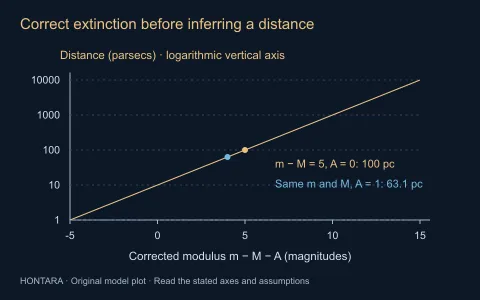
Write the assumptions that allowed you to use distance alone. If four real stars had the same apparent flux, they would not necessarily be equally distant because their luminosities could differ. Extinction along a line of sight could also reduce received light.
Finish with one supported model statement and one claim this table cannot justify about a real star. Retain the original flux column beside the magnitude column so another learner can reconstruct both the calculation and the direction of the comparison.
PAUSE AND THINK
Does the change from r=2 to r=4 add more magnitudes than r=1 to r=2?
Explore the answer
No. Both are distance doublings with a fourfold flux reduction, so each adds about 1.505 magnitudes under the stated assumptions.
RECORD YOUR OWN EVIDENCE
Your activity sheet
You need: Paper, ruler, pencil and calculator with base-10 logarithms, or the supplied magnitude checks.
For the same invented steady source at relative distances 1, 2, 4 and 10, calculate F=1000/r² and Δm=−2.5 log10(F/1000). Keep the band and all source properties fixed.
Name or group: Date:
| Relative distance | Flux units | Δm from r=1 | Prediction/check |
|---|---|---|---|
| 1 | |||
| 2 | |||
| 4 | |||
| 10 |
Explain the sign of the magnitude change when flux decreases.
Compare the two successive distance doublings.
Why would different intrinsic luminosities or intervening dust invalidate this simple distance-only comparison?
Invented same-source values in one measurement band. Relative distances and flux units are model quantities, not a named star catalogue.