On this page
Identify the physical kind of variation
Cepheid variables are pulsating stars whose size and temperature change through a repeating cycle. Their brightness rises and falls in a characteristic pattern. This differs from an eclipse, where one member of a system blocks light from another along our line of sight.
The distinction matters before using a distance calibration. A regular light curve alone does not prove that a star is a classical Cepheid. Classification uses the pattern, period, colours and other evidence rather than merely noticing that a source varies.
THE BIG IDEAS
- Cepheid variation is pulsation rather than an eclipse.
- Period–luminosity use requires a population and band calibration.
- Dust, crowding and cycle sampling affect distance estimates.
Measure a period from repeated observations
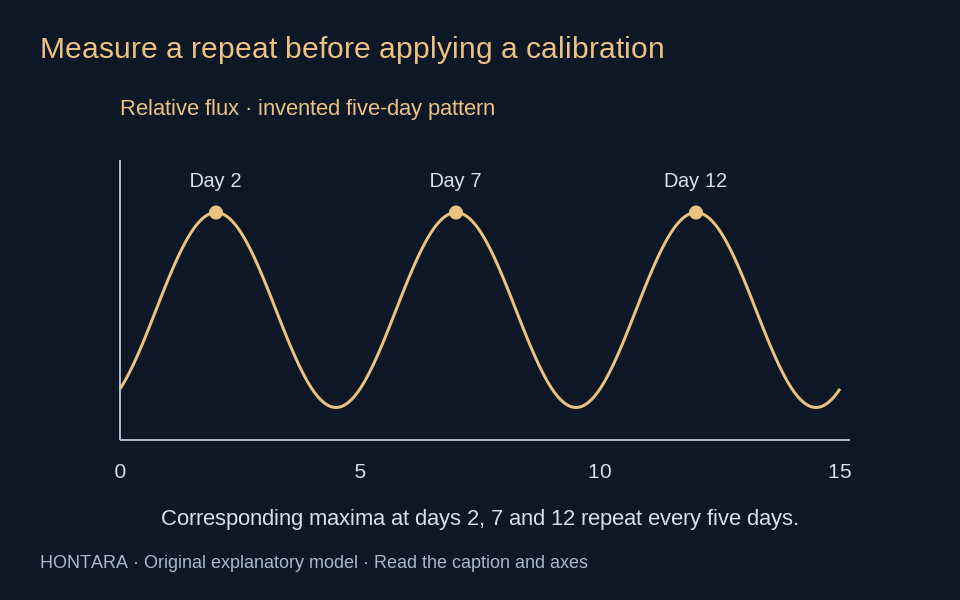
A pulsation period is the interval over which the brightness pattern repeats. In an invented record with corresponding maxima at days 2, 7 and 12, the period is five days. The spacing between unlike features in a cycle is not automatically a full period.
Sparse observing cadence can confuse the repetition time or miss parts of a cycle. A useful analysis records dates, uncertainties and the measurement band, then tests whether a proposed period aligns the complete pattern rather than just two convenient data points.
Apply a calibrated relationship, not a universal slogan
Within an appropriately classified Cepheid population, pulsation period correlates with intrinsic luminosity. Longer-period classical Cepheids are generally more luminous than shorter-period members in a calibrated relation. The relation’s coefficients depend on the band and the population being studied.
Different Cepheid types and pulsation modes must not be mixed indiscriminately. Metallicity, dust extinction and unresolved neighbours can affect distance work. The period supplies a powerful clue through an established calibration, not an exact luminosity from any arbitrary variable star.
Carry the clue into a distance estimate
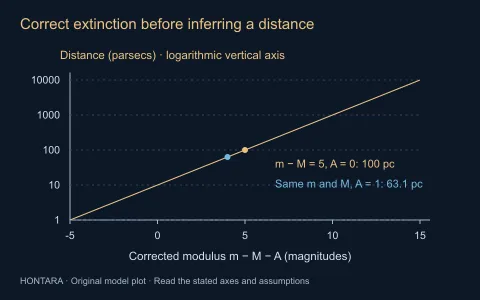
Suppose a fictional calibrated example has mean absolute magnitude M=−4 and extinction-corrected mean apparent magnitude m=6 in the same band. The distance modulus is ten, giving d=1,000 parsecs. Here the absolute magnitude is supplied by the stated calibration rather than guessed from the diagram.
If extinction correction is missing, the observed star can look too faint and its inferred distance too large. Mean brightness must also be defined consistently over the pulsation cycle; one observation at maximum is not interchangeable with a calibrated mean magnitude.
Understand the ladder and its cross-checks
Nearby Cepheids with independent distance constraints help establish the calibration. Cepheids in more distant galaxies can then link to other distance indicators, including supernovae. Each connection carries measurement and modelling uncertainty rather than eliminating uncertainty by being called a standard candle.
When reading a distance claim, ask how the variable was classified, which filter and calibration were used, how dust and crowding were addressed and what uncertainty was reported. These questions reveal why many observations and multiple indicators are stronger than a single attractive light-curve sketch.
To audit a worked example, keep the period measurement separate from the assigned calibrated absolute magnitude and from the extinction-corrected apparent magnitude. Each is a different input. If a correction changes the apparent magnitude by one, the inferred distance changes by a factor of about 1.585 rather than one parsec.
PAUSE AND THINK
Can the five-day spacing between maxima identify an exact distance by itself?
Explore the answer
No. It gives a candidate period. Classification, an appropriate intrinsic-brightness calibration, apparent brightness and extinction information are still needed.