On this page
How big is each unit?
Use AU for orbital sizes and distances between planets and spacecraft. Light-years make it easy to think about how long a light signal has travelled. Parsec-based units are common in star catalogues, galaxy distances and measurements of cosmic expansion.
| Unit | Size | Typical use |
|---|---|---|
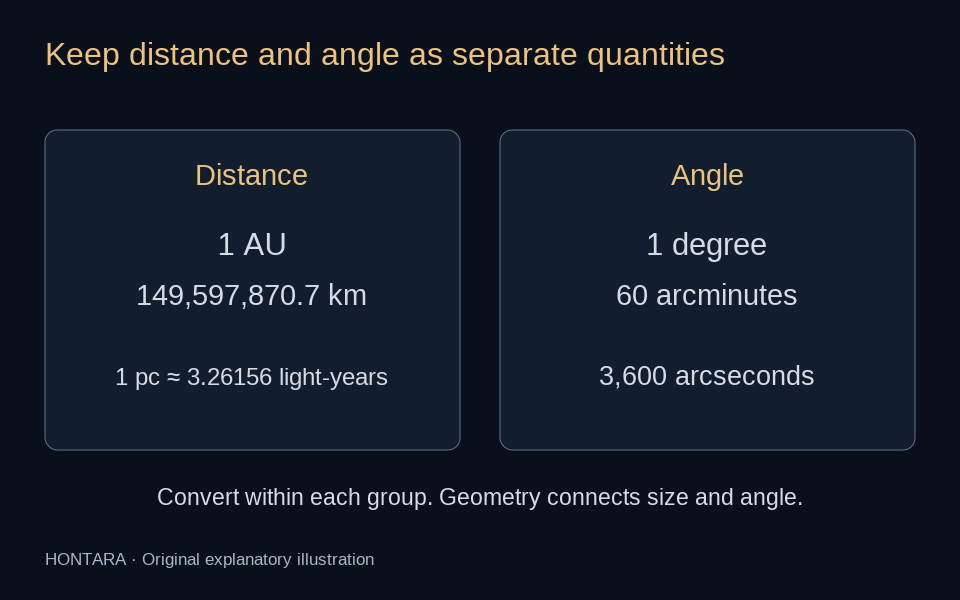
| Astronomical unit (AU) | Exactly 149,597,870.7 km. | Distances within the Solar System. Earth’s average orbital scale is about 1 AU. |
| Light-year (ly) | About 9.46 trillion km or 63,241 AU. | Distances to nearby stars and the time their light has travelled. |
| Parsec (pc) | About 3.26 light-years or 206,265 AU. | Parallax distances and larger scales using kiloparsecs or megaparsecs. |
Why a parsec is tied to an angle
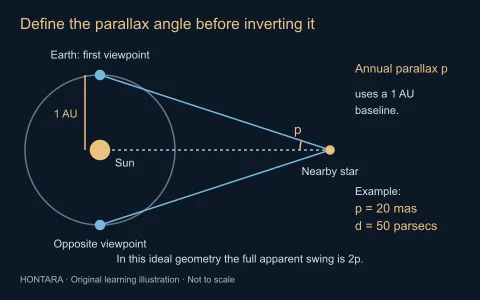
A nearby star appears to shift slightly against more distant stars as Earth moves around the Sun. The annual parallax angle uses a 1 AU baseline. A distance of 1 parsec corresponds to about 1 arcsecond of parallax. A star with a parallax of one tenth of an arcsecond is about 10 parsecs away.
You can use parsecs for distances measured in other ways too. A kiloparsec has 1,000 parsecs and a megaparsec has 1 million.
Two conversions you can do by hand
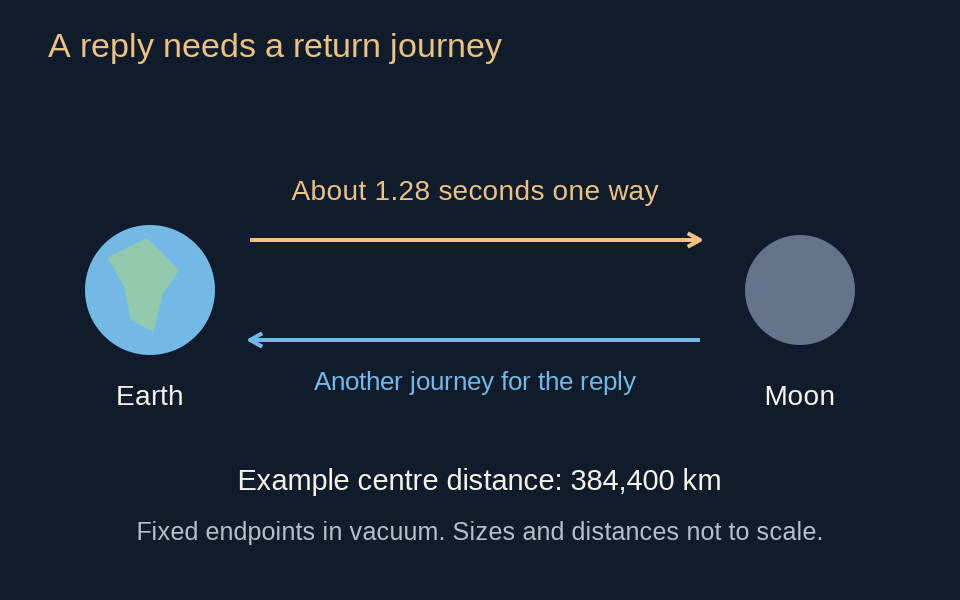
Light travels about 300,000 km each second. Divide the kilometres in an AU by that speed and you get about 499 seconds, or 8 minutes and 19 seconds. That is roughly the time for sunlight to reach Earth.
Multiply a catalogue distance of 10 pc by 3.26 to get about 32.6 light-years. That lets you describe the same distance in a second unit. The time a spacecraft would take depends on its own speed and trajectory.