On this page
Use a changing viewpoint
Hold a finger at arm’s length and alternate which eye is open. Against a distant background the finger seems to change position. The finger has not jumped: your viewing position has changed. Stellar parallax uses the same geometric idea, with positions along Earth’s orbit providing the changing viewpoint.
For the same observing baseline a nearer object has a larger apparent angular shift than a farther object. Stars are so distant that their annual parallaxes are generally fractions of an arcsecond. One arcsecond is 1/3600 of a degree. An ordinary sketch greatly exaggerates this angle to make the geometry readable.
THE BIG IDEAS
- Parallax decreases as distance increases for a fixed baseline.
- Annual parallax is half the ideal full apparent swing.
- An uncertain parallax needs more than an unqualified reciprocal.
Name the angle before calculating
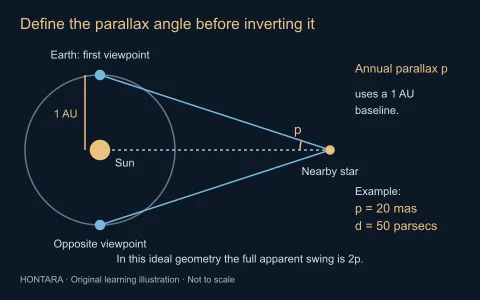
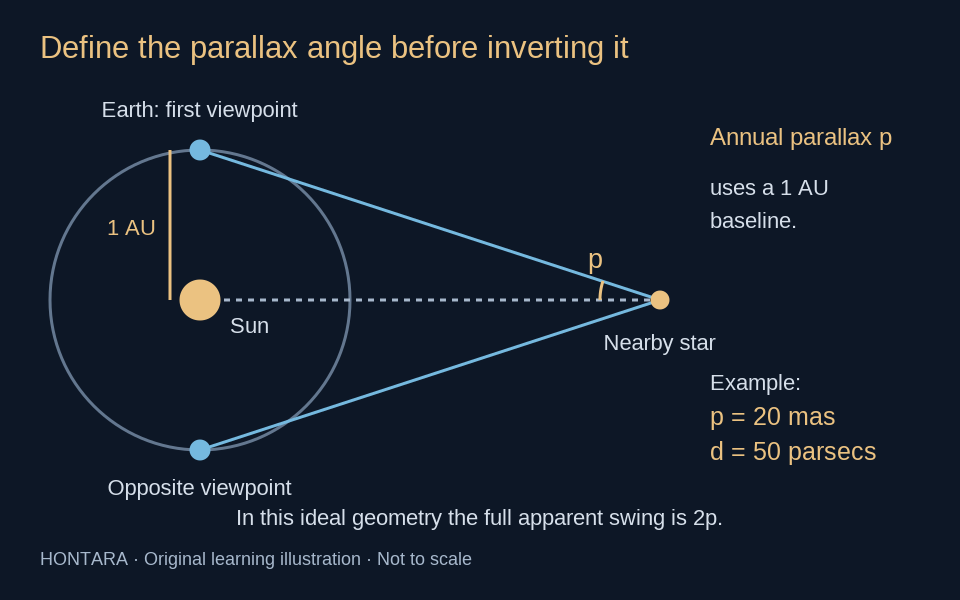
The annual parallax p is associated with a baseline of one astronomical unit, approximately the Earth–Sun distance. In the ideal perpendicular geometry the full apparent swing between opposite orbital viewpoints is 2p. Confusing that full swing with p introduces a factor-of-two error.
The parsec is a distance unit defined using a one-arcsecond angle and a one-AU baseline. In the small-angle convention used for stellar distances, d in parsecs is 1 divided by p in arcseconds. If p is in milliarcseconds, use 1000 divided by p. A parsec is about 3.26 light-years.
Work a synthetic example
Suppose an invented measurement gives p = 20 milliarcseconds. Convert first: 20 milliarcseconds = 0.020 arcseconds. The reciprocal distance is 1/0.020 = 50 parsecs, or approximately 163 light-years. A second illustrative star with p = 10 milliarcseconds has a reciprocal distance of 100 parsecs.
Halving the parallax doubles this reciprocal distance. It does not make the star intrinsically fainter or change its physical size. Parallax supplies geometric distance information. Apparent brightness also depends on the source’s luminosity and on material between it and the observer.
Keep the uncertainty attached
A catalogue parallax is a fitted measurement with uncertainty, possible systematic offsets and other quality information. Astronomers separate annual parallax from the star’s own motion across the sky. A single pair of casually taken photographs is not equivalent to that astrometric solution.
When the uncertainty is large compared with p, directly inverting p can give a misleading distance. Noisy fitted parallaxes can even be negative; this does not mean a star has a negative physical distance. Use a suitable published distance inference and its interval for serious catalogue work. The simple reciprocal remains useful for learning the geometry and for carefully qualified high-precision examples.
PAUSE AND THINK
An ideal full swing is 40 milliarcseconds. What p enters the distance formula?
Explore the answer
p is 20 milliarcseconds. The reciprocal distance is 1000/20 = 50 parsecs. Using 40 would incorrectly halve the result.