On this page
THE BIG IDEAS
- Define the full baseline and the full angular shift before calculating.
- The symmetric half-angle formula estimates the perpendicular distance.
- Small angular errors become more important as the target moves farther away.
Make perspective measurable
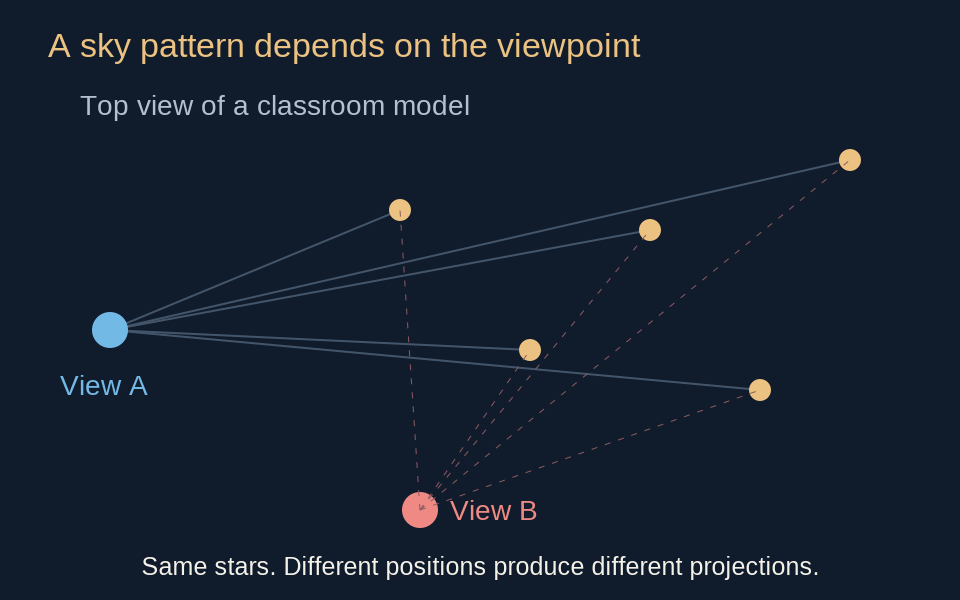
A nearby object appears in a different direction from two separated viewpoints. This activity turns that geometry into a distance estimate. You need joined sheets about 1.2 m long, tape, a ruler, protractor, pencil, string and a calculator with tangent in degree mode. Work on a clear table or floor without sharp pins.
The construction uses a symmetric triangle. It is not a measurement of stellar distance and does not need a telescope. Your first task is to state exactly which length and angle you are using.
Construct a checkable triangle
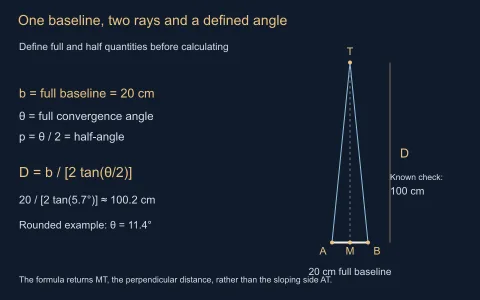
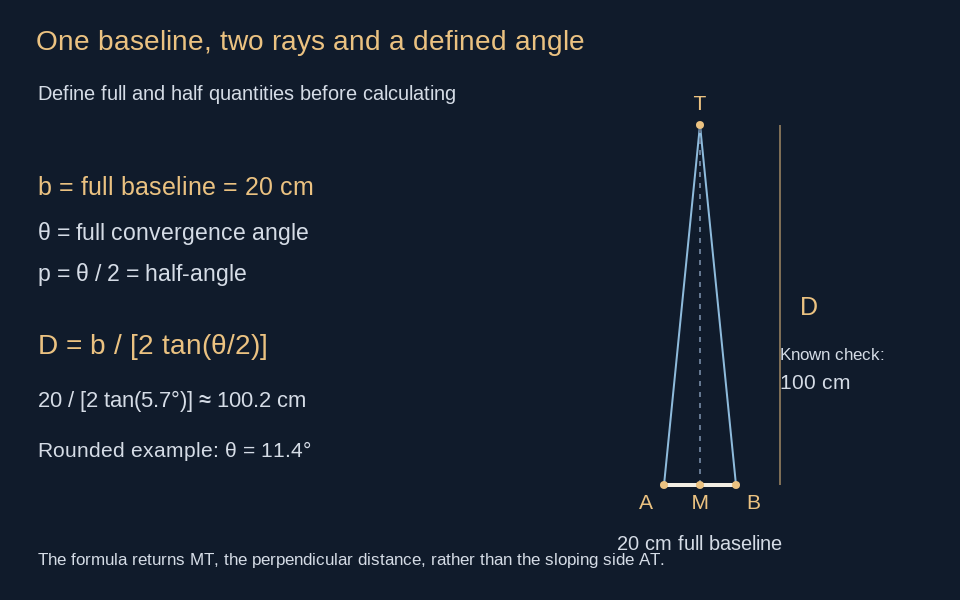
Mark viewpoints A and B 20 cm apart and mark their midpoint M. From M draw a perpendicular to the baseline. Place target T 100 cm along this perpendicular. The known 100 cm lets you check the inference later. Keep T and both viewpoints fixed.
Draw straight lines AT and BT using a ruler or taut string, extending them as needed. At T measure the angle between the two lines. Call this full convergence angle θ. It should be around 11.4° in the marked setup, but record what you actually measure.
Use one angle convention throughout
The full baseline is b = AB = 20 cm. By symmetry, the half-baseline is 10 cm and the half-angle p = θ/2 is about 5.7°. The distance along the perpendicular is D = (b/2) ÷ tan(p), or equivalently b ÷ [2 tan(θ/2)].
With θ = 11.4°, D = 20 ÷ [2 tan(5.7°)] ≈ 100.2 cm. This is an example calculation using a rounded angle, not a prediction that every protractor reading will return exactly 100 cm. Check that your calculator is using degrees rather than radians.
Record repeated readings and a second target
Have three learners independently read the drawn angle, or cover the earlier value before measuring again. Calculate a distance for each reading and report the range. Do not average rounded angles simply to obtain the known distance.
Then move T to 50 cm from M while leaving AB fixed. Draw new rays in another colour. The full angle should be larger, approximately 22.6°. Predict the direction of that change before measuring. Use the same formula to infer the new distance.
Connect the model to astronomy carefully
For stellar annual parallax, the conventional angle p is associated with a one-AU baseline from the orbit’s centre, not the full two-AU separation between opposite Earth positions. Our p and θ labels prevent silently exchanging a full angular shift and a half-angle.
Real stellar triangles are enormously more slender than this model. Small angular errors can then produce large distance uncertainty. Your tabletop estimate also depends on drawing accuracy, a true perpendicular and keeping the target on the midpoint line. State those limits when explaining your result.
PAUSE AND THINK
What happens if you use 20 ÷ tan(5.7°) for the example?
Explore the answer
You obtain about 200 cm, twice the intended distance. The 5.7° half-angle goes with the 10 cm half-baseline. Use 10/tan(5.7°) or 20/[2 tan(5.7°)].
RECORD YOUR OWN EVIDENCE
Your activity sheet
You need: Joined paper sheets about 1.2 m long, tape, ruler, protractor, pencil, string and calculator with degree-mode tangent.
Mark A and B 20 cm apart. Place target T 100 cm along the perpendicular from their midpoint M. Draw AT and BT, measure their full convergence angle θ and calculate D = b ÷ [2 tan(θ/2)].
Name or group: Date:
| Full baseline b (cm) | Full angle θ (°) | Half-angle p (°) | Inferred D (cm) |
|---|---|---|---|
| 20 | |||
| 20 | |||
| 20 |
For b = 20 cm and θ = 11.4°, calculate D and compare it with the marked 100 cm.
Explain why using the full baseline with the half-angle would produce a factor-of-two mistake.
Record what happened, including uncertain results. Use the answer guidance in this resource to discuss your explanation.