On this page
THE BIG IDEAS
- A flat star pattern hides depth.
- Connecting lines belong to our diagrams rather than the sky.
- The classroom model exaggerates how easily a viewpoint can change.
A picture made by perspective
Stars in a familiar sky pattern can be at very different distances from Earth. The lines drawn between them on a chart are guides for people, not physical connections. In this activity, you will build a pattern that works from one marked position and changes when the observer moves. You do not need to imitate a real constellation to investigate this idea.
Gather simple materials
Use five paper stars, reusable tape, books or other stable supports, a pencil and notebook. Avoid sharp skewers or dangling thread across walkways. Set the supports on a table where they cannot fall. A seated observer can do the entire activity and classmates can move the supports if reaching is difficult.
Arrange your pattern
- 1. Mark one observing position on the table edge. Close one eye to make the viewpoint easier to repeat.
- 2. Put the paper stars on supports at different distances beyond the viewing mark.
- 3. Move each support sideways until the stars appear to make a simple letter or zigzag from the marked position.
- 4. Sketch the pattern as it appears from that position. Draw imaginary connecting lines if they help you recognise it.
- 5. Move to the side of the table and sketch the same stars again. Do not change their positions.
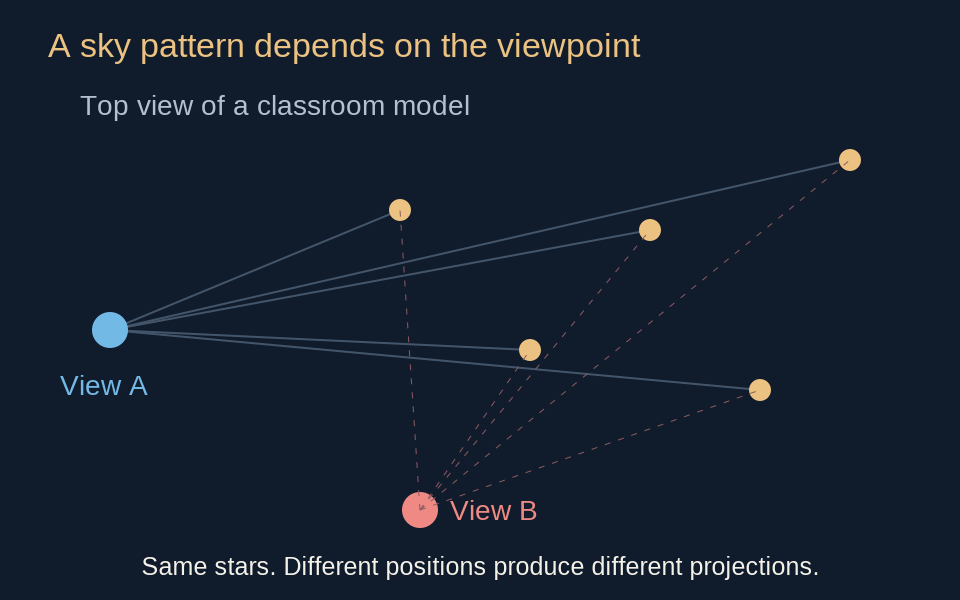
- 6. Make a top-view plan showing the different distances of the supports from the original observer.
Explain the change
The first drawing compresses depth into a flat pattern. From a different viewpoint, the apparent alignments change because nearby supports shift against more distant ones. The three-dimensional arrangement stayed the same while its projection changed. This helps explain why a constellation is a view from our neighbourhood in space.
Do not conclude that all stars within a constellation are unrelated. Some may belong to a physical group, while others merely share a direction from Earth. Modern constellations also name defined regions of sky, not just the stick figures commonly shown in illustrations.
What the model exaggerates
Walking a metre beside the table produces a large change because the supports are close. Walking around a schoolground does not noticeably rearrange distant stars. The classroom distances are deliberately compressed. Label your two drawings viewpoint A and viewpoint B, then state which quantities the model leaves out, including true star distances, brightness and motions over long times.
PAUSE AND THINK
Did the stars need to move for the second pattern to look different?
Explore the answer
No. Moving the observer changes the projection of the same three-dimensional arrangement.
RECORD YOUR OWN EVIDENCE
Your activity sheet
You need: Five paper stars, stable supports, tape, pencil and a marked viewpoint.
Arrange the same stars at different depths. Compare views without moving the supports.
Name or group: Date:
| Viewpoint | Pattern seen | What stayed fixed? | What changed? |
|---|---|---|---|
| A | |||
| B |
Can nearby marks on a drawing represent stars far apart in space? Explain.
Why does a one-metre move affect this model more than the real constellations?
Record what happened, including uncertain results. Use the answer guidance in this resource to discuss your explanation.