On this page
THE BIG IDEAS
- A projection can hide differences in distance.
- Constellation drawings and physical stellar groups are different concepts.
- The classroom model exaggerates viewpoint changes.
Learning objectives and setup
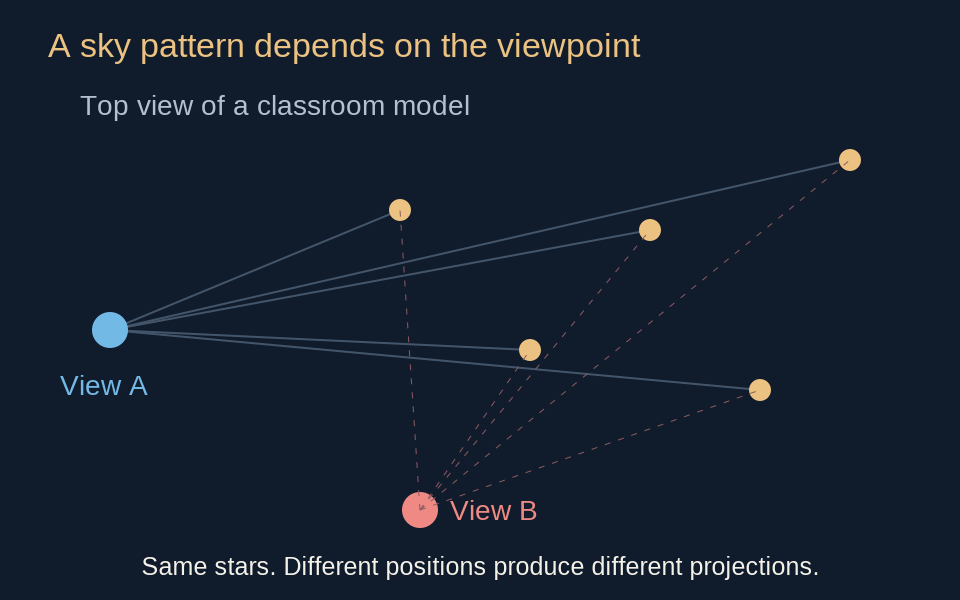
Students will explain how objects at different distances can appear in one flat pattern and distinguish drawn connections from physical connections. Prepare five paper stars on stable supports, a marked viewpoint and plain paper. A table model works well for seated learners. Before class, arrange the stars at different depths so they form a simple recognisable shape from one position.
Lesson sequence
- Minutes 0-7: Show a dot pattern and ask students what can be known from the picture alone. Record claims about shape separately from claims about distance.
- Minutes 7-17: Let groups view the three-dimensional star arrangement from the marked position, then from the side.
- Minutes 17-27: Students draw the two views and a top-view plan of the supports.
- Minutes 27-37: Discuss familiar constellation pictures and the modern use of constellations as defined sky regions.
- Minutes 37-45: Learners explain what a flat chart omits and complete the exit prompt.
Student task prompts
- 1. Which features of the model changed when you moved: the supports, their distances from one another or the pattern you saw?
- 2. Could two stars close together in a drawing be far apart in space? Explain with the model.
- 3. Does a connecting line on a constellation chart represent a physical structure?
- 4. Why would walking across the schoolground not noticeably rearrange the real stars?
Answer guide
Only the viewpoint and the resulting projected pattern changed during the demonstration. Different depths can be hidden by a flat image, so small angular separation does not establish physical proximity. The lines are human drawing conventions. Real stars are so distant that the small viewpoint change from walking across a schoolground does not produce the dramatic effect seen with table objects.
Avoid the opposite overstatement that no stars in a constellation can be related. Some belong to physical groups. The lesson’s claim is that apparent pattern alone is not sufficient evidence for that relationship.
Differentiate and assess
Provide a partially drawn top view for learners who find spatial diagrams difficult. Allow a verbal explanation supported by pointing instead of requiring polished art. Invite advanced students to propose what additional measurements could reveal depth. A successful exit response distinguishes appearance from physical arrangement and names one limitation of the table model. Discuss cultural star pictures respectfully while keeping scientific claims about distances and physical associations evidence-based.
PAUSE AND THINK
What can a flat constellation picture tell you with confidence?
Explore the answer
It can show an intended apparent pattern or sky region, but it does not by itself establish the stars’ true distances or physical relationships.
RECORD YOUR OWN EVIDENCE
Your activity sheet
You need: Five paper stars, stable supports, tape, pencil and a marked viewpoint.
Arrange the same stars at different depths. Compare views without moving the supports.
Name or group: Date:
| Viewpoint | Pattern seen | What stayed fixed? | What changed? |
|---|---|---|---|
| A | |||
| B |
Can nearby marks on a drawing represent stars far apart in space? Explain.
Why does a one-metre move affect this model more than the real constellations?
Record what happened, including uncertain results. Use the answer guidance in this resource to discuss your explanation.