On this page
THE BIG IDEAS
- A labelled construction prevents ambiguous uses of the word parallax.
- The full-angle and half-angle forms are equivalent only with the matching baseline.
- Reading uncertainty needs to be carried through the distance calculation.
Preparation and learning target
Learners should infer a distance from a measured baseline while distinguishing a full angular shift from a half-angle. They need a protractor, right-angle geometry and degree-mode tangent. Provide joined paper about 1.2 m long, tape, ruler, pencil, string and a calculator. Use the paired sheet as the common record.
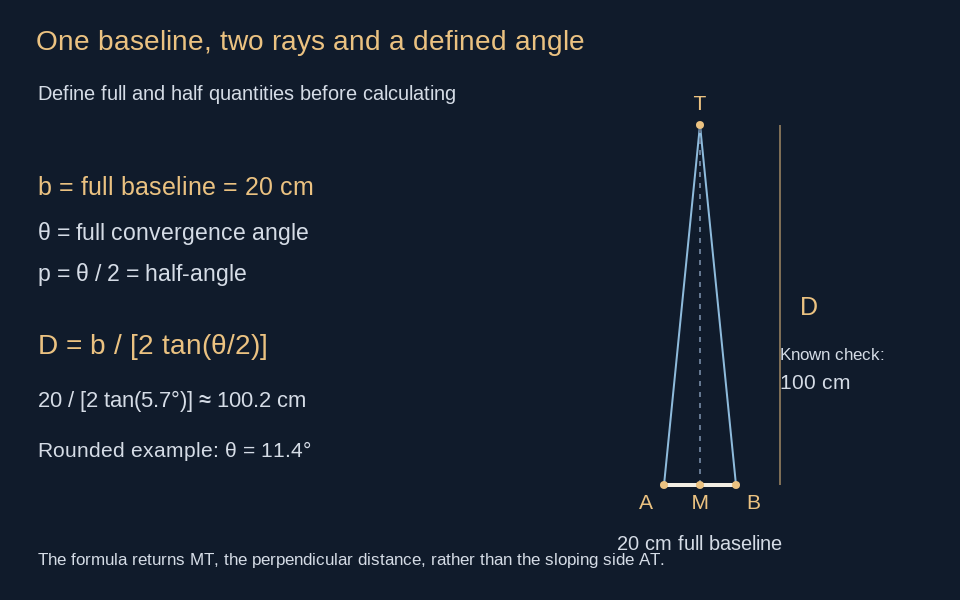
Prepare a 20 cm baseline AB with midpoint M and a target T 100 cm along the perpendicular from M. The known distance is a check on the method, not a number to substitute when a reading is inconvenient. A paper construction avoids the need for outdoor landmarks or a specialist instrument.
Minutes 0-10: make a viewpoint prediction
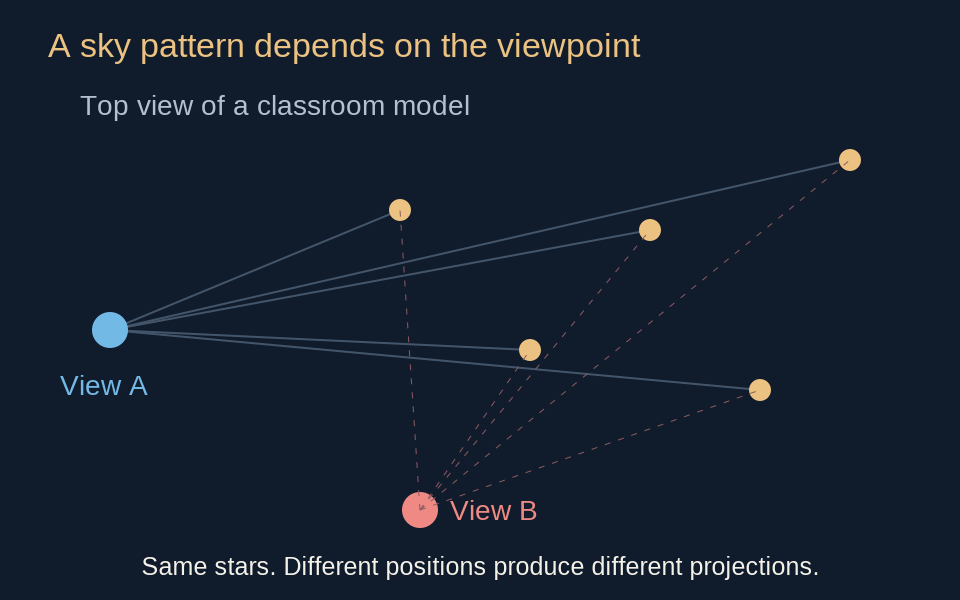
Ask students to draw the two sightlines from A and B to T and predict what would happen if T moved farther away. Ask separately what would happen if the baseline became wider while target distance stayed fixed. These are different controlled changes.
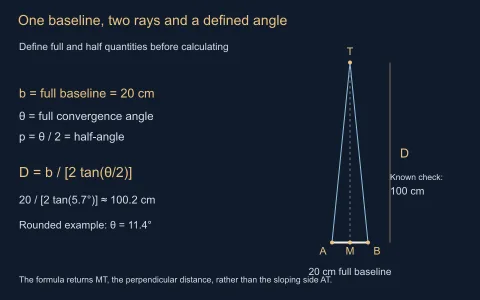
Label the full baseline b and full angle θ at the target. Use a different colour for the central perpendicular MT. Explain that the distance being inferred is MT, not the slightly longer sloping side AT.
Minutes 10-25: measure and derive
Groups draw a clean symmetric triangle and measure the full angle between the rays at T. Then split it into two right triangles. Each has baseline b/2 and target angle p = θ/2, giving tan(p) = (b/2)/D.
Rearrange this before numerical substitution: D = b/[2 tan(θ/2)]. For b = 20 cm and θ = 11.4°, p = 5.7° and D is approximately 100.2 cm. Ask why 20/tan(5.7°) would be wrong. It combines a full baseline with a half-angle and returns twice the intended value.
Minutes 25-40: test sensitivity
Students obtain three independent angle readings and calculate a range of inferred distances. They should preserve the readings instead of adjusting them toward 100 cm. Discuss thick pencil lines, the protractor scale and the accuracy of the perpendicular.
For a supplied uncertainty comparison, full angles of 11° and 12° give about 103.9 cm and 95.1 cm at the same 20 cm baseline. These are alternative angle inputs, not a measured confidence interval. Moving T to 50 cm increases θ to about 22.6°; the same equation should still apply.
Minutes 40-50: transfer the convention
Stellar annual parallax conventionally uses the angle associated with a one-AU baseline. Observations from opposite sides of Earth’s orbit have a two-AU separation, with a maximum full displacement corresponding to twice that parallax angle in the simple geometry.
Require learners to explain the difference with labelled lines, not just the word parallax. Real stars have much smaller angles than a classroom protractor can resolve. The model teaches geometric inference and sensitivity; it does not reproduce the precision, motion corrections or observing programme of a real astrometric mission.
Assessment and adaptation
A complete exit response labels b, θ, p and D, calculates one example with units and diagnoses the factor-of-two error. A learner who calculates the right value while mixing the labels has not demonstrated a transferable method.
Supply a partly drawn triangle and a tangent-value table if calculating is a barrier. For extension work, compare the exact tangent result with the small-angle form D ≈ b/θ when θ is in radians. Keep the radian requirement explicit and check the approximation against the same diagram.
PAUSE AND THINK
Why should MT rather than AT be used when checking the result?
Explore the answer
The formula used here comes from tan(p) = (b/2)/MT, so it returns the perpendicular midpoint-to-target distance. AT is the hypotenuse of a half-triangle and is slightly longer.
RECORD YOUR OWN EVIDENCE
Your activity sheet
You need: Joined paper sheets about 1.2 m long, tape, ruler, protractor, pencil, string and calculator with degree-mode tangent.
Mark A and B 20 cm apart. Place target T 100 cm along the perpendicular from their midpoint M. Draw AT and BT, measure their full convergence angle θ and calculate D = b ÷ [2 tan(θ/2)].
Name or group: Date:
| Full baseline b (cm) | Full angle θ (°) | Half-angle p (°) | Inferred D (cm) |
|---|---|---|---|
| 20 | |||
| 20 | |||
| 20 |
For b = 20 cm and θ = 11.4°, calculate D and compare it with the marked 100 cm.
Explain why using the full baseline with the half-angle would produce a factor-of-two mistake.
Record what happened, including uncertain results. Use the answer guidance in this resource to discuss your explanation.