TRY IT YOURSELF
Explore the parallax reciprocal
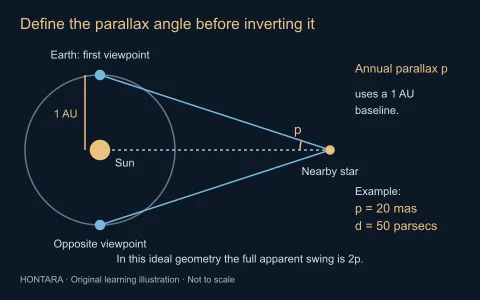
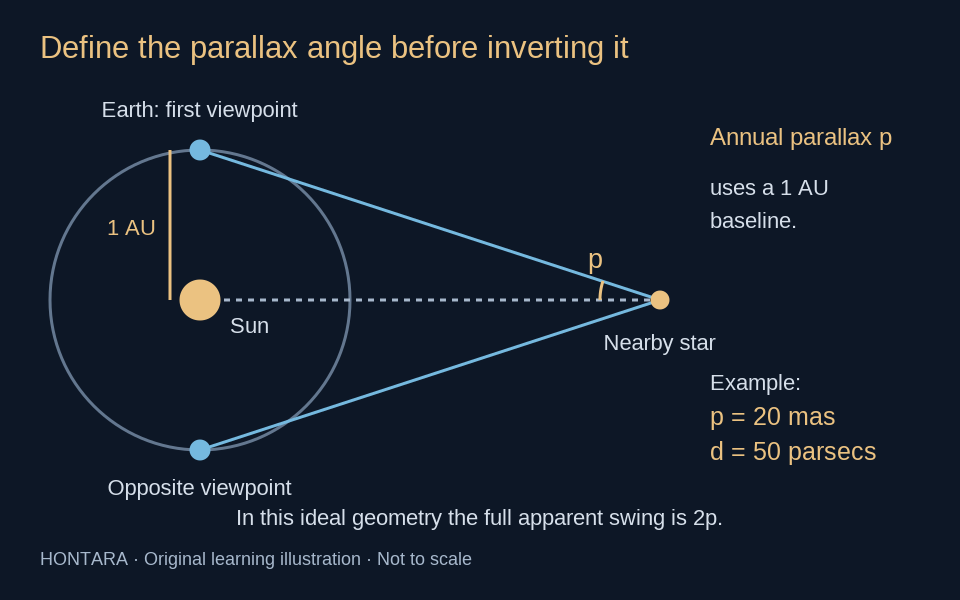
20 milliarcseconds gives 50 parsecs, about 163 light-years. Use zero if the parallax uncertainty is unknown.
On this page
THE BIG IDEAS
- Use annual parallax p rather than the full swing 2p.
- Unknown uncertainty is not zero physical uncertainty.
- Noisy parallaxes need an appropriate distance inference.
Use annual parallax in milliarcseconds
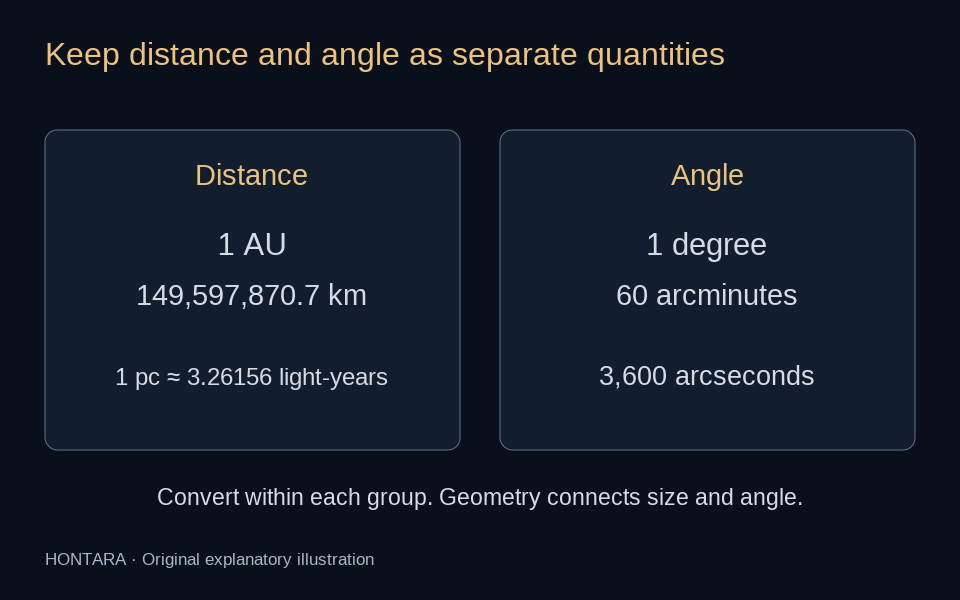
Enter a positive annual parallax in milliarcseconds, abbreviated mas. One arcsecond equals 1,000 milliarcseconds. The input is the annual parallax p, not the full ideal peak-to-peak apparent positional swing of 2p between opposite orbital viewpoints.
If you know the quoted parallax standard uncertainty, enter it in milliarcseconds too. Use zero when it is unknown. Zero here means no uncertainty was supplied; it does not mean the measurement is exact. The calculator is an educational reciprocal model rather than a catalogue-quality distance estimator.
Check the reciprocal and units
The formula is d(parsecs) = 1000/p(mas). A parallax of 20 mas gives 50 parsecs. Multiplying by about 3.26156 gives approximately 163.08 light-years. For 10 mas the reciprocal is 100 parsecs; for 100 mas it is 10 parsecs.
The parsec and light-year are both distance units. Neither is a duration. This calculation contains no assumption that the star shines as brightly as the Sun. It relates a geometric angle to distance through the definition of the parsec and the small-angle stellar-parallax convention.
Inspect the uncertainty behaviour
For a small fractional standard uncertainty, first-order propagation gives u(d) approximately equal to d × u(p)/p. With p = 20 mas and u(p) = 1 mas, the fractional uncertainty is 5% and the approximate distance standard uncertainty is 2.5 parsecs.
This approximation includes only the uncertainty you enter. It excludes calibration offsets and other systematic effects. To keep its use conservative, the calculator displays the symmetric approximation only when u(p)/p is at most 10%. That cutoff is a teaching guardrail, not a universal scientific quality threshold.
Know when to use a published inference
For larger fractional uncertainty, the reciprocal is still displayed as arithmetic but is explicitly labelled unsuitable as a reliable distance estimate. No symmetric distance uncertainty is then reported. The transformation is nonlinear and a distance inference can require additional modelling and an asymmetric interval.
Fitted parallaxes may be zero or negative because they are noisy estimates, while a physical stellar distance is positive. This shortcut accepts only positive parallaxes; it cannot rescue a poor measurement by taking its absolute value. For scientific use, follow the catalogue’s quality guidance and a suitable published distance analysis.
PAUSE AND THINK
Would taking the absolute value of a negative catalogue parallax produce a dependable distance?
Explore the answer
No. A negative fitted value can arise from measurement noise. Taking its absolute value conceals the measurement problem and is not a valid distance-inference method.