On this page
Use one eye and a steady arm
Extend your arm and close one eye. Line up an edge of your hand with a reference point such as a roofline or a bright star. Count how many hand widths fit from that reference to your target. Keep your arm straight and rotate your wrist so the width follows the direction you are measuring.
A little finger or a fist gives a rough scale. The result depends on your hand size and how far it is from your eye. The full Moon spans about half a degree, so a finger at arm’s length is usually wider than the Moon.
Calibrate your fist at home
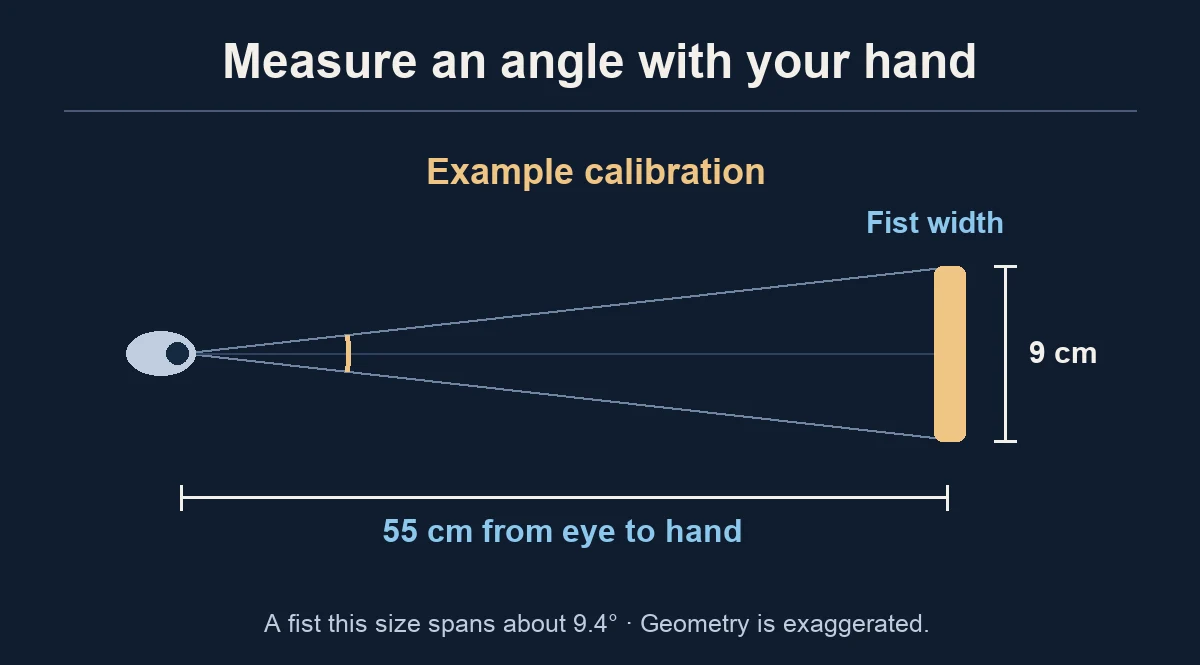
Measure the width across the fist you use for observing. Then have someone measure from your viewing eye to that fist when your arm is comfortably extended. Use the same units for both numbers. For a 9 cm width at 55 cm, the angle is 9.4° using twice the arctangent of half the width divided by the distance.
For a check without trigonometry, draw two marks 10 cm apart on a sheet and view them straight on from about 57 cm. Their separation is close to 10°. Compare how much of that span your fist covers when you use the usual observing position.
Use the estimate to clear a roof or find a neighbour
If a bright planet is about 30° high and your fist spans 9.4°, it should be just over three fist widths above a level horizon. If your building blocks the first two fist widths in that direction, the planet should appear roughly one fist above the roofline.
To follow a chart, start on a bright star you recognise. Move the required number of hand widths toward the next object. Check the small pattern around the destination before deciding you have found it. Keep the Sun out of your field of view.