On this page
A changing view of a sunlit world
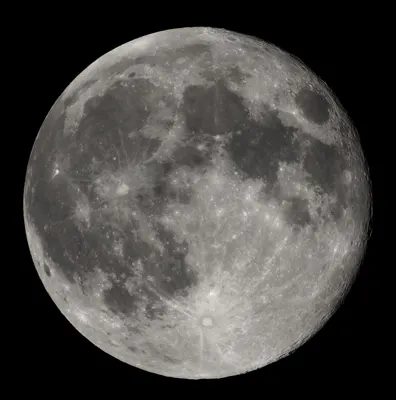
The Moon does not make its own visible light. We see sunlight reflected from its surface. Apart from the special circumstances of a lunar eclipse, sunlight illuminates one half of the Moon. Its familiar sequence of shapes happens because the Moon travels around Earth and we see different amounts of that illuminated half. A crescent is not a smaller Moon. It is a small visible portion of the sunlit hemisphere.
Explore a Moon-phase model
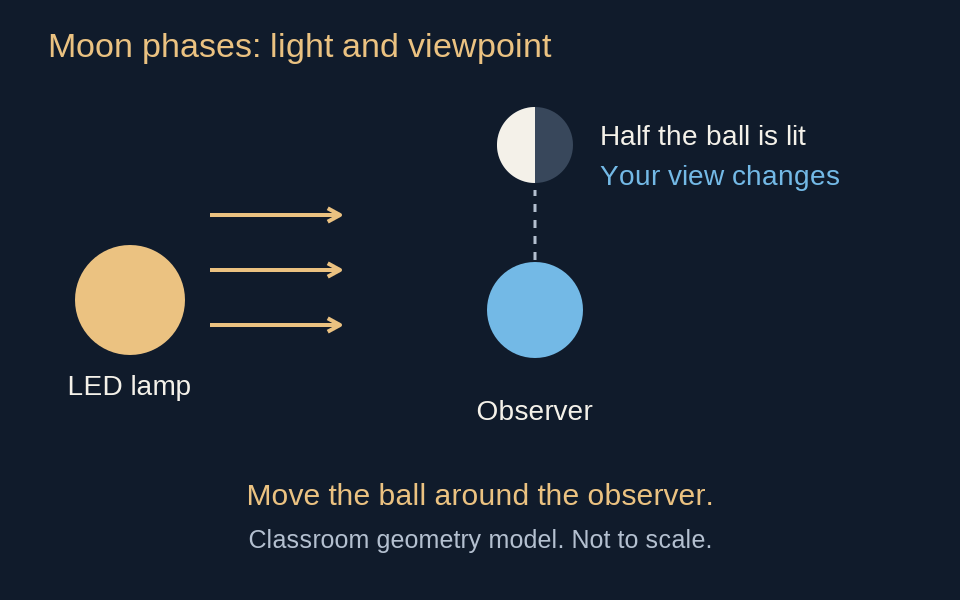
Move the Moon around Earth and compare the illuminated portion seen from Earth. Sunlight comes from the left.
First Quarter · 50% of the visible disk illuminated
Ideal circular-orbit model, not today’s Moon. Sizes, distances and orbital tilt are simplified. Sunlight illuminates half the lunar sphere; the fraction of that lit half visible from Earth changes. This diagram does not model eclipses. The apparent orientation in your real sky can differ from the north-up disk shown here.
THE BIG IDEAS
- Sunlight normally illuminates half the Moon.
- Phases describe how much of that sunlit half faces Earth.
- A quarter moon looks half bright.
Follow the geometry
Imagine looking down on the Earth–Moon system from above. Near new moon, the Moon lies in roughly the same direction as the Sun in our sky. Its illuminated half mostly faces away from Earth. Near full moon, it lies opposite the Sun and its bright half faces us. Between those positions we see crescents, quarter phases and gibbous phases. The orbit is tilted, so most new and full moons do not produce eclipses.
Names that describe change
Waxing means the illuminated fraction visible from Earth is increasing. Waning means it is decreasing. A quarter moon looks half illuminated: the name refers to progress through the phase cycle, not the fraction of its face that appears bright. The cycle from one new moon to the next takes about 29.5 days. The Moon’s orientation in your view changes with your location and its position in the sky.
Notice when it is visible
Lunar phase also helps explain timing. A full moon is roughly opposite the Sun, so it rises around sunset and sets around sunrise. A first-quarter moon is often useful for evening observing. These are approximate relationships rather than a timetable for a particular date. The Moon is also visible in daylight on many days. Look well away from the Sun and never point binoculars or a telescope toward the Sun.
Make a useful record
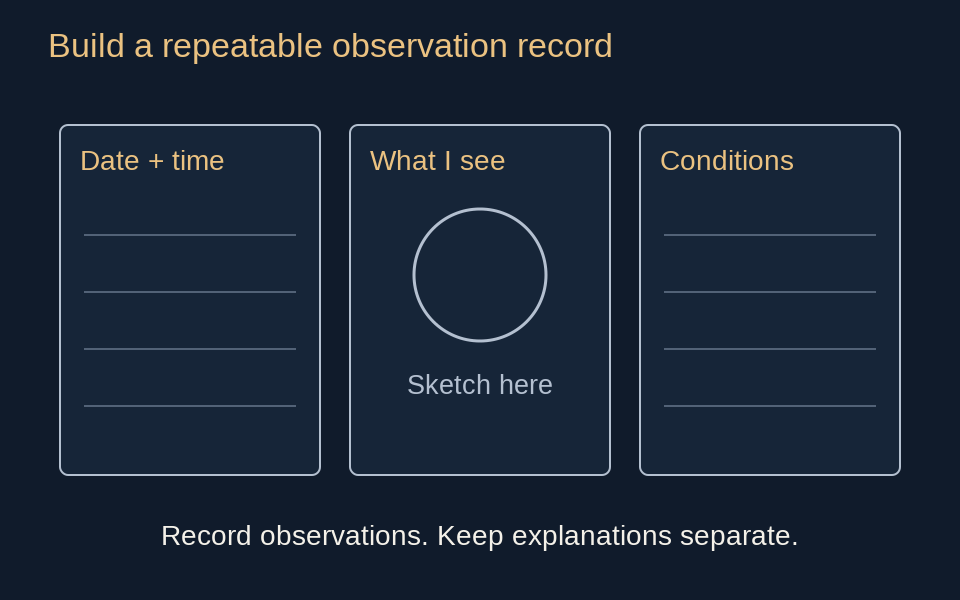
On several evenings, sketch the Moon’s outline and shaded portion. Record the date, time and direction you faced. If clouds prevent a view, write cloudy rather than filling in a guessed drawing. Compare the sketches a week later. The changing bright portion and its changing position together are evidence of orbital motion. Earth’s shadow explains lunar eclipses, but it does not explain this ordinary monthly sequence.
PAUSE AND THINK
Would observers in different countries see completely different phases on the same date?
Explore the answer
They see essentially the same phase, although the Moon can appear rotated and local rising and setting times differ.