On this page
THE BIG IDEAS
- Record time and viewing conditions with every drawing.
- The illuminated fraction visible from Earth changes through the lunar cycle.
- A missing observation is different from an observation of an absent Moon.
Your investigation
Does the Moon look the same at the same clock time every day? A diary lets you investigate this without buying equipment. Plan for about four weeks, but start with three observations. Each entry takes ten to fifteen minutes. A missed observation is useful information about your circumstances, not a reason to invent a result.
Prepare a repeatable record
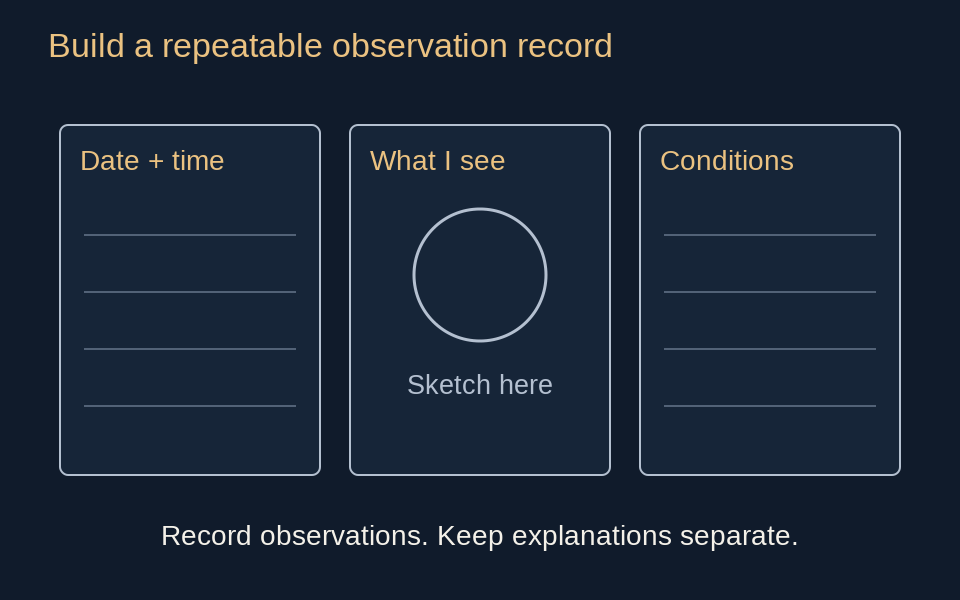
Use a notebook, pencil, clock and a safe observing place. Draw a circle for each entry and leave space for date, time, direction, cloud cover and a short note. Agree on an outdoor boundary with an adult. Observe from ground level away from roads. Never search close to the Sun or point binoculars at the daytime sky. Naked-eye observations are enough.
Make each observation
- 1. Start after sunset when the Moon is easy to identify. Record your actual time rather than the time you planned.
- 2. Sketch the bright portion inside your circle. Include a nearby roofline or tree as a rough position reference.
- 3. Write what you can directly see: bright on one side, high above the roof or hidden by cloud. Put explanations in a separate column.
- 4. Repeat on several evenings. If the Moon is absent, record not seen from this place at this time.
- 5. Compare entries after a week. Continue into morning observations with adult supervision if evening visibility changes.
Read the pattern
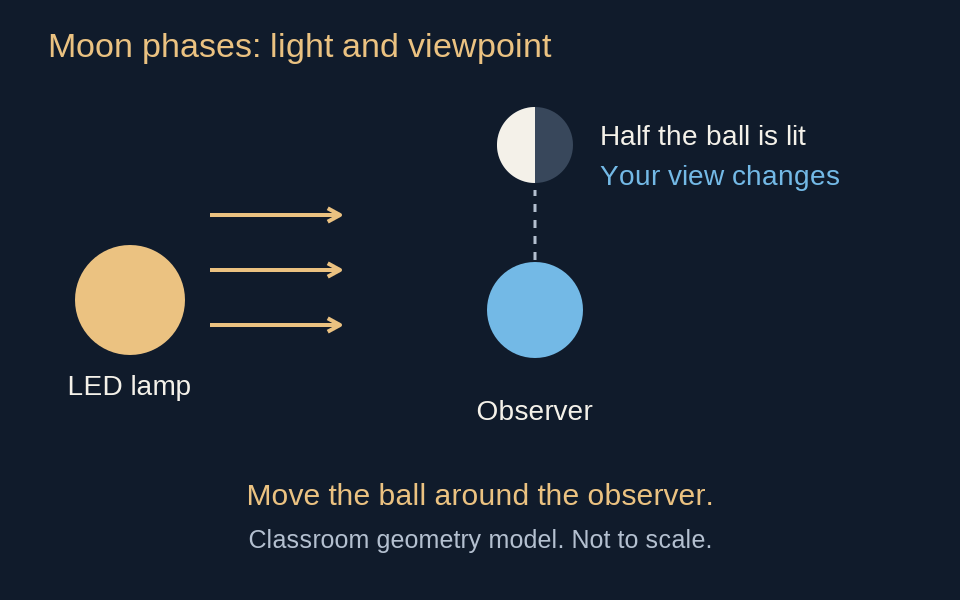
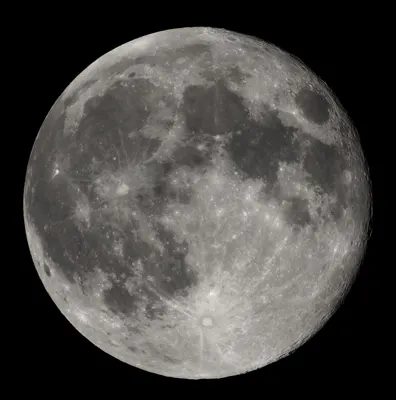
Sunlight illuminates roughly half the Moon. The portion of that illuminated half visible to us changes as the Moon moves around Earth. The repeating sequence takes about a month. Earth’s ordinary shadow does not produce the phases. Your drawings are views from Earth, so they should not be confused with a diagram looking down on the Moon’s orbit.
A same-time diary will not show every phase equally well. The Moon’s rising and setting times shift through the cycle. Buildings, weather and trees can also hide it. A blank evening therefore cannot establish that the Moon has disappeared.
Turn notes into evidence
Arrange your drawings chronologically and label which entries support a claim of change. Keep uncertain sketches marked uncertain. Compare your record with a classmate’s before looking at a reference phase diagram. Differences may come from timing, orientation or drawing choices. Finish with one question your diary could not answer and propose a new observation that might help.
PAUSE AND THINK
Why might the Moon be missing from an evening diary for several days?
Explore the answer
It may be below the horizon, near the Sun in the sky, behind an obstacle or hidden by cloud. The diary alone must not choose between these explanations without more evidence.
RECORD YOUR OWN EVIDENCE
Your activity sheet
You need: Notebook, pencil, clock and a safe ground-level observing place.
Begin with three after-sunset observations. Record what you see before proposing an explanation.
Name or group: Date:
| Date + time (IST) | Bright shape + direction | Conditions | Observation |
|---|---|---|---|
What changed between two observations? Use dates in your answer.
What other explanation could account for a missed view? What would you check next?
Record what happened, including uncertain results. Use the answer guidance in this resource to discuss your explanation.