On this page
THE BIG IDEAS
- Ask for predictions before each model position.
- Use both observer-view and top-view diagrams.
- Assess the explanation rather than just phase vocabulary.
Learning goal and preparation
By the end, students should explain why the Moon changes apparent shape while sunlight still illuminates approximately half of it. They should identify Earth’s shadow as an explanation for a lunar eclipse rather than ordinary phases. Prepare a cool LED lamp, pale ball, observation circles and two contrasting statements written on the board. No outdoor solar viewing is involved.
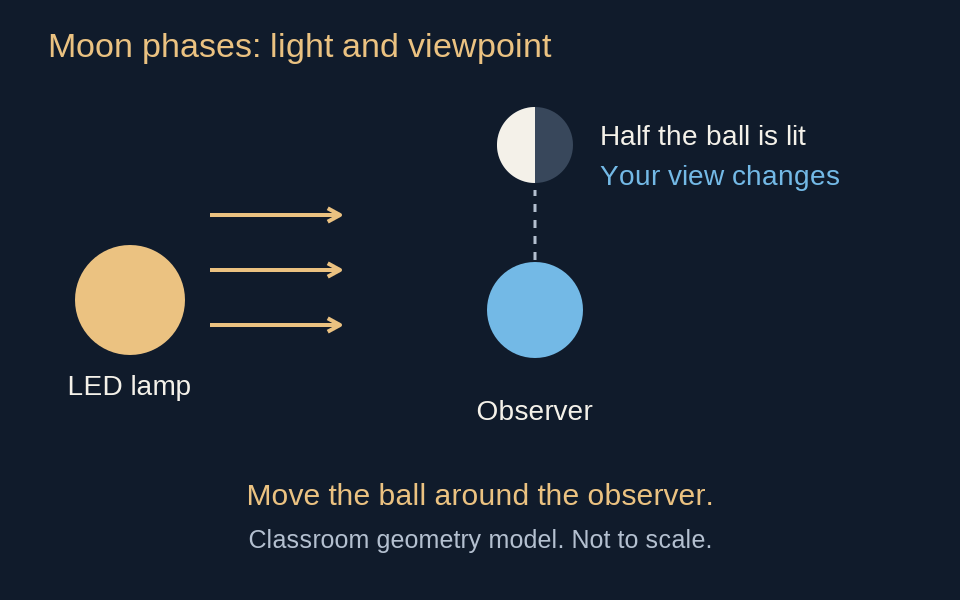
Use these contrasting claims: Earth blocks sunlight to make every crescent, or we see different portions of the Moon’s sunlit half. Secure the lamp and cord. The observer stands a few steps away, holds the ball at arm’s length and turns to view it in different directions relative to the lamp.
Keep the lamp out of the direct line of sight and lift the ball above the observer’s head-shadow near the full position. A partner can move the ball for a seated observer.
Lesson sequence
- Minutes 0-5: Ask learners to draw a crescent Moon and anonymously explain what makes its dark part dark. Keep the drawings for comparison.
- Minutes 5-15: Demonstrate the lamp-and-ball model from the observer’s position. Stop at four positions and ask for predictions before showing the view.
- Minutes 15-25: In pairs, students draw both a top view of the model and the visible shape from Earth at two positions.
- Minutes 25-35: Groups evaluate the claim that Earth blocks the Sun every time we see a crescent. Require them to refer to a model position.
- Minutes 35-45: Students revise their starting explanations and answer the exit questions below.
Student task sheet
Give students these prompts orally or on paper. Leave space for labelled diagrams rather than accepting only memorised phase names.
- 1. From outside the model, how much of the ball is illuminated at two different positions?
- 2. From the observer’s position, why can a half-lit ball look like a crescent?
- 3. What happens if the observer’s head blocks the lamp and why should that event be treated separately?
Answer guide
For question 1, approximately half remains illuminated unless an object blocks the light. For question 2, the observer sees only a small portion of the illuminated half because of the Sun-Moon-Earth arrangement. For question 3, the model enters shadow in an eclipse-like alignment. Raising the ball slightly removes that alignment and restores the ordinary phase demonstration.
Accept accurate words or diagrams. Do not require the same left-right orientation from every sketch unless all students used the same viewpoint. Ask students to state where the observer is before judging a drawing.
Support, extension and assessment
For support, provide outlines of the ball with separate labels for illuminated and visible. Let a partner describe changes aloud while another draws. For extension, ask why a simple coplanar model accidentally produces an eclipse each cycle and what tilt would change. Assess three features: the source of moonlight, the changing viewing geometry and the distinction between phases and eclipse shadow. A correct list of phase names alone does not demonstrate this understanding.
PAUSE AND THINK
What is the most useful follow-up when a learner says the dark part is Earth’s shadow?
Explore the answer
Ask them to identify which object blocks the lamp at a crescent position. In the ordinary phase model nothing does, allowing them to test and revise the explanation.
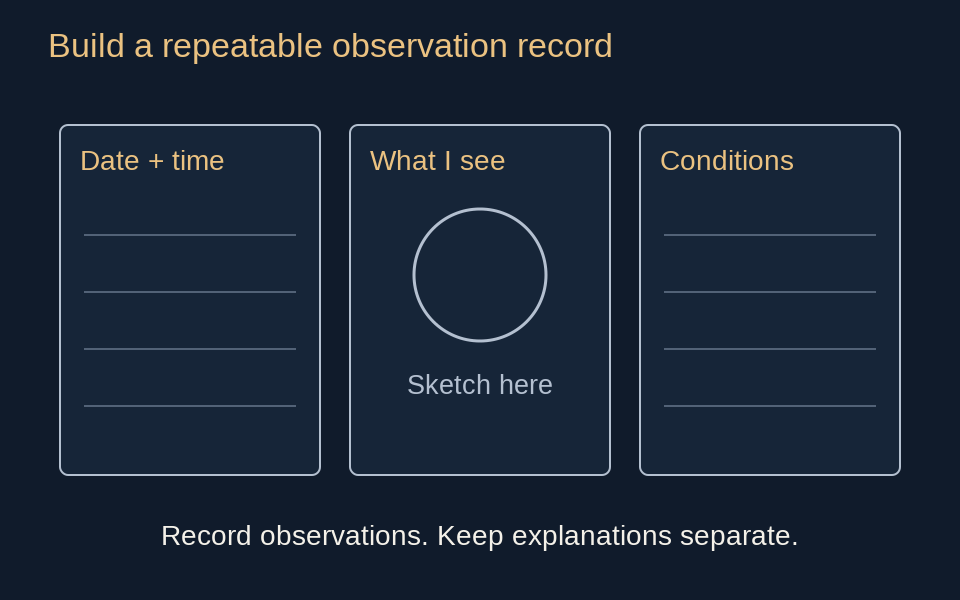
RECORD YOUR OWN EVIDENCE
Your activity sheet
You need: Cool LED lamp, pale ball, a marked observing position and paper.
Predict the visible bright portion at four ball positions, then compare with the view from the observer.
Name or group: Date:
| Ball position | Prediction | Observed view | Explanation |
|---|---|---|---|
| 1 | |||
| 2 | |||
| 3 | |||
| 4 |
How much of the ball was lit in each position?
Explain the difference between the lit half and the portion the observer could see.
Record what happened, including uncertain results. Use the answer guidance in this resource to discuss your explanation.