On this page
Explore a Moon-phase model
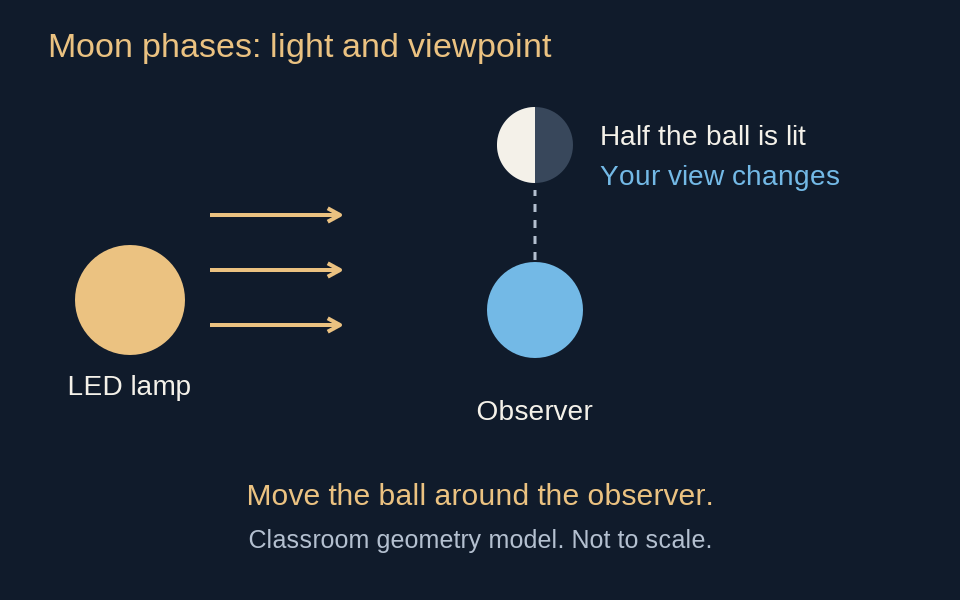
Move the Moon around Earth and compare the illuminated portion seen from Earth. Sunlight comes from the left.
First Quarter · 50% of the visible disk illuminated
Ideal circular-orbit model, not today’s Moon. Sizes, distances and orbital tilt are simplified. Sunlight illuminates half the lunar sphere; the fraction of that lit half visible from Earth changes. This diagram does not model eclipses. The apparent orientation in your real sky can differ from the north-up disk shown here.
THE BIG IDEAS
- An observer sees only part of the illuminated hemisphere at most positions.
- Phases are not ordinarily caused by Earth’s shadow.
- A useful model needs an explicit list of its limitations.
What the model represents
A stationary LED lamp represents the Sun. Your head represents the observing position on Earth and a pale ball represents the Moon. The purpose is to compare the part lit by the lamp with the part visible to your eyes. It is a geometry model, not a scale model of the actual sizes or distances.
Materials and arrangement
Use a cool LED desk lamp, a plain ball, pencil and paper. A loosely crumpled white paper ball can replace a purchased foam ball, although its uneven surface makes the boundary less clear. An adult should secure the lamp and cable. Keep the room dim enough for contrast but bright enough to move safely. Do not stare into the lamp. Never substitute the Sun.
Build a sequence
- 1. Place the lamp on a stable surface. Stand a few steps away and hold the ball at arm’s length.
- 2. Hold the ball a little to one side of the lamp’s direction while keeping the lamp out of your direct line of sight. Look at the ball, not the lamp. Its illuminated portion facing you should be narrow.
- 3. Turn a quarter turn away from that starting direction while keeping the ball at arm’s length in front of your eyes. Sketch the roughly half-lit disc you see.
- 4. Continue around in small steps. Hold the ball slightly above your head’s shadow when facing away from the lamp.
- 5. Repeat with a partner watching from the side. Ask the partner how much of the ball the lamp illuminates.
Explain what changes
Your partner should see that the lamp lights one half of the ball at every position unless something blocks the light. Your own view can show a crescent, a half-lit disc or an almost fully lit disc. The lighting and the viewing direction must both be considered.
When the ball is opposite the lamp from your viewpoint, its illuminated face looks full. If your head blocks the lamp, the ball becomes dark. That interruption models an eclipse-like alignment rather than an ordinary phase. Real lunar phases happen without Earth blocking sunlight from the Moon.
Check the model’s limits
The lamp’s rays spread considerably at classroom distances and the ball’s orbit is too small relative to your head. Mark these limitations on your drawing. Explain why raising the ball avoids an accidental shadow. For an extra challenge, predict the appearance at a new position before turning, then compare the prediction with the observed shape. Good models make testable predictions while also leaving some features out.
PAUSE AND THINK
Why does the ball sometimes disappear into darkness behind you?
Explore the answer
Your head can block the lamp. Raise the ball slightly to remove that accidental alignment and distinguish an eclipse model from the phase cycle.
RECORD YOUR OWN EVIDENCE
Your activity sheet
You need: Cool LED lamp, pale ball, a marked observing position and paper.
Predict the visible bright portion at four ball positions, then compare with the view from the observer.
Name or group: Date:
| Ball position | Prediction | Observed view | Explanation |
|---|---|---|---|
| 1 | |||
| 2 | |||
| 3 | |||
| 4 |
How much of the ball was lit in each position?
Explain the difference between the lit half and the portion the observer could see.
Record what happened, including uncertain results. Use the answer guidance in this resource to discuss your explanation.