On this page
THE BIG IDEAS
- Venus is a planet seen near sunrise or sunset in suitable periods.
- Its cloud-covered disk shows phases.
- Beginner optical observations must avoid the Sun entirely.
A planet that stays near the Sun
Venus orbits closer to the Sun than Earth does. In our sky it therefore remains relatively near the Sun, appearing during some periods after sunset or before sunrise. It does not behave like a planet that can remain opposite the Sun all night. Its popular names, evening star and morning star, refer to one planet rather than two stars.
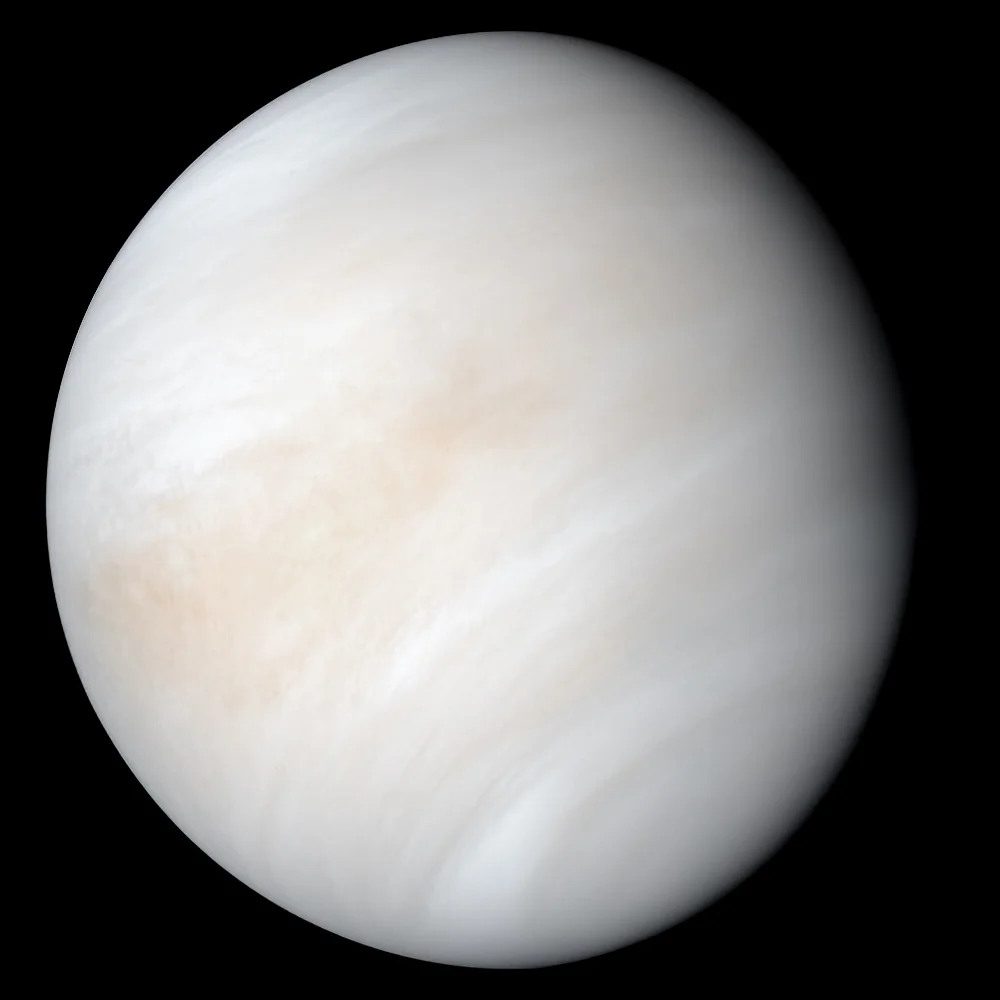
The planet’s bright appearance comes from sunlight reflected by extensive clouds. Those clouds conceal the surface from ordinary visual observing. A telescope will not show a landscape through them.
Plan the observation before taking out optics
Use a current chart for your exact place and time to determine whether Venus is an evening or morning target. For beginners, choose an evening opportunity after the Sun has completely set. Check that the direction is free of obstructions and that there is enough time before Venus also sets.
Never search for Venus near the Sun with binoculars or a telescope. A mistaken sweep can cause permanent eye injury. Do not attempt a daylight hunt as an extension of this beginner guide. Morning sessions should finish before sunrise and require careful supervision.
What the unaided eye can tell you
Venus may appear strikingly bright against twilight. Watch it relative to a fixed landmark without assuming that brightness alone proves its identity. A plane changes position quickly and may show flashing lights; a planet remains in the same star pattern over a short interval, with the whole sky gradually moving.
Over several evenings, record the date, local time and approximate height. Use a consistent observing time relative to sunset if you want the comparison to be meaningful. Cloud or haze can change the apparent brightness dramatically.
A telescope shows phases
Through a telescope, Venus can appear crescent-shaped, half-lit or gibbous. The phase depends on the Sun-Venus-Earth geometry. Its apparent size also changes with distance. A thin crescent can look larger than a fuller phase, even though less of the visible disk is illuminated.
Low altitude often makes Venus shimmer and show false coloured edges. Start at low power and increase only if the outline remains clean. A plain phase sketch is a better beginner goal than attempting cloud details.
Connect your sketch to a model
Draw the observed illuminated shape and then make a simple top-down diagram of the Sun, Earth and Venus. Ask where the sunlight must come from to create that phase. Your drawing is a geometric explanation, not a precisely scaled orbit. Repeating this exercise during a different appearance helps connect the bright point in the sky with an orbiting world.
PAUSE AND THINK
Why is Venus not an all-night object opposite the Sun?
Explore the answer
Its orbit lies inside Earth’s orbit, so its apparent separation from the Sun is limited.