On this page
THE BIG IDEAS
- Mercury needs a current location and time check.
- Elongation alone does not determine local visibility.
- Begin with an unaided-eye evening attempt after complete sunset.
Begin with a date rather than a direction
Mercury changes position against the stars and is usually seen against twilight. A remembered instruction to look west is not a permanent finder chart. An evening apparition places it on the sunset side of the sky; a morning apparition places it on the sunrise side. Whether either is useful depends on the date, location, horizon and weather.
For a first attempt, choose an evening opportunity and begin with your unaided eyes after the Sun has fully set. Use an unobstructed public or permitted ground-level view. A bank of haze or a nearby tree can hide a target that a calculation places above the astronomical horizon. Do not move into an unsafe position to recover the view.
Check the separation and local altitude
Use a current planetarium chart set to your observing location and planned time. Check Mercury’s direction, altitude and setting time, then check sunset for the same place and date. If a chart uses Universal Time, add 5 hours 30 minutes for IST and carry the date forward when needed. Write down the settings so another person can reproduce your plan.
JPL Horizons provides an official observer ephemeris for checking changing planetary positions. Mercury is the target and Earth is the observing body; the observing site and time span must match your plan. Read the output headings rather than assuming that a table uses local time. The linked Horizons service is a calculation tool, not a forecast of clear weather.
Why a large elongation is only part of the story
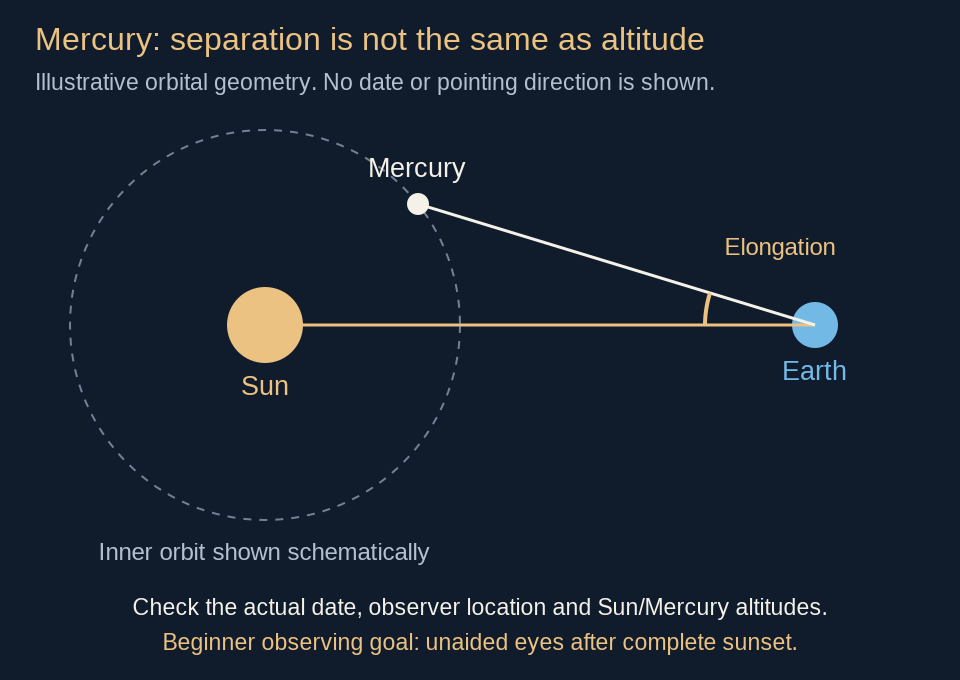
Elongation is the angular separation between Mercury and the Sun as viewed from Earth. A larger separation can create a longer observing opportunity, but it does not guarantee a high target after sunset. The angle at which the planetary path meets your horizon also matters. Two apparitions with similar elongations can therefore offer very different views from the same town.
The illustration shows this geometry schematically. It does not plot tonight’s Mercury or give a safe pointing direction. A fixed star pattern can remain useful for years; a Mercury position must be checked for the actual observing date.
Keep optical equipment out of the first search
Never sweep binoculars, a telescope or a finder near the Sun to hunt for Mercury. An unaided-eye evening identification after complete sunset is the appropriate beginner goal here. Do not attempt daytime viewing from this guide. Any later optical observing should be led by an experienced observer with a definite identification and a setup that prevents solar pointing.
Mercury may look like a small bright point through the twilight rather than a miniature spacecraft image. Low altitude also puts a long path of turbulent air between you and the planet. A poor view is not fixed simply by increasing magnification.
Record an attempt without turning a guess into a sighting
Before going outside, make a small plan with the date, time in IST, expected direction and estimated altitude from your current chart. Afterwards, note horizon obstructions, cloud and whether the candidate matched the prediction. If uncertain, write “candidate not confirmed”. A later check against the same settings is more useful than a confident but unsupported label.
A missed attempt can still teach you something. Was Mercury predicted to be too low? Had it already set? Was the correct date selected? Keep those alternatives separate from the possibility that the planet was present but hidden by haze.
PAUSE AND THINK
Why might two equally large Mercury elongations produce different views from the same place?
Explore the answer
The planetary path can meet the horizon at a different angle. Mercury’s altitude during useful twilight and its setting time can therefore differ even at a similar separation from the Sun.