TRY IT YOURSELF
UTC and IST date converter
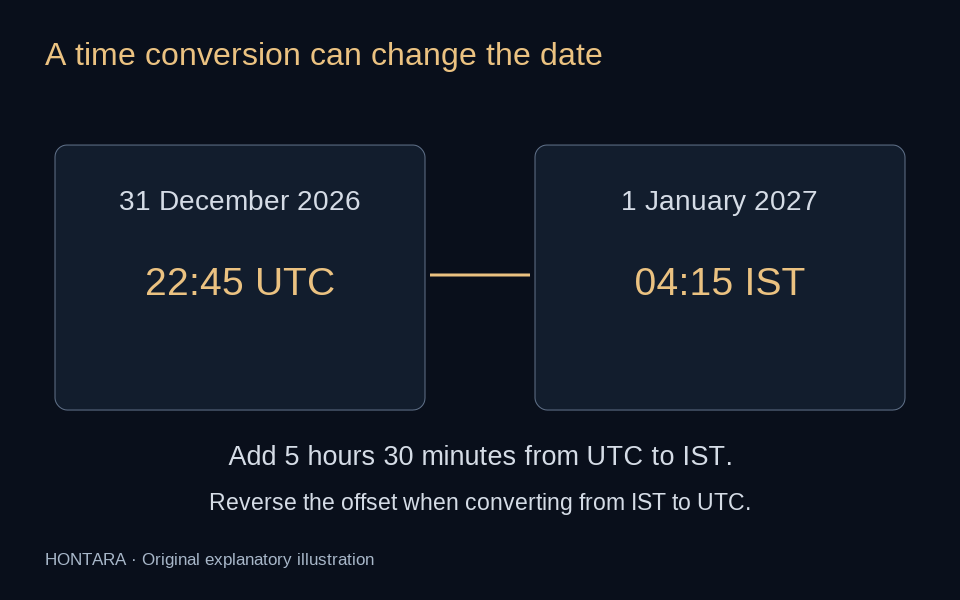
31 December 2026 at 22:45 UTC is 1 January 2027 at 04:15 IST.
On this page
THE BIG IDEAS
- IST is UTC +05:30.
- Copy the converted date as well as the clock time.
- A time-zone conversion does not predict local visibility.
A time label needs a time zone
A sky-event listing is incomplete if its clock time has no zone. This tool converts civil date and time between UTC and Indian Standard Time. IST is UTC plus 5 hours 30 minutes. It does not use your browser’s local zone to guess which one you meant.
Enter the source date and clock time, then select the source zone. The result uses the other zone. Inputs cover years 2000 to 2100 and minute precision. The initial date is a worked example rather than a claim that an event happens at that moment.
Follow a year-boundary example
Start with 31 December 2026 at 22:45 UTC. Adding five hours reaches 03:45 on 1 January 2027. Adding the remaining thirty minutes gives 04:15 IST on 1 January. Both the day and year have changed.
Reverse the example by entering 1 January 2027 at 04:15 IST. Subtracting 5 hours 30 minutes returns 22:45 UTC on 31 December 2026. Copy the resulting date with the time; keeping only the hour can move an observation onto the wrong night.
Use it alongside an observing source
Check the source’s own labels before converting. UT1, TT and other astronomical time scales are not interchangeable names for UTC. This converter implements only the stated civil offset between UTC and IST. It does not transform a dynamical ephemeris time scale.
The Moon calendar in this library already displays its phase predictions in IST. Do not add the offset again. If you compare an external UTC entry with the library, keep the event name and both dates in your notes so you are comparing the same prediction.
Separate a shared instant from a local view
Converting a listed instant does not calculate whether the target is above your horizon or whether clouds will hide it. A lunar phase instant and local Moonrise are different questions. Use a location-aware observing source for rise, set and visibility information.
This minute-resolution teaching tool does not model leap seconds or provide a clock-synchronisation service. For practice, convert 2 February 2027 at 01:00 IST. The answer is 1 February at 19:30 UTC. Explain the date rollover before using a converter, then compare your reasoning with the result.
PAUSE AND THINK
What is 20:00 UTC on 10 March 2027 in IST?
Explore the answer
01:30 IST on 11 March 2027. Adding 5 hours 30 minutes crosses midnight.