On this page
THE BIG IDEAS
- Date, time and conditions make an observation reusable.
- Keep expected features separate from observed features.
- Failed attempts can guide a better next session.
A useful record can be simple
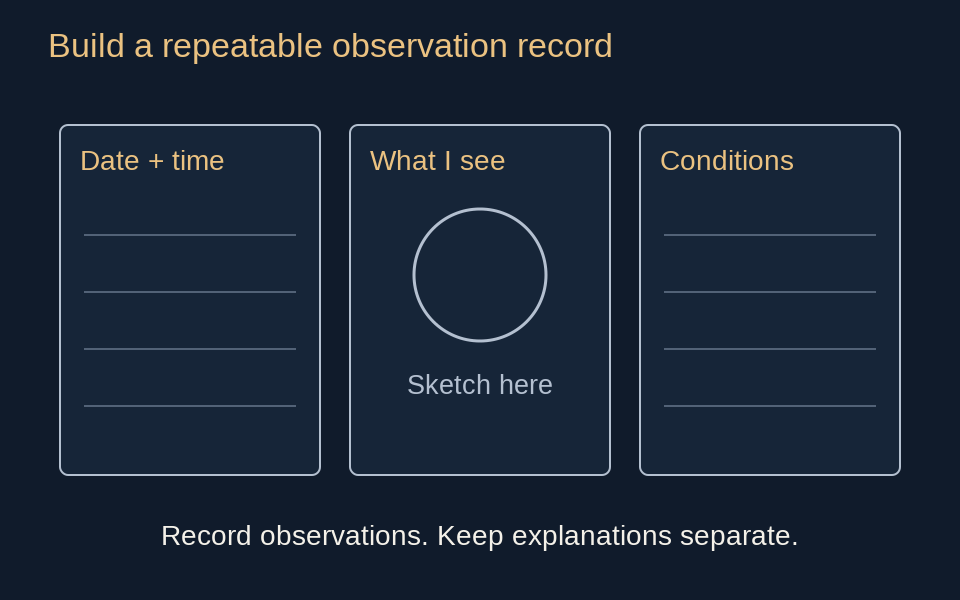
An observing journal is a record of a question, the circumstances and what you noticed. It does not need polished drawings or expensive stationery. A notebook that opens easily beside your chair is often enough. The important feature is consistency.
Write the date, local time and location before beginning. Include a time-zone label when observations may be compared with published predictions. For India, local civil time is normally IST, which is UTC plus five hours and thirty minutes.
Describe the setup
Record the target, telescope or binocular type and the eyepiece when relevant. If you calculate magnification, keep the telescope and eyepiece focal lengths available so the number can be checked later. Unaided-eye observations deserve the same basic record.
Note whether you were standing, seated or using a support. An improvement next time may come from steadiness rather than a change in the object. Include local glare, clouds, haze and whether the Moon was visible.
Draw before checking a detailed image
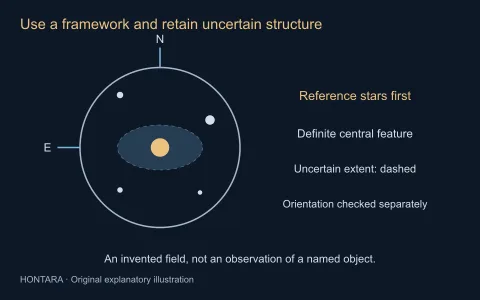
Make a quick sketch of the features you can confidently see. Use larger dots for brighter stars and gentle shading for diffuse light. Mark the orientation if you know it, or record a visible landmark that allows comparison later.
Keep uncertain features visibly uncertain. A question mark or dashed edge is better than a confident line added from memory of a photograph. If you consult a chart afterwards, put the identification in a separate note.
Include unsuccessful attempts
A non-detection can be useful when it includes context. “M31 not seen through bright haze with Moon up” is more informative than leaving the page blank. It helps you choose a darker opportunity without assuming the telescope failed.
Separate observation from interpretation. “Three points beside Jupiter” describes what was seen. “One moon was hidden” is a possible explanation to check against an ephemeris for the recorded time. Both belong in the journal, but they are different kinds of statement.
Review rather than merely collect
After several sessions, compare the records and ask one question: which conditions improved the view, which eyepiece was comfortable or which feature changed? Choose a follow-up observation that tests the idea. For a classroom group, compare descriptions without ranking children by drawing skill. The scientific habit is making a clear claim with evidence and acknowledging uncertainty. A small honest notebook can teach more than a long list of targets marked as completed.
A completed example to learn from
The following is an invented example of a beginner’s record. It shows how to separate what was noticed from an interpretation; it is not a HONTARA observing report.
- Date and time: 12 January, 19:30 IST. Place: a familiar garden with a clear view in the planned direction. Target: Orion. Equipment: unaided eyes.
- Conditions: some thin cloud, no lamp shining directly into my eyes and a neighbour’s light to the side.
- Observation: three bright points form a short line. I can identify the pattern on my chart but cannot confidently count the fainter stars below it.
- Interpretation to check: the chart labels the short line as Orion’s Belt. The faint region may be difficult because of cloud or glare; the observation alone does not identify a single cause.
- Next question: after the sky clears, can I recognise the same field and make a second sketch from the same position?
PAUSE AND THINK
Why record an object that you tried but could not see?
Explore the answer
The circumstances help explain the non-detection and let you plan a fair comparison under better conditions.
RECORD YOUR OWN EVIDENCE
Your observing record
You need: Notebook or printed sheet, pencil, clock and a safe observing place.
Name the target and record the conditions. Keep an observation separate from what you think it means.
Name or group: Date:
| Target + time (IST) | Equipment + power | Conditions | Direct observation |
|---|---|---|---|
What interpretation fits your observation and what uncertainty remains?
What would you change or repeat next time?
Record what happened, including uncertain results. Use the answer guidance in this resource to discuss your explanation.