On this page
THE BIG IDEAS
- The best lunar phase depends on the target.
- The terminator often reveals surface relief clearly.
- Moonrise and moonset matter as well as phase.
Match the Moon to the purpose
For Moon and planet viewing, an evening with moonlight can still be useful. Faint galaxies, nebulae and meteors benefit from a darker sky. Choose your target before choosing the date.
The phase calendar shows when the Moon reaches each phase. Select a date to check the Moon’s rise or set and the hours of full darkness for Honavar.
For lunar detail, look near the terminator
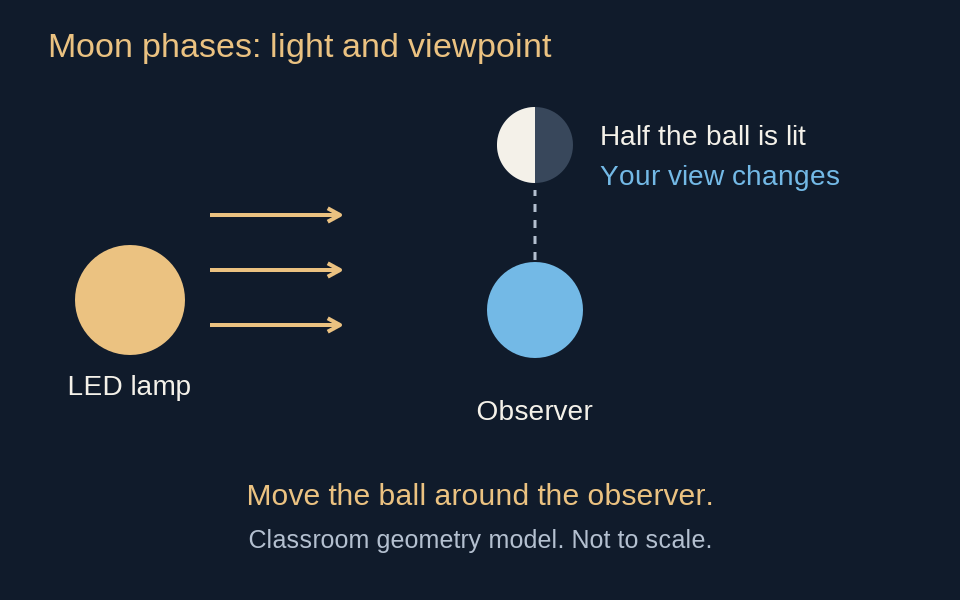
Craters and ridges cast longer shadows near the terminator, the boundary between lunar day and night. A crescent or quarter Moon can show more relief there than the same region shows under the more direct light of full Moon.
A waxing crescent or first-quarter Moon is often visible after sunset. A waning crescent is usually a morning target. Check actual rise and set times for the date you choose.
For faint objects, consider moonlight
Find a time when the sky is fully dark and the Moon is below the horizon. Near new Moon that can be much of the night. On other dates there may be a useful stretch after moonset or before moonrise.
Then check that your target is high enough above buildings or trees. Even a moonless night can be too bright or hazy to see a faint galaxy well.
Try two views on one Honavar evening
On 14 December 2026, the planner puts crescent moonset around 10:30 pm IST in Honavar. Go out early for the crescent if it is clear. For the Geminids, wait until moonset and give your eyes time to adjust before watching a wide patch of sky.
Choose what to look for on a bright night
When the Moon is bright and up for most of the night, try a bright planet or a double star. If you want to see the Moon itself, look for the dark plains and bright rays around craters such as Tycho. Those rays are easier to pick out near full Moon.
PAUSE AND THINK
Why might first quarter be better than full Moon for studying crater shapes?
Explore the answer
Near the terminator, sunlight strikes at a low angle and produces useful shadows. At full Moon, many visible features have much less pronounced shadow relief.