On this page
Five days of moonrise near Honavar
NASA JPL Horizons calculated these times for a point near Honavar at 14.3° N and 74.4° E. The example covers 30 October to 3 November 2026. Times are in Indian Standard Time and assume a clear horizon near sea level.
| Date | Moonrise (IST) |
|---|---|
| 30 Oct | 22:07 |
| 31 Oct | 23:12 |
| 1 Nov | No moonrise |
| 2 Nov | 00:13 |
| 3 Nov | 01:11 |
Why 1 November had no moonrise
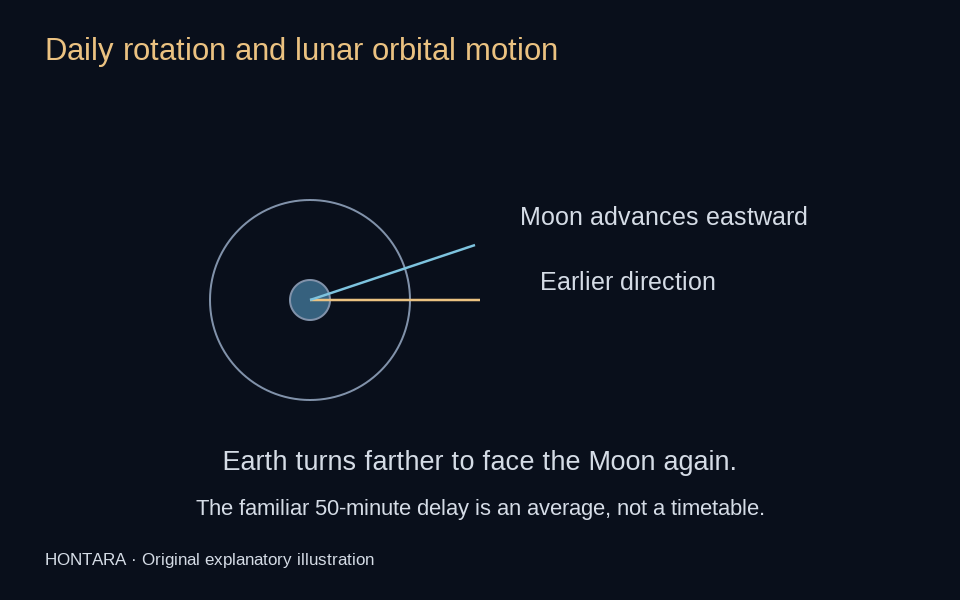
Moonrise shifted 65 minutes later from 30 to 31 October. The next rise was 25 hours and 1 minute after the 31 October rise. Counting from 23:12, that puts it past the following midnight at 00:13 on 2 November.
On 1 November, the Moon was already above the horizon at midnight because it rose the night before. It set around 12:31 pm. On 3 November the rise time was 58 minutes later than on 2 November.
Why the delay changes
Over an evening, Earth’s rotation carries the Moon westward across the sky. Over successive days, the Moon also shifts about 12 to 13 degrees eastward against the stars as it orbits Earth. That shift means Earth has to turn farther to bring it back to your horizon.
The Moon’s orbital speed varies. The angle at which its path crosses the horizon also changes with the date and your latitude. Together they change the time between one moonrise and the next.
What the Moon’s phase tells you
A full Moon rises around sunset because it’s roughly opposite the Sun. A first-quarter Moon usually rises around midday. The phase gives you an approximate time of day. A moonrise timetable uses your location and date to give a local time.
Find moonrise for your location
Choose your town and date in a moonrise timetable. Check that the times are local. If a rise is close to midnight, check the dates on either side. Hills, buildings and trees can make your first view later than the published time.
PAUSE AND THINK
Can the Moon-phase table tell you the exact time the Moon rises over your house?
Explore the answer
No. A phase table gives phase instants. A moonrise prediction also needs an observing location and horizon convention; your buildings or trees can delay your first view further.