On this page
THE BIG IDEAS
- Convert event times to your local time zone.
- Check location, altitude, darkness and obstructions.
- Treat predictions as planning information rather than guarantees.
A date is only the beginning
An astronomical calendar might list a conjunction, meteor shower, full Moon or eclipse. Those labels identify events, but they do not by themselves tell you whether an event can be seen from your garden. Visibility depends on the observer’s location, local time, horizon and daylight.
Begin by checking the calendar’s intended region and time standard. A date given in Universal Time can correspond to a different local date. India Standard Time is UTC plus 5 hours 30 minutes, so an event late in a UTC day can fall on the following date in India.
Read the event description carefully
A conjunction describes an apparent meeting in the sky, not a physical collision. Opposition is a useful geometric arrangement for an outer planet, but observing conditions still matter. A meteor shower’s peak is a predicted period of increased activity rather than a promise of a particular number of meteors at your site.
Some events are instantaneous calculations while others unfold over hours or days. Learn which kind you are planning for. A close pairing might remain interesting on neighbouring evenings, while an eclipse requires a location-specific sequence of times.
Check your own sky
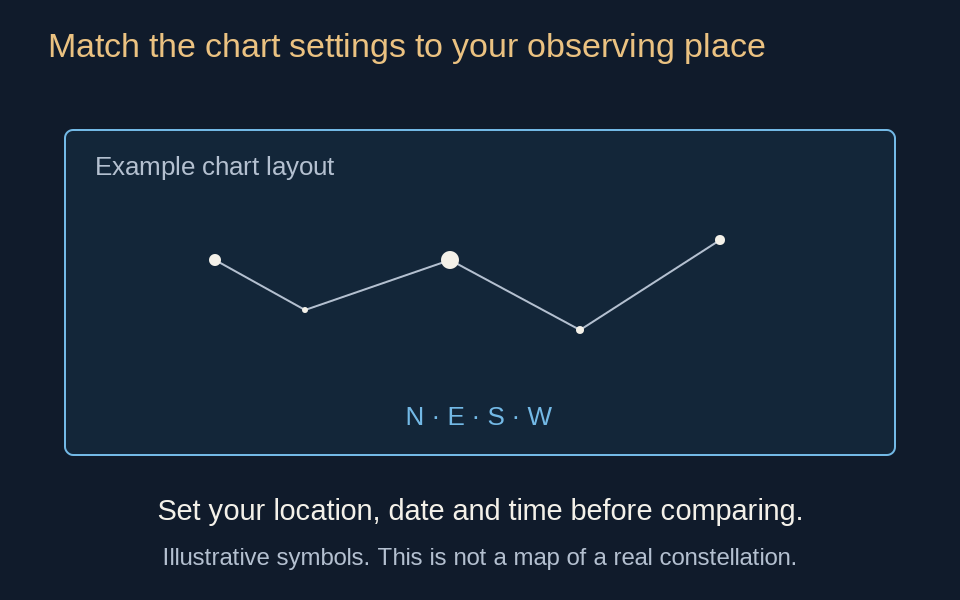
Set a planetarium tool to your location and the intended observing date. Check the local time zone before examining the horizon. Find the target’s altitude and direction at a time when the sky is suitably dark. Trees, buildings and hills may obstruct a target that is technically above the mathematical horizon.
Next consider moonlight and weather. A bright Moon may reduce the visibility of faint objects but is itself an excellent target. Cloud forecasts are uncertain, so identify a backup date or indoor activity for a group session.
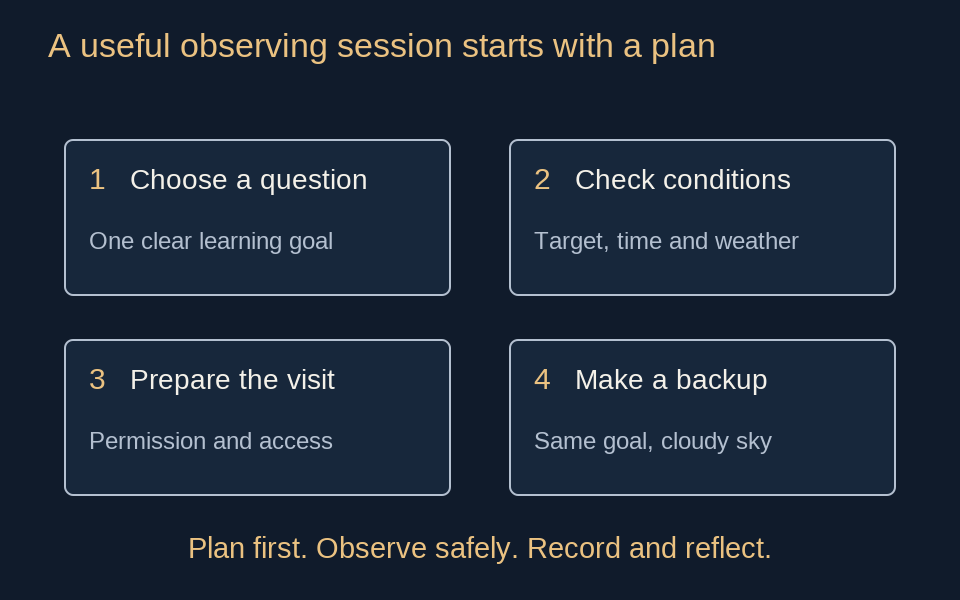
Write an observing plan
Record the source, event date, time zone, location, target and equipment. Add the reason you chose the time and a note about what participants should expect to see. A simple sketch or a few bright stars may be a more realistic goal than a dramatic photograph.
Use the linked current sources to confirm each planned event. This page is a planning guide rather than a live calendar. Never improvise solar observing equipment for an event; use an appropriately supervised specialist session or a trusted live broadcast.
A time-zone conversion with date rollover
If a calendar lists an event at 22:00 UTC on 10 January, add 5 hours 30 minutes to obtain 03:30 IST on 11 January. Both the clock time and the calendar date change. This is an arithmetic example, not a prediction of an event on that date.
A useful planning record would read: source time 10 January, 22:00 UTC; India time 11 January, 03:30 IST; target and exact event to be confirmed from the source; local altitude and horizon to be checked; weather alternative prepared. Do not mark an event visible merely because you have converted its time correctly.
PAUSE AND THINK
An event is listed at 22:00 UTC on 10 January. What date and time is that in India?
Explore the answer
It is 03:30 IST on 11 January. The local calendar date changes when 5 hours 30 minutes are added.