On this page
Why the planets follow a band
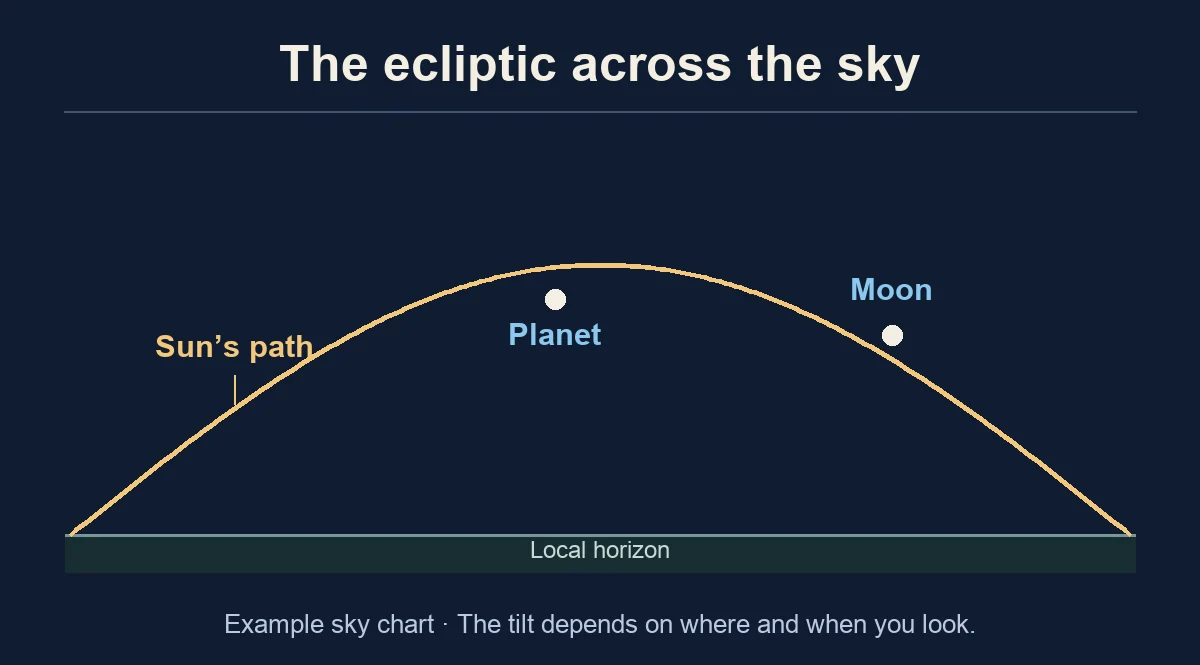
Imagine extending the plane of Earth’s orbit out in every direction until it meets a sphere around us. Its intersection is a great circle. The Sun appears on this circle as Earth goes around it. From our seat inside the solar system, the other planets look like they travel through roughly the same band.
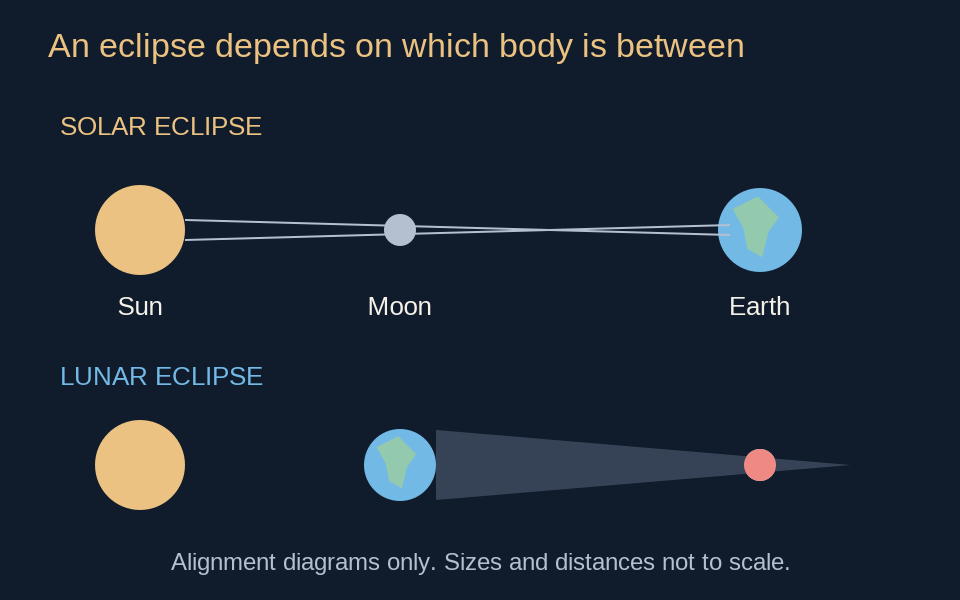
Their orbital planes have small tilts relative to Earth’s, so a planet can sit above or below the line on a chart. The Moon’s orbit is tilted by about 5° to the ecliptic. It crosses the plane twice during an orbit at points called nodes. An eclipse needs the right Moon phase near a node.
How to tell it apart from nearby reference lines
The celestial equator extends Earth’s equator into space. It meets the ecliptic at an angle of about 23.4°. The two crossing points identify the Sun’s positions at the equinoxes. The zodiac is the band of constellations along the Sun’s path. The ecliptic itself is the line through that band.
The Milky Way is a different band. Its glow traces the crowded disc of our galaxy. The ecliptic traces a plane inside our solar system. You may see both on a star chart even when the Milky Way is too faint to see outdoors.
Trace it on a chart after dark
Set a sky chart to your location and time. Turn on the chart’s ecliptic line and match one bright planet to the real sky. Estimate where the line would continue from that planet and look for the Moon or another plotted planet. A single photo or chart may make the line appear more curved because it shows a broad piece of the sky on a flat surface.
Return several days later at a similar time. The stars along the band will be familiar, while the Moon will appear among a different group of them. That movement makes the band easier to recognise.