On this page
Three bodies must line up
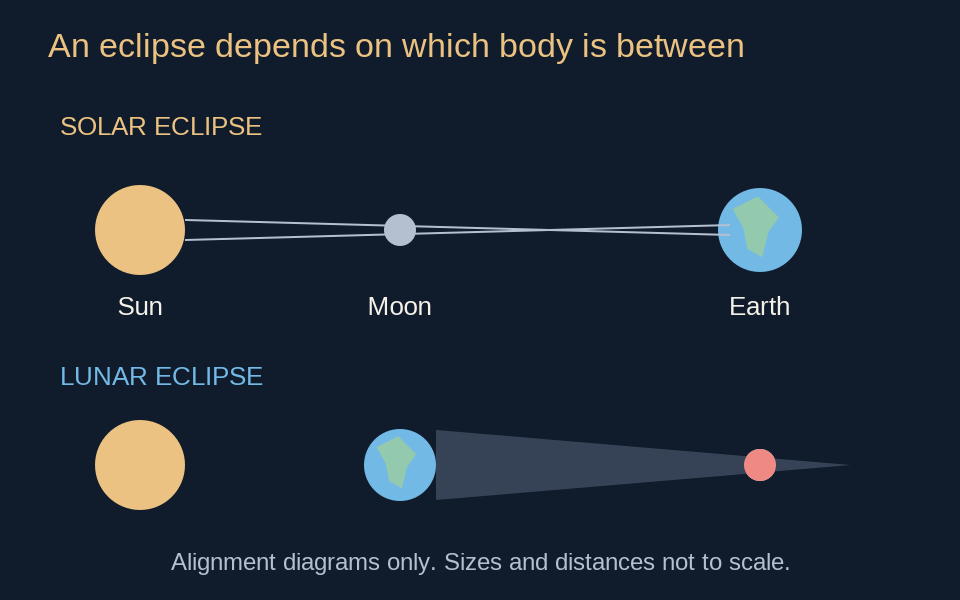
Eclipses occur when the Sun, Earth and Moon align closely enough for one body to block light reaching another. In a solar eclipse, the Moon passes between Earth and the Sun. In a lunar eclipse, Earth lies between the Sun and Moon and its shadow falls on the Moon. These arrangements explain why solar eclipses occur near new moon and lunar eclipses near full moon.
THE BIG IDEAS
- Solar and lunar eclipses have different alignments.
- The Moon’s tilted orbit prevents monthly eclipses.
- Solar eclipse viewing needs purpose-made protection.
Why eclipses do not happen every month
The Moon’s orbital plane is tilted relative to Earth’s orbital plane around the Sun. Most months, the Moon passes above or below the alignment needed for an eclipse. An eclipse becomes possible when the phase and the Moon’s position near a crossing of these planes coincide. A flat classroom diagram can hide this tilt, so a three-dimensional model is more helpful than a picture showing every orbit on one sheet.
Different regions of shadow
A shadow has a darker central region called the umbra and a lighter outer region called the penumbra. Observers in different places can therefore experience different parts of a solar eclipse. The apparent sizes of the Sun and Moon also matter: if the Moon appears too small to cover the Sun completely, an annular eclipse leaves a bright ring. A lunar eclipse can likewise be penumbral, partial or total depending on the Moon’s path.
The red Moon and the darkened Sun
During a total lunar eclipse, some sunlight is bent through Earth’s atmosphere into the shadow. The atmosphere removes much of the shorter-wavelength light, which can leave the Moon looking coppery or red. Its exact appearance varies. During a total solar eclipse, the faint outer solar atmosphere can become visible from the narrow path of totality. A partial eclipse outside that path is a different viewing situation.
Safety comes before spectacle
A lunar eclipse is safe to watch with unaided eyes. Solar observing requires special precautions: ordinary sunglasses are not suitable. Use verified solar viewers that meet ISO 12312-2 for direct viewing, following their instructions. Never look through binoculars or a telescope while wearing eclipse glasses; concentrated sunlight can destroy them. Optical equipment requires a properly fitted front-mounted solar filter and expert supervision. Beginners can follow an organised event rather than improvising equipment.
PAUSE AND THINK
Why can one region see a total solar eclipse while another sees only a partial eclipse?
Explore the answer
They lie in different parts of the Moon’s shadow. Totality is restricted to the path where the Sun is fully covered.