On this page
THE BIG IDEAS
- Local visibility must be checked for the specific eclipse.
- Lunar and solar eclipses have different viewing requirements.
- Solar viewing through optical instruments requires specialist filtering.
First identify the kind of eclipse
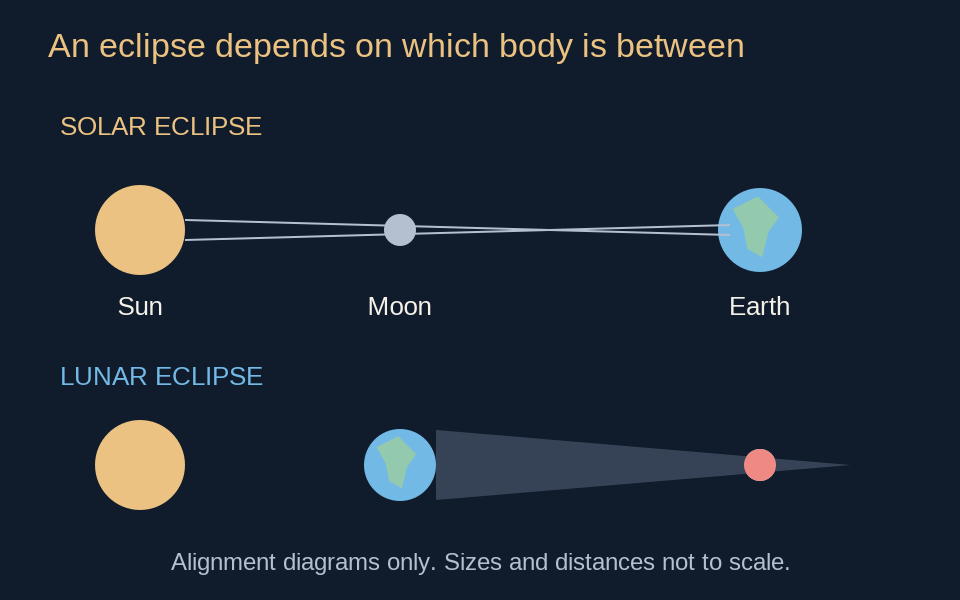
During a lunar eclipse, Earth’s shadow falls on the Moon. During a solar eclipse, the Moon blocks part or all of the Sun from a particular location. The viewing arrangements are very different. A lunar eclipse can be viewed directly with unaided eyes; solar viewing requires appropriate protection.
A global eclipse date does not mean the event is visible everywhere. Check an authoritative map and location-specific circumstances. The event may be below your horizon or only partly visible from your site.
Put local times in a clear plan
Find the start, maximum and end times that apply to your location. Check the time standard and convert to local civil time where needed. Also examine the Sun’s or Moon’s altitude and nearby obstructions. A theoretically visible event can be hidden by a building or a low horizon.
For a group, include arrival time, supervision, access and a weather alternative. A trusted live broadcast can still support an educational session when the event is not locally visible or cloud blocks the view.
Plan solar viewing with specialist care
Never look at the Sun through ordinary sunglasses or an unfiltered telescope, camera or binoculars. Handheld eclipse viewers are not filters for optical instruments. Concentrated sunlight can damage them and cause serious eye injury. Instrument filters belong at the front and must be appropriate for the equipment.
For beginners and school groups, arrange solar observing with knowledgeable organisers. For direct viewing without magnifying optics, use special-purpose viewers that meet ISO 12312-2 and follow the American Astronomical Society’s guidance on choosing and inspecting them. Eclipse glasses do not make an unfiltered telescope, binoculars or camera safe. Optical equipment needs an appropriate securely fitted front filter and expert advice. Keep protection in place throughout partial and annular phases.
Choose a scientific question
An observation is more meaningful when learners know what to record. A lunar-eclipse group can sketch the changing shadow boundary and compare its appearance over time. A supervised solar-eclipse programme can use safe projected or broadcast images to compare the changing outline.
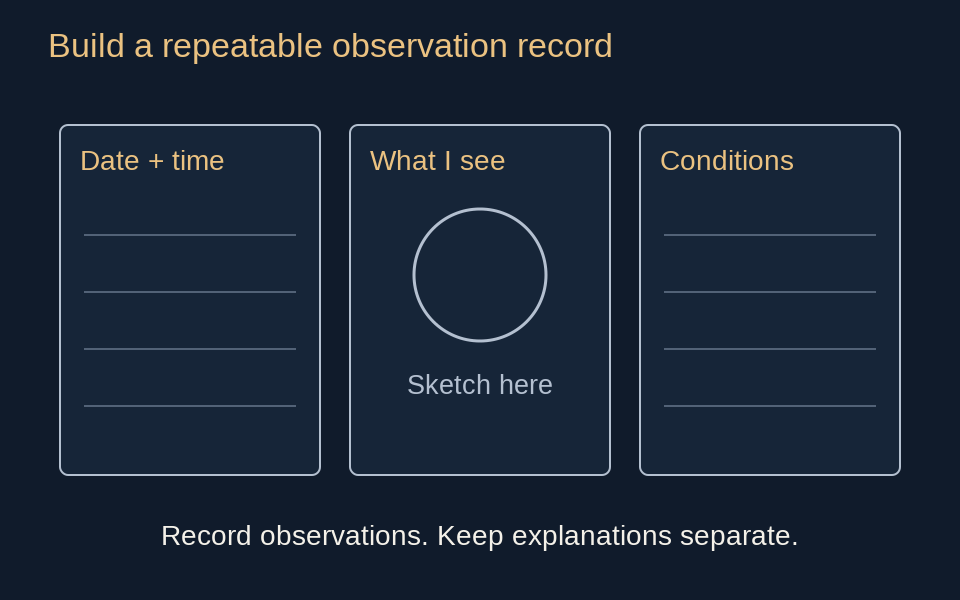
Record time, observing method and conditions with every sketch. Explain that cloud and exposure settings can change appearance. No eclipse date or local schedule is supplied here because those details must be verified for the specific event. Keep scientific curiosity and safe arrangements together from the start of planning.
Fill in the local circumstances
Use the American Astronomical Society’s linked maps-and-calculators collection to find circumstances for the specific eclipse and observing place. Record the source, eclipse type, your location, time standard, first contact, maximum, last contact and the Sun’s or Moon’s altitude. Leave unknown fields blank until verified.
For a school group, add the organiser responsible for the viewing setup, the equipment and filter checks, participant supervision and a weather alternative. Agree on these arrangements before selecting a viewing activity. Safe equipment and knowledgeable supervision are essential for solar observing.
PAUSE AND THINK
Can eclipse glasses make it safe to look through an unfiltered telescope at the Sun?
Explore the answer
No. Eclipse glasses are not designed to protect you from sunlight concentrated by a telescope or binoculars. Use a properly equipped and supervised solar-observing setup.