On this page
Find a time when the planets overlap
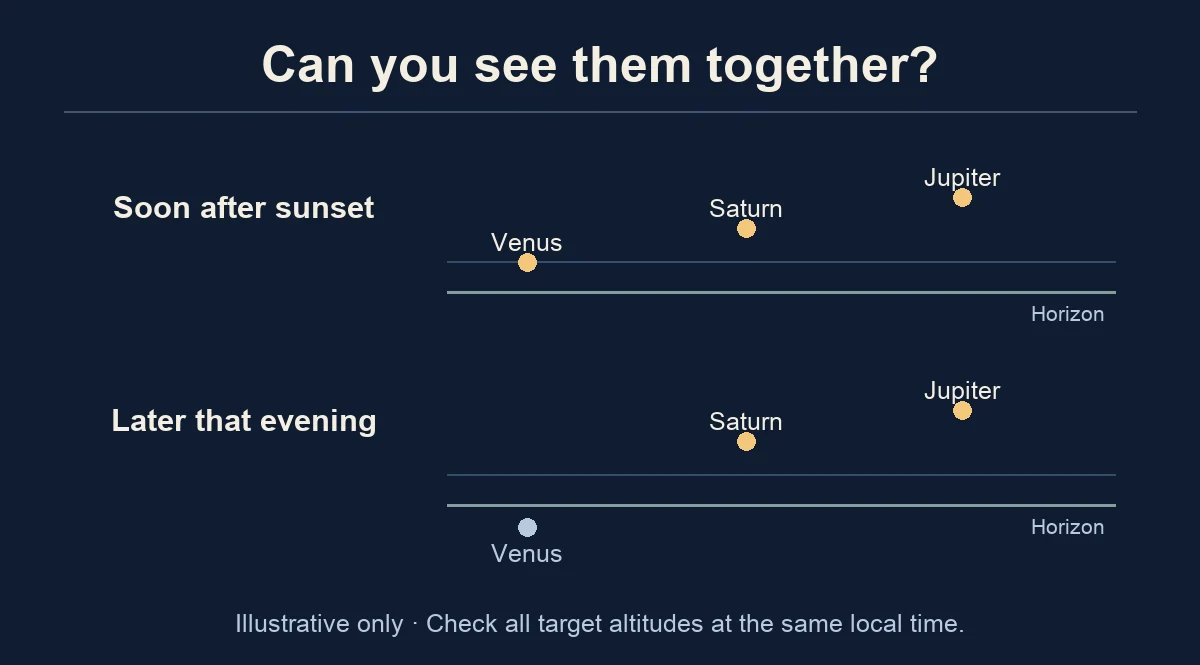
Start with the date in the announcement and open a full sky chart set to your town. Compare the planets at the same local clock time. For an evening lineup, step forward from sunset until the first planet gets too low. For a morning lineup, work back from sunrise. The useful window may be much shorter than the visibility of any one planet.
About 10° of altitude is a reasonable starting point for a bright target over an open horizon. Buildings, hills, haze and clouds can make you need a higher target. From coastal Karnataka, check the forecast for the actual viewing direction. One clear patch of sky can reveal Jupiter while low cloud hides Venus.
Choose what to try with your eyes
Venus and Jupiter are usually easy starting points when they are above the horizon in twilight. Mars and Saturn can take more careful matching with a chart. Mercury often has the shortest viewing window because it stays near the Sun in the sky.
A headline may count planets too faint to pick out in twilight. Uranus needs a precise star chart and favourable conditions. Neptune is a telescope target and needs a darker sky. It can be worthwhile to see the bright lineup first and try a fainter target at another time.
Check the Sun’s position before the session. Wait until sunset to use binoculars or a telescope and stop before sunrise in the morning. Skip any target plotted close to the Sun.
Use the horizon to identify each point
Face the direction marked for the lowest planet. Look for the brighter one first and work along the chart from it. Use rooftops, trees or a clear horizon as reference points. Planets can be spread over a large part of the sky, so move your eyes across it before trying to take a picture of the whole group.
Write the names you identified next to their chart positions. Check again a few evenings later. The lowest planet may be easier to see or may have moved into twilight while the others remain visible.