On this page
THE BIG IDEAS
- A telescope reveals the rings as a small delicate structure.
- Ring tilt changes with viewing geometry.
- Stable air matters more than excessive magnification.
Know what makes the view special
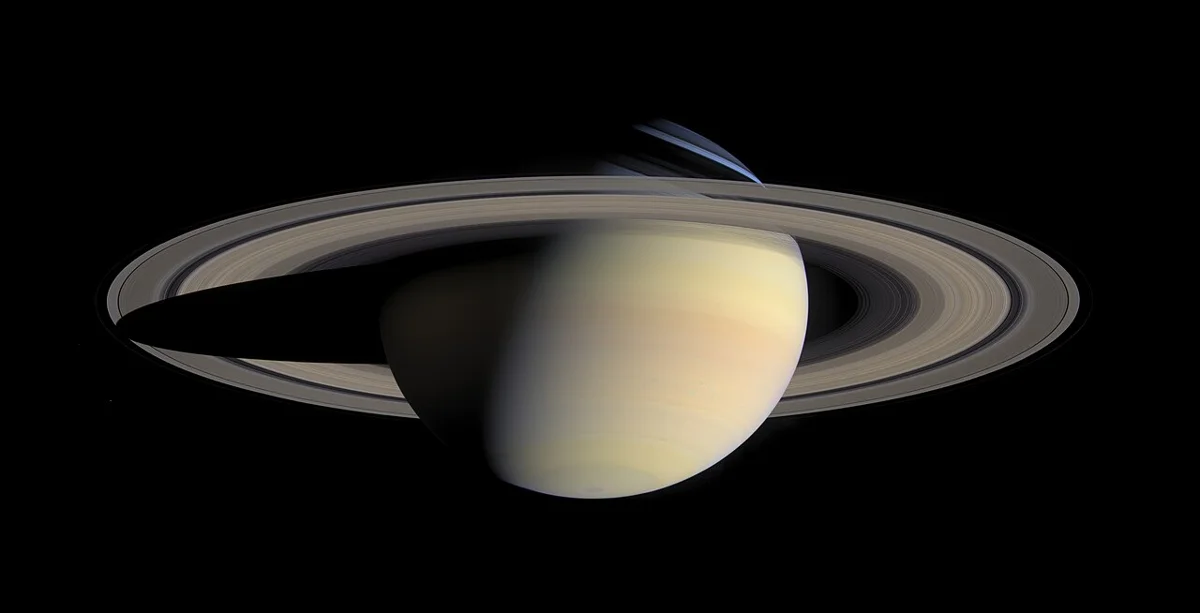
Saturn is visible to the unaided eye when its position and the sky allow, but its rings need optical magnification to become distinct. A modest telescope can show a tiny planet with extensions or a separated ring outline. The experience is more delicate than a large photograph suggests.
The rings contain countless orbiting particles, mostly water ice with other material mixed in. They form a thin system around the planet. In an eyepiece, reflected sunlight combines into the familiar ring shape rather than revealing individual particles.
Use a current position
Check a planetarium for Saturn at your location, date and intended observing time. Do not reuse a map from a different year. Saturn moves slowly compared with the Moon but its useful evening season changes. Choose a safe site with a clear view in the direction shown.
Wait until the planet has climbed away from the horizon if possible. A low Saturn can look stretched, coloured or unsteady because the atmosphere is interfering with the light. That does not mean your telescope is defective.
Find focus before adding power
Locate Saturn using a low-power eyepiece. Centre it and adjust the focus gently until its edge is as clean as conditions allow. Then try more magnification in small steps. If the image becomes larger without gaining detail, return to the previous eyepiece.
Sit comfortably and watch for a minute rather than taking a hurried peek. Atmospheric steadiness fluctuates. A brief clear interval can reveal the separation between the planet and the rings more convincingly than the average view.
Expect the ring angle to change
The tilt of Saturn’s rings as seen from Earth changes during its orbit. Some years they look broadly open; at other times the view is much closer to edge-on. Compare observations with illustrations for the correct date rather than a generic image.
The dark Cassini Division and subtle cloud markings are more demanding than merely recognising the rings. They depend on aperture, ring orientation and observing conditions. Do not treat them as required targets for a successful first session.
Try a shape study
Draw the planet and the outer ring outline without shading. Estimate the ring width relative to the planet’s diameter using your sketch, not a ruler held to the eyepiece. Write whether each edge seemed crisp or soft. Add the time, magnification and approximate sky conditions. Returning in a later season can reveal a changed ring presentation while preserving the memory of your first view.
PAUSE AND THINK
Why might Saturn’s rings look much narrower than in an older photograph?
Explore the answer
Earth can see the thin ring plane at a different tilt; a nearly edge-on view makes the rings appear narrower.