On this page
Start with a difference in gravity
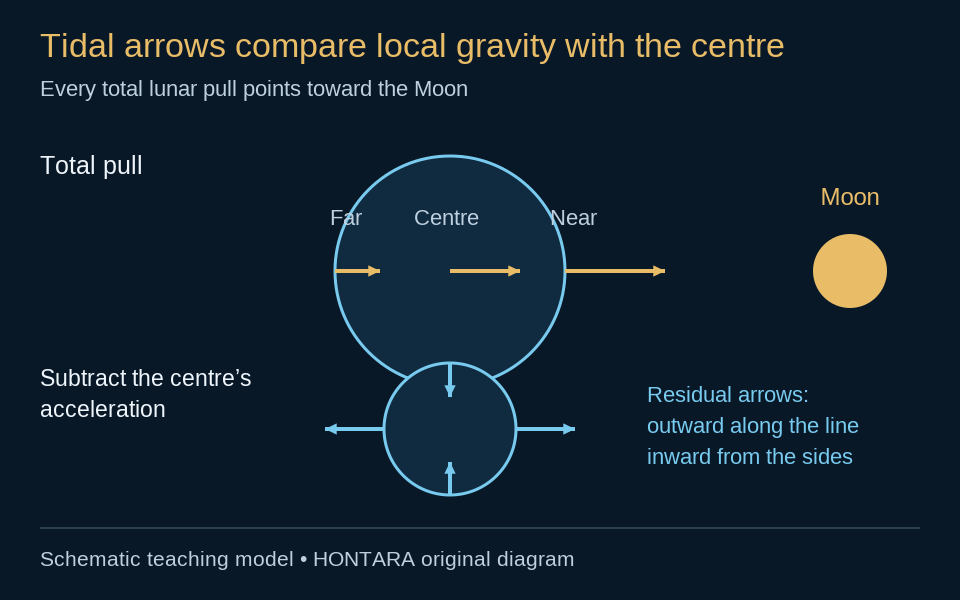
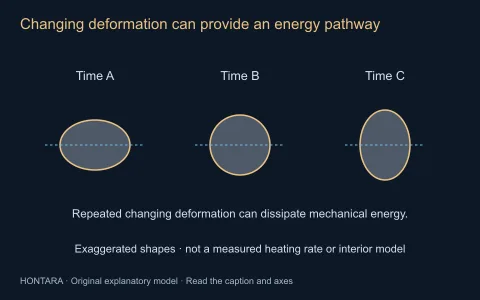
A planet pulls more strongly on the near side of an extended moon than on its far side. That tidal difference competes with the moon’s self-gravity and material strength. The balance is a different question from whether the moon’s centre follows a stable orbit.
A Roche limit describes a disruption threshold under specified assumptions. It is not a surface where a planet’s gravitational field stops or a universal wall that every grain crosses with the same outcome. The orbiting body’s properties matter.
THE BIG IDEAS
- Tidal differences compete with self-gravity and material strength.
- A Roche distance needs body-model and centre-distance assumptions.
- A present dynamical constraint does not uniquely establish ring origin.
Name the body model before using a number
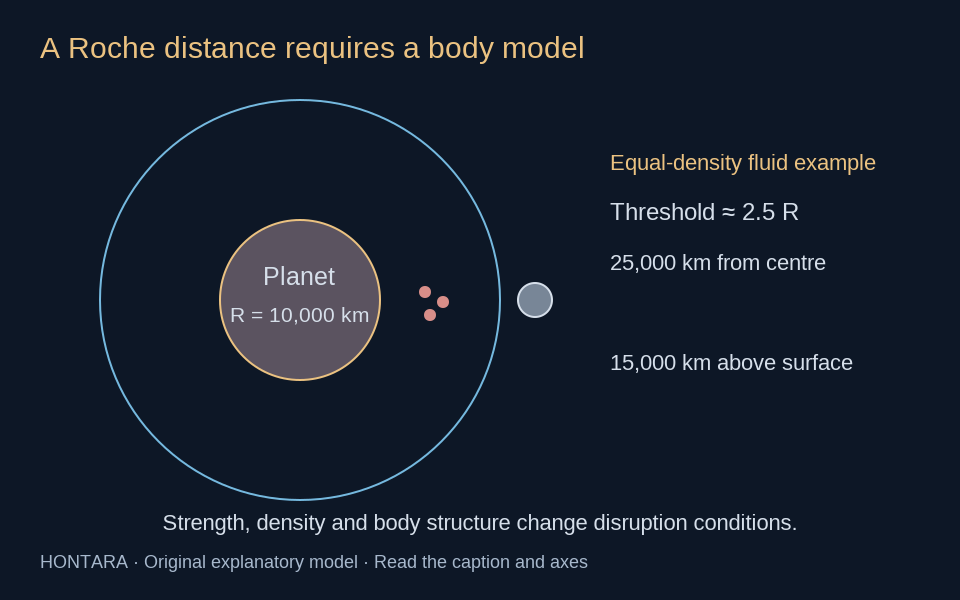
A fluid body held together mainly by self-gravity responds differently from a small strong rock. Density ratio, shape, rotation and material strength affect disruption. A rigid fragment can survive where an ideal strengthless fluid satellite of a different size could not.
NASA’s introductory equal-density example places a fluid-like threshold around 2.5 planetary radii from the centre. For a fictional planet of radius 10,000 km that scale is about 25,000 km centre distance, or 15,000 km above its surface. Those two distances must not be interchanged.
Connect disruption with ring material
Debris near a planet can remain as many orbiting particles rather than easily assembling into one large moon under strong tidal conditions. The particles themselves still orbit; they are not a solid painted disk or a rigid wheel rotating at one angular speed.
Inner and outer particles have different characteristic orbital periods. Collisions, gravity and interactions with moons create structure within the ring system. A simple Roche argument explains an important constraint but not every gap, wave, narrow ring or diffuse outer component.
Keep origin evidence separate from a present constraint
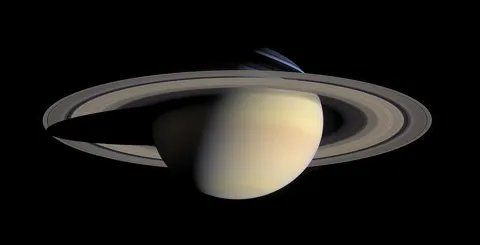
Saturn’s ring origin involves competing and developing physical scenarios, including the evolution or disruption of icy bodies and collision debris. Simulations can test whether a proposed event supplies the right material and orbital distribution. A simulation producing plausible rings does not make its history uniquely proven.
The Roche environment constrains where some debris can assemble or remain dispersed. It does not directly date the ring particles or tell us whether one particular progenitor was destroyed in the proposed manner. Composition, dynamics and observational constraints must be considered together.
Use the idea without overextending it
Draw the planet’s surface and a separate example threshold, label centre distances and state the fluid/equal-density assumptions. Then place a small strong fragment and explain why the illustrative boundary is not automatically its destruction location.
Finish by distinguishing two questions: what physical effects influence the survival of an extended body and what evidence reconstructs an actual ring system’s origin? That distinction prevents an informative tidal model from becoming an unsupported complete story of Saturn’s past.
A useful uncertainty check changes the body model while leaving the planetary radius fixed. Ask what tensile strength or internal structure would be needed to apply the same numerical threshold to a solid fragment. If those properties are missing, preserve the missing information instead of treating the example line as a measured universal boundary.
PAUSE AND THINK
Is an equal-density fluid Roche estimate a universal destruction altitude for every small rock?
Explore the answer
No. It assumes a particular kind of extended strengthless body and is measured from the planet’s centre. Material strength and other properties change the problem.