On this page
Begin with differential gravity
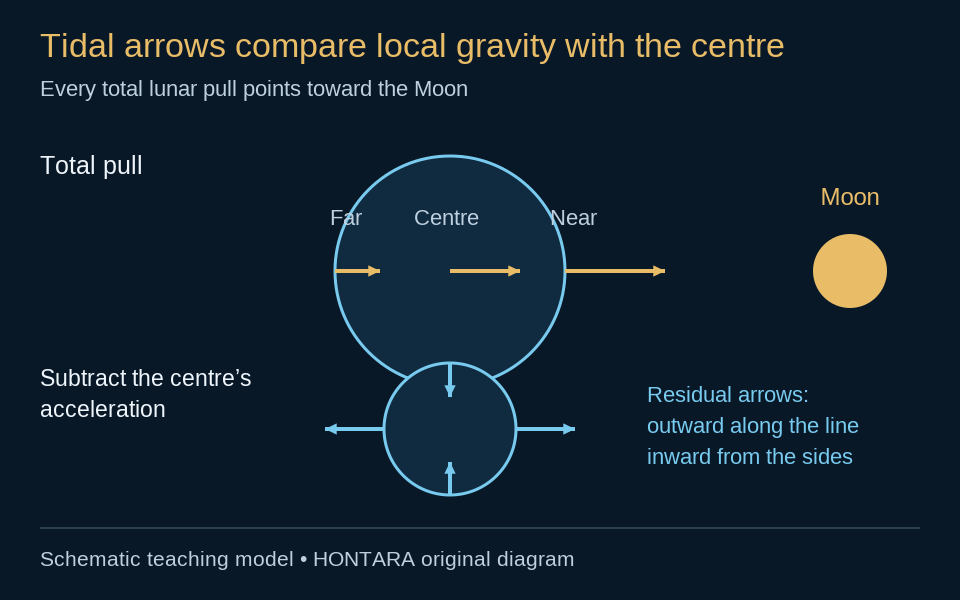
A large planet pulls differently across an extended moon. This creates a tendency to stretch the body along one direction and compress it along others. The resulting deformation depends on the moon’s internal structure, rigidity and gravitational response.
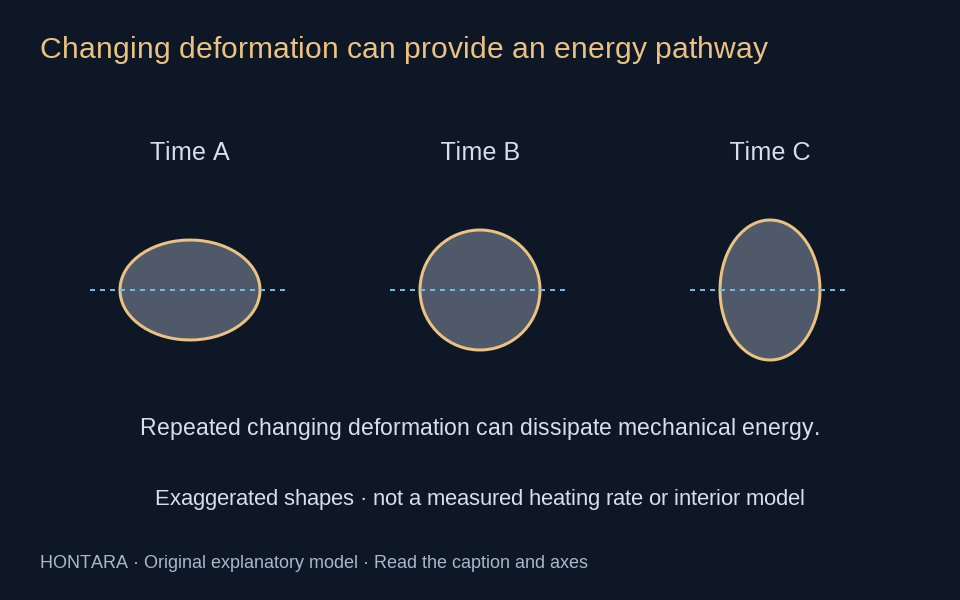
A deformation that simply remains fixed is not the complete explanation of ongoing heating. To dissipate mechanical energy repeatedly, the tidal forcing and the material’s response must vary over time. That time dependence is central to the thermal process.
THE BIG IDEAS
- Changing tidal deformation can dissipate mechanical energy as heat.
- Synchronous rotation does not guarantee constant tidal stress.
- Neighbouring moons can influence the sustained orbital forcing.
See why orbital shape matters
An eccentric orbit changes the moon–planet separation through the cycle, altering tidal forcing. Even a synchronously rotating moon can then experience changing deformation. Synchronous rotation means the rotation and orbital periods match, not that every stress remains constant.
In an illustrative comparison, two otherwise similar moons may have very different tidal heating if one has a changing tidal environment and the other approaches a more circular, steady configuration. A statement that all close moons are heated equally leaves out essential dynamics and material properties.
Connect resonance with continued forcing
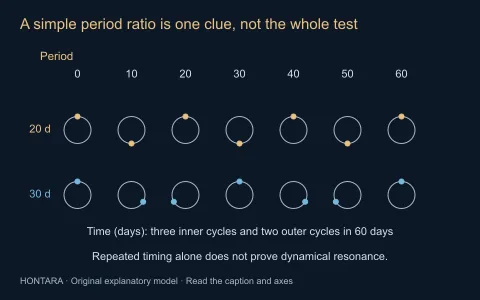
Interactions with neighbouring moons can maintain an eccentricity that tidal dissipation would otherwise tend to reduce. Io, Europa and Ganymede form a linked orbital system used to understand how repeated gravitational timing can sustain an active tidal environment.
The energy ultimately comes from orbital and rotational reservoirs and their evolution. It is not created by squeezing alone. A complete model tracks transfers between the bodies and dissipation within them rather than treating heating as an unlimited independent power source.
Compare different visible outcomes
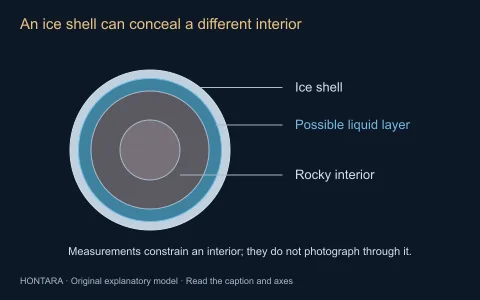
Io’s intense volcanism offers striking evidence for internal activity in a strongly tidally influenced setting. Europa’s icy exterior and inferred ocean illustrate a different outcome with different material properties and heat transport. A shared mechanism does not require identical surfaces.
The amount and location of heat depend on structure and how materials respond at the forcing frequency. Do not infer an exact ocean thickness or volcanic output from orbital eccentricity alone. Such quantities require models constrained by observations and explicit assumptions.
Use a model with an honest limitation
Draw a moon at two positions on an eccentric orbit and exaggerate its changing shape. Label the exaggeration and distinguish the deformation from the moon’s centre-of-mass path. A sketch is useful for following the mechanism but does not calculate strain, viscosity or power.
For an explanation, identify the varying forcing, the dissipative material response and the energy reservoir. Then name an observation that could constrain the result, such as heat emission or geological activity. This is more informative than saying a planet’s gravity heats every nearby moon automatically.
An observed heat output provides a quantitative test of an energy model, not just a dramatic illustration. A model predicting far too little available dissipated power needs revision even if its sketch shows stretching. The comparison must use consistent timescales and account for possible stored heat or other internal energy sources.
PAUSE AND THINK
Would a drawing of a permanent stretched bulge alone explain continuing tidal heat production?
Explore the answer
No. Continuing dissipation requires a time-dependent response and an energy transfer. The orbital and material behaviour must be specified.