On this page
Separate present position from formation position
A planet’s present orbit need not be its original formation orbit. Interactions with a protoplanetary disk, other planets or tidal effects can change orbital size and shape over time. Migration refers to such orbital evolution rather than a planet propelling itself like a spacecraft.
The possible processes operate in different environments and at different stages. A close-in giant planet raises questions about formation and subsequent evolution, but its current orbit alone does not uniquely reveal the route it followed.
THE BIG IDEAS
- Present-day orbital size does not uniquely fix formation location.
- Migration involves exchanges of energy and angular momentum.
- A near-simple period ratio alone does not prove dynamical resonance.
Track an exchange, not disappearing momentum
A disk exerts gravitational torques on an embedded planet and receives an opposing exchange of angular momentum. The planet’s semimajor axis can change as a result. Interactions between planets can redistribute energy and angular momentum within a larger system.
Migration can be inward or outward depending on the conditions and mechanism. Do not draw every possible planet sliding monotonically toward its star. A model must state what exchanges momentum, which forces are included and whether the disk or another body is being treated dynamically.
Read the simplest period ratio
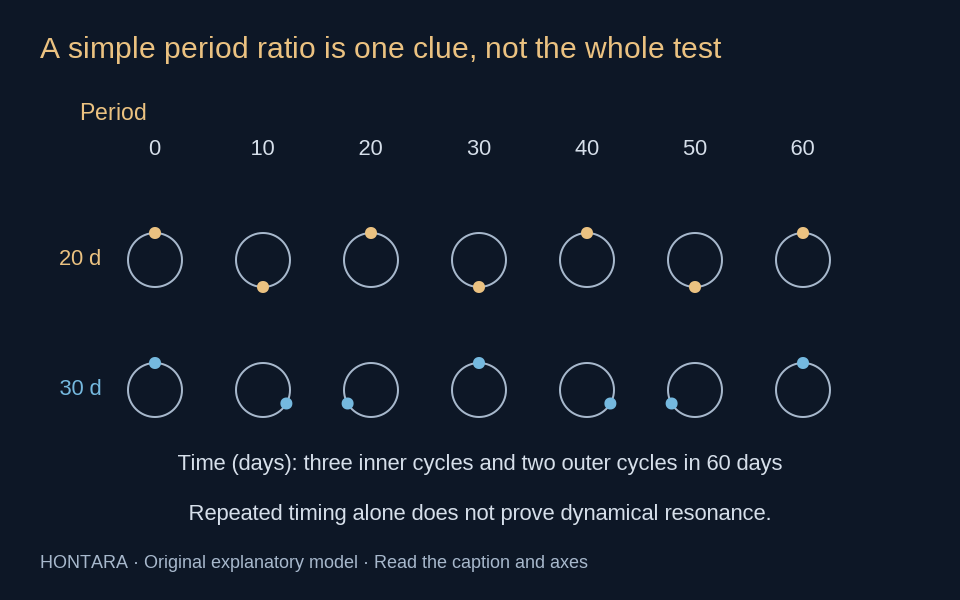
In a 3:2 period ratio, the outer body completes two orbits while the inner completes three over the same interval. If the illustrative periods are 20 and 30 days, both return to their respective full-cycle counts after 60 days. The relevant repeated geometry can strengthen particular gravitational interactions.
A mean-motion resonance involves the behaviour of orbital angles as well as a period ratio near a simple fraction. A numerical ratio close to 1.5 alone is not sufficient evidence that a pair is dynamically resonant.
Use resonant chains as evidence with limits
Kepler-223 and HD 110067 provide observed examples used to investigate resonant planetary architectures. Migration models can produce some chains and help test whether a system may have avoided major later disruption. The observed pattern constrains histories rather than preserving a literal movie of formation.
Different initial conditions or dissipative processes can sometimes lead to similar present arrangements. A convincing formation argument compares model predictions with masses, orbital parameters and the stability of the whole system, including uncertainties in the observations.
Keep a useful model comparison
Build an illustrative table of periods, count inner and outer cycles over a common interval and distinguish that arithmetic from demonstrating resonance. Then ask what additional timing or dynamical evidence would test the repeating-angle behaviour.
Planetary migration is an explanation to evaluate through evidence, not a universal story imposed on every close orbit. A useful conclusion identifies the mechanism a model includes and the present-day properties it successfully explains while preserving the alternatives that the data do not yet separate.
For the 20/30-day pair, Kepler’s period scaling at a shared dominant stellar mass gives an illustrative semimajor-axis ratio of 1.5^(2/3), about 1.31. The orbital-distance ratio is therefore not itself 1.5. This numerical check connects a repeated timing pattern with the geometry a dynamical model must explain.
PAUSE AND THINK
For 20-day and 30-day illustrative periods, how many orbits does each complete in 60 days?
Explore the answer
The inner 20-day body completes three and the outer 30-day body completes two. This arithmetic is consistent with a 3:2 period ratio but does not alone prove resonance.