On this page
THE BIG IDEAS
- Name the order of a period or circuit-count ratio.
- Use angular records to distinguish opposition from a full reset.
- An imposed model does not demonstrate gravitational stability.
Define a narrow learning objective
Learners should track two assigned angular rates and explain when the complete configuration repeats. They should also distinguish that kinematic result from a demonstration of gravitational resonant locking or stability. A simple ratio is a useful starting clue rather than the whole physical mechanism.
Prepare two labelled counters and concentric circular tracks of radii 3.00 and approximately 4.76 cm. Their circular Kepler-consistent size ratio is illustrative; the actual motion is controlled by the tick instructions. No gravitational force is generated by the paper tracks.
Run a 45-minute sequence
Use five minutes for the ratio convention, ten to prepare tracks and directions, ten to advance through eight ticks, ten for comparison of ticks 4 and 8 and ten for an exit explanation. Require counterclockwise motion for both bodies so different groups are using the same model.
Allow a partner to move counters while another reads angles or counts circuits. Make labels, angle marks and spoken positions available without relying on colour. Keep completed-circuit counts separate from angles reduced modulo 360°, since a displayed 0° does not reveal how many full turns occurred.
Use the timing answer guide
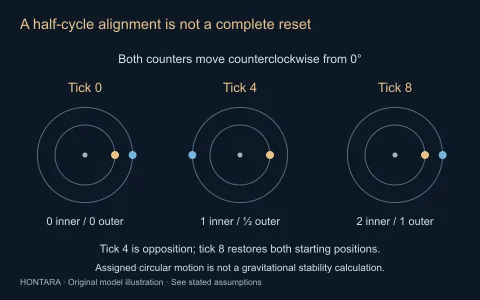
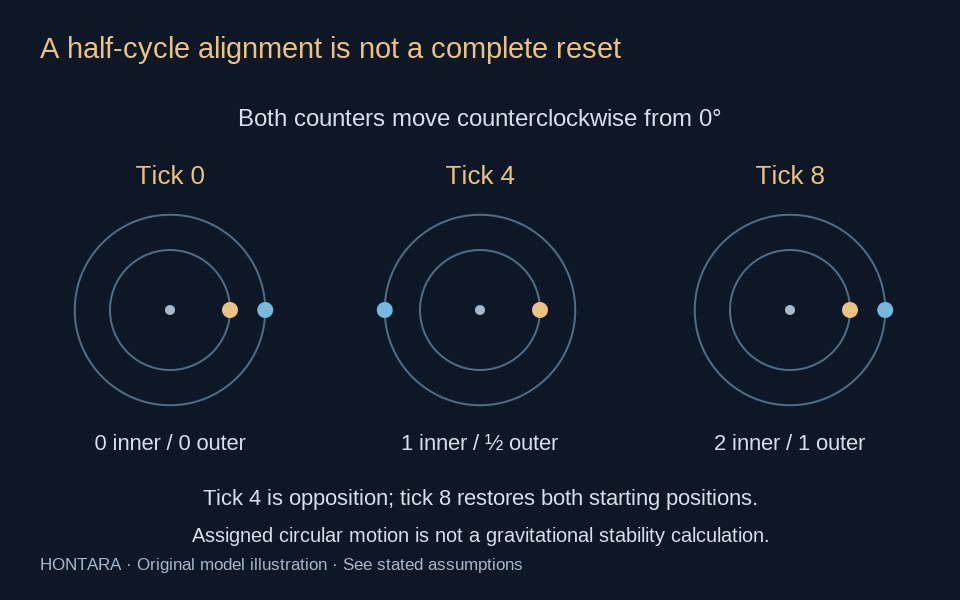
The inner body advances 90° per tick and has period four ticks. The outer advances 45° and has period eight. At tick 2 their angles are 180° and 90°; at tick 4 they are 0° and 180°; at tick 8 both are 0°.
By tick 8 the circuit counts are two inner and one outer. Thus the outer-to-inner period ratio is two while the inner-to-outer circuit-count ratio is two over the shared interval. Ask learners to name the order rather than writing an unexplained 2:1 beside either quantity.
Address the straight-line shortcut
A common error is to declare a full reset at tick 4 because the bodies lie on a line through the centre. They are on opposite sides, so the same-direction configuration has not repeated. The angular record supplies the relevant evidence.
Another error is to infer that the pair must be dynamically stable because the counters never collide. Their paths and rates were imposed, with no mutual gravitational feedback. Collision avoidance in this drawing is therefore not a calculation of stability in an interacting moon or planetary system.
Assess a changed timing model
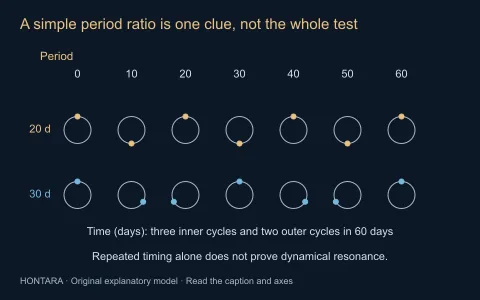
For an exit task prescribe periods of four and six ticks, still starting in the same direction. Ask when both counters complete an integer number of circuits. Expect twelve ticks, with three inner circuits and two outer circuits. Keep that result separate from any real-system claim.
For extension return to an official account of Enceladus/Dione or the Galilean moons and ask what evidence concerns interactions rather than only timing. Resonant angles, gravitational evolution and tidal processes need additional models. The classroom exercise prepares learners to read those questions without pretending to solve them with counters alone.
PAUSE AND THINK
Why do four- and six-tick periods share a complete reset after twelve ticks?
Explore the answer
Twelve is a common multiple of both periods: the bodies complete three and two circuits respectively. This is a timing statement about the prescribed model.
RECORD YOUR OWN EVIDENCE
Your activity sheet
You need: Paper, compass or prepared circles, two labelled counters, ruler and pencil.
Verify the eight-tick table, distinguish the tick-4 opposition from the tick-8 reset and solve the four/six-tick extension.
Name or group: Date:
| Tick | Inner angle | Outer angle | Same direction? |
|---|---|---|---|
| 0 | 0 | 0 | |
| 1 | 90 | 45 | |
| 2 | 180 | 90 | |
| 3 | 270 | 135 | |
| 4 | 0 | 180 | |
| 5 | 90 | 225 | |
| 6 | 180 | 270 | |
| 7 | 270 | 315 | |
| 8 | 0 | 0 |
State both period order and circuit-count order in words.
Explain why no collision in the drawing is not a stability proof.
Calculate the complete reset for periods four and six ticks.
Ideal circular timing model. Near-commensurate periods are an ingredient of resonant dynamics, not a complete proof of resonant locking or stability.