On this page
THE BIG IDEAS
- Define whether a ratio compares periods or completed circuits.
- Opposite-side alignment is not a return to the starting configuration.
- Assigned commensurate timing is not a full stability calculation.
State what two-to-one refers to
This model represents an inner body completing two circuits while an outer body completes one. Their periods are four and eight ticks respectively. Both move counterclockwise from the same initial direction. Write that convention before using the phrase two-to-one, because a period ratio and a count-of-circuits ratio run in opposite orders.
The task models a commensurate timing pattern, one ingredient of orbital resonance. It does not calculate the gravitational interaction that maintains or changes a real resonance. Real systems require additional dynamical evidence beyond noticing that two quoted periods are close to a simple ratio.
Build two circles and a position table
Draw concentric tracks with radii 3.00 and approximately 4.76 cm, or use a prepared outline. Those illustrative radii are consistent with the circular two-body period ratio through Kepler’s law. The counters do not attract one another and their motion is assigned rather than generated by a force.
Mark cardinal directions and 45° divisions. Place labelled inner and outer counters at 0°. For each tick move the inner one 90° and the outer one 45° counterclockwise. Record the resulting angles modulo 360°, keeping a count of completed circuits separately.
Check the half-cycle carefully
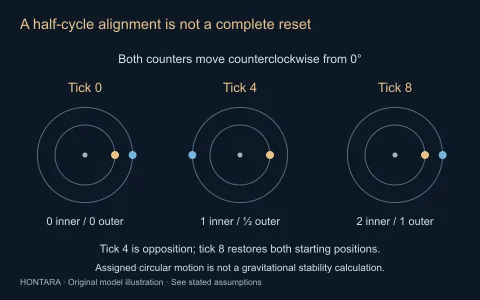
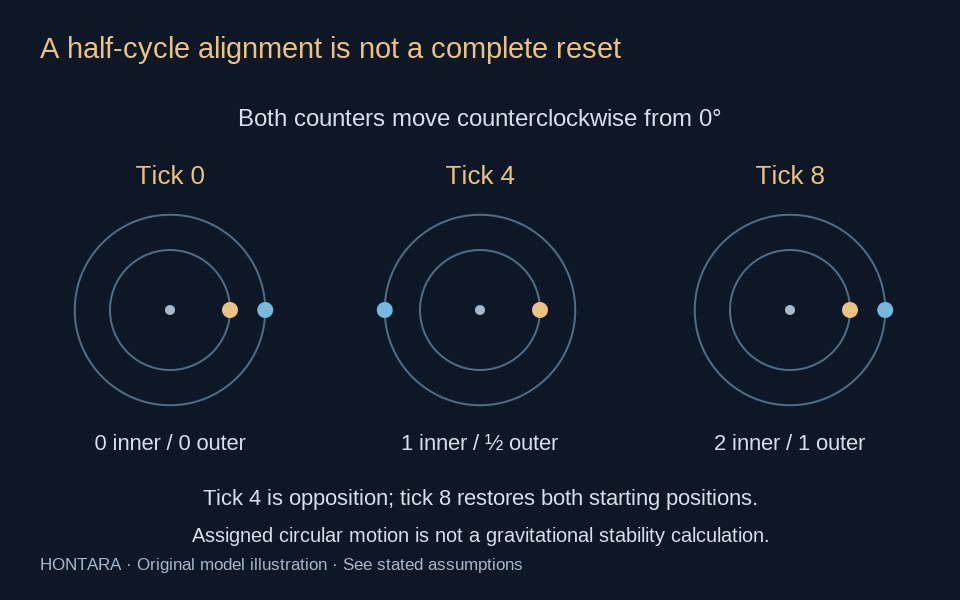
At tick 2 the inner counter is at 180° and the outer at 90°. At tick 4 the inner has completed one circuit and is back at 0°, while the outer is at 180°. The configuration has not returned to its starting state.
Distinguish being on the same straight line from being in the same direction from the centre. Opposite sides at tick 4 do not constitute the same-direction alignment that started the model. Use the worksheet’s angle columns to support the distinction rather than relying on a quick glance.
Find the full repeating configuration
At tick 8 the inner has made two circuits and the outer one. Both angles return to 0° and the assigned configuration repeats. Compare the relative angle changes to explain why the same-direction alignment takes eight ticks in this particular same-direction model.
If you alter one assigned period, make a new table instead of forcing the old answer. The repetition interval depends on both rates and the initial convention. A diagram of one alignment is not enough to establish the complete timing pattern.
Connect the rhythm without overclaiming
NASA describes real resonant relationships among moons such as Enceladus and Dione. Their gravitationally interacting system is more than two counters following prescribed circles. Use it as a reason to investigate dynamics rather than as evidence that every two-to-one drawing is stable.
Finish with one precise model result, two inner circuits per outer circuit and one missing dynamical ingredient. The paper exercise illustrates repeatable geometry and bookkeeping. It does not establish orbital migration, tidal heating or protection from collision for a real pair.
PAUSE AND THINK
Why is tick 4 not the complete reset in this model?
Explore the answer
The inner counter has returned to 0° but the outer counter is at 180°. Both only regain their initial positions at tick 8.
RECORD YOUR OWN EVIDENCE
Your activity sheet
You need: Paper, compass or prepared circles, two labelled counters, ruler and pencil.
Draw concentric circular tracks of radii 3.00 and about 4.76 cm. Start both counters at 0° and move counterclockwise: inner +90° per tick, outer +45° per tick. Record positions from tick 0 through 8.
Name or group: Date:
| Tick | Inner angle | Outer angle | Same direction? |
|---|---|---|---|
| 0 | 0 | 0 | |
| 1 | 90 | 45 | |
| 2 | 180 | 90 | |
| 3 | 270 | 135 | |
| 4 | 0 | 180 | |
| 5 | 90 | 225 | |
| 6 | 180 | 270 | |
| 7 | 270 | 315 | |
| 8 | 0 | 0 |
At tick 4, has the whole configuration returned to its starting positions?
How many inner and outer circuits occur by tick 8?
Why does a repeating kinematic pattern not by itself establish a stable gravitational resonance?
Ideal circular timing model. Near-commensurate periods are an ingredient of resonant dynamics, not a complete proof of resonant locking or stability.