On this page
Look below the frozen surface
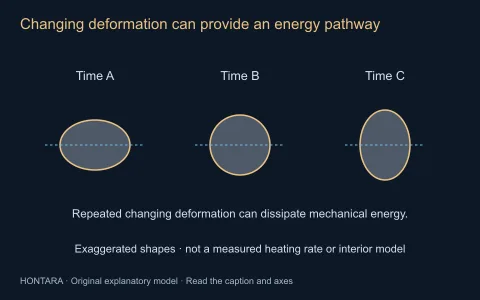
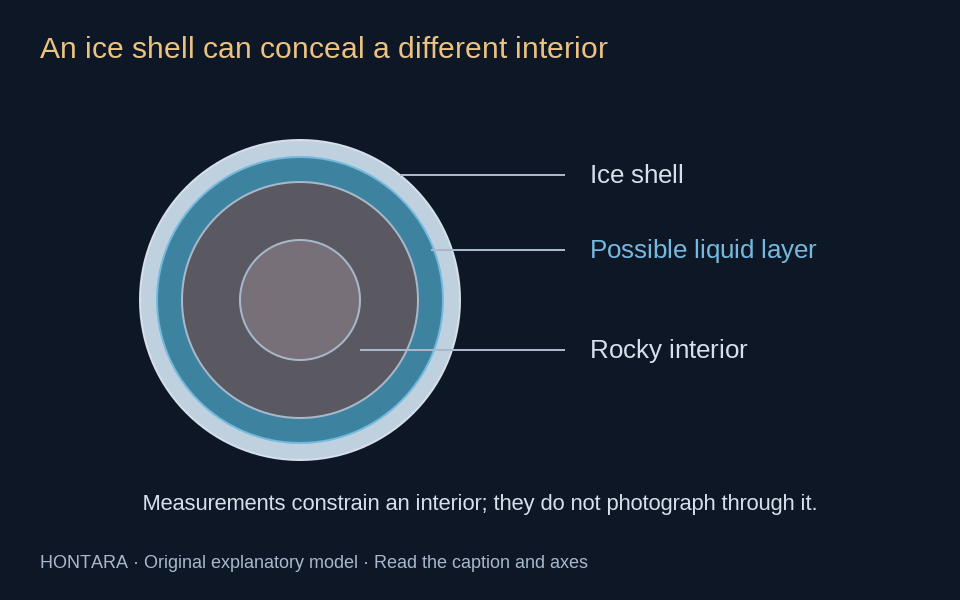
A bright icy surface does not establish that a moon is frozen solid throughout. Heat from formation, radioactive decay and tidal processes can affect interior temperatures. A liquid layer may exist below an outer ice shell even far from the Sun’s surface-liquid-water habitable zone.
The relevant question is the internal structure and energy supply of a particular world. Do not assume all icy moons contain identical oceans at the same depth. Pressure, salinity, composition and thermal history influence which layers can remain liquid.
THE BIG IDEAS
- An ice shell can conceal a liquid layer.
- Independent evidence types constrain different interior properties.
- An ocean or potentially habitable setting is not a life detection.
Treat each observation as a constraint
Europa’s magnetic response to Jupiter’s changing field has been interpreted as evidence for an electrically conducting subsurface layer, consistent with a salty ocean. Surface fractures and disrupted terrain provide different information about the shell’s behaviour and possible exchange with deeper material.
No single attractive surface photograph reveals an entire ocean directly. The inference becomes stronger when independent observations agree with one physical structure better than alternatives. Magnetic measurements also require careful separation of the surrounding plasma environment and the internal response.
Distinguish a plume sample from an ocean dive
Enceladus ejects material into space through its south-polar plume, allowing spacecraft instruments to analyse particles and gases without physically entering a liquid ocean. Such observations constrain chemistry and processes that may connect to the interior.
A plume’s composition is not automatically an unchanged complete sample of the ocean. Transport, freezing, gas separation and instrument response can affect what is measured. Interpret the pathway between proposed source and detector instead of treating every detected species as a direct seafloor measurement.
Organise a comparison by evidence type
Make columns for magnetic behaviour, surface geology, plume chemistry and gravitational or shape information. Mark which types exist for a chosen world and what each can constrain. A missing measurement is not a zero-valued measurement or evidence that a process is absent.
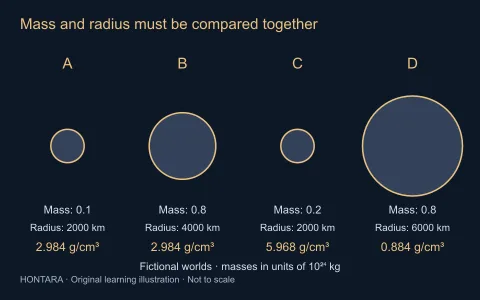
For a fictional example, a conductive-layer inference plus geological activity would motivate an ocean model but would not alone determine exact depth, global continuity or salinity. These model parameters need additional data and uncertainty estimates rather than a single universal cartoon cross-section.
Keep liquid water, habitability and life separate
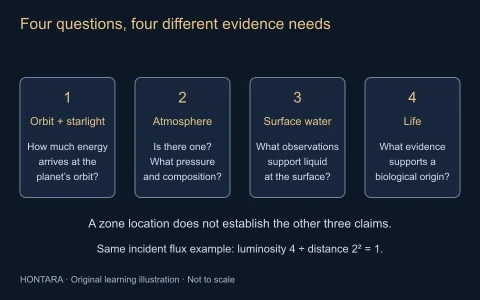
Water is important to life as known on Earth, but an ocean alone does not prove suitable chemical energy, accessible nutrients or organisms. Habitability describes conditions that could support life, while evidence of life requires a further and much more demanding chain of reasoning.
When reading a mission result, identify what was detected and which model links it to an interior environment. Then ask which biological claim, if any, is actually supported. This evidence ladder respects the importance of ocean worlds without turning promising environments into invented inhabited ones.
A second useful comparison separates a global ocean hypothesis from a local liquid reservoir. Both might affect some observations, so geographical coverage and consistency across different measurements matter. Write down what part of the interior each proposed model requires rather than assigning a worldwide ocean simply because a small region appears active.
PAUSE AND THINK
Does a conducting subsurface layer uniquely determine an ocean’s exact depth and composition?
Explore the answer
No. A conducting layer is an important constraint, but detailed structure and material properties need additional observations and modelling.