On this page
Compare mass with the whole volume
Mass describes how much matter a body contains. Bulk density divides that mass by the body’s total volume. Two objects can have the same mass but different densities if their volumes differ. A larger planet is not automatically a denser one.
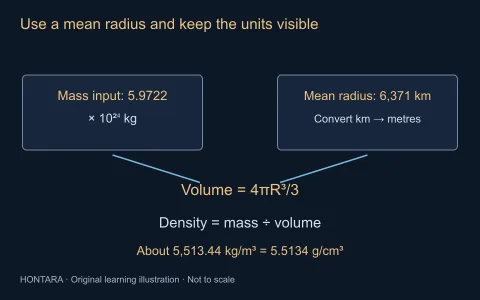
For a spherical approximation the volume is 4πR³/3. For a flattened planet, use a volume-equivalent mean radius when applying this formula: the radius of a sphere having the same volume as the body. An equatorial radius or a photographed diameter is a different input.
THE BIG IDEAS
- Mean density is mass divided by total volume.
- Doubling radius changes spherical volume by a factor of eight.
- Similar bulk densities do not prove identical compositions.
Notice the cubic dependence
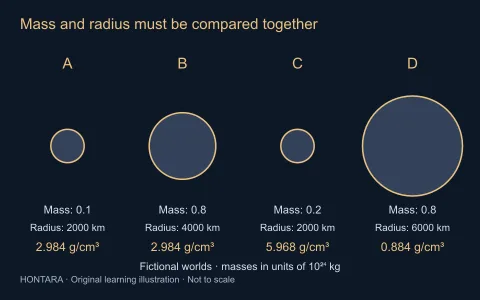
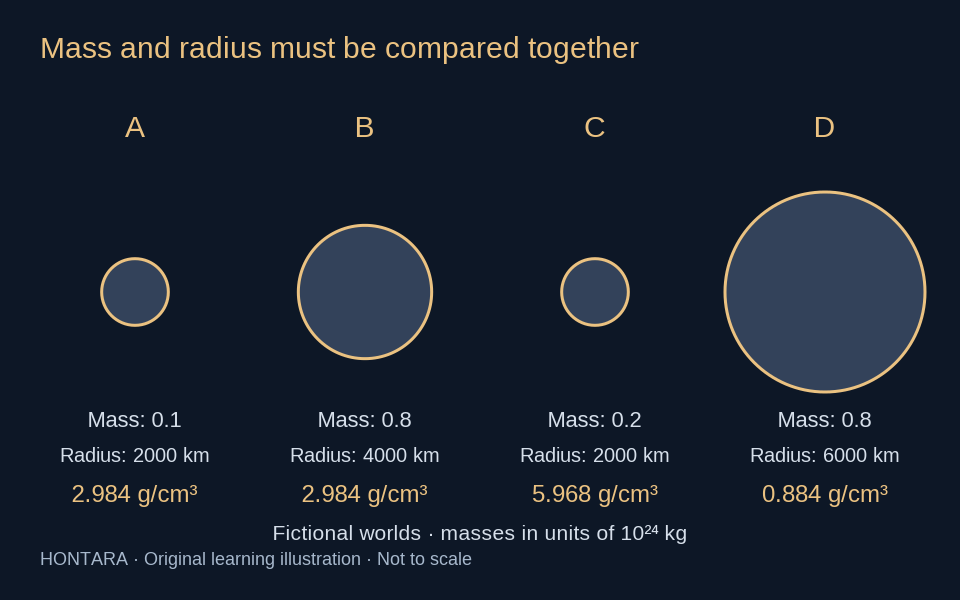
If radius doubles while mass stays fixed, volume increases eightfold and bulk density falls to one eighth. If mass also increases eightfold, the bulk density stays unchanged. These relationships are useful checks before trusting a calculator result.
Consider invented world A with mass 0.1 × 10²⁴ kg and mean radius 2,000 km. World B has eight times its mass and twice its radius. Both have mean density about 2.984 g/cm³. Their equal bulk averages do not establish identical interiors or surface conditions.
Treat composition as an inference
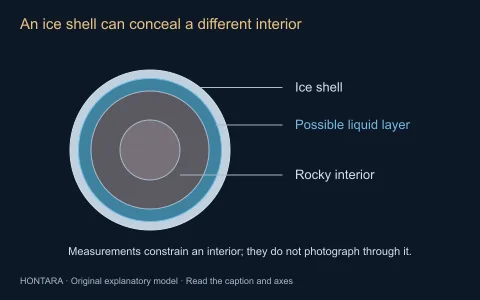
Density helps constrain possible mixtures of materials, but it is not a unique chemical fingerprint. Interior compression changes the density of materials and the distribution of layers matters. Different combinations of composition and internal conditions can produce similar whole-body averages.
A measurement of mass and radius therefore supports an inference through a physical model. More evidence, such as gravitational structure, spectra or mission measurements, can reduce ambiguity. Do not identify an exact rock, ice or gas fraction from one rounded density value alone.
Keep units and scale explicit
One g/cm³ equals 1,000 kg/m³. Using mass 5.9722 × 10²⁴ kg and a volume-equivalent mean radius of 6,371 km gives an Earth example near 5.5134 g/cm³. These are rounded physical inputs; a long calculator output is not a statement of perfect knowledge.
The same bulk average does not apply at every depth. A planet can contain regions with very different local densities. When comparing published tables, inspect the chosen radius, units, rounding and reference values before treating a small numerical difference as a physical disagreement.
PAUSE AND THINK
Two model worlds have equal mass but one has twice the radius. How do their mean densities compare?
Explore the answer
The larger-radius world has eight times the spherical volume and one eighth the mean density, under the stated approximation.