On this page
THE BIG IDEAS
- Use matched units and radius rather than diameter.
- Controlled pairs reveal mass and cubic-radius effects.
- A model density is not a unique material identification.
Copy a table before calculating
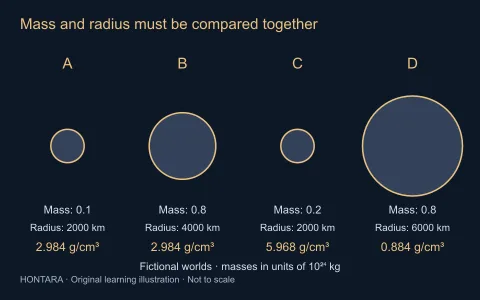
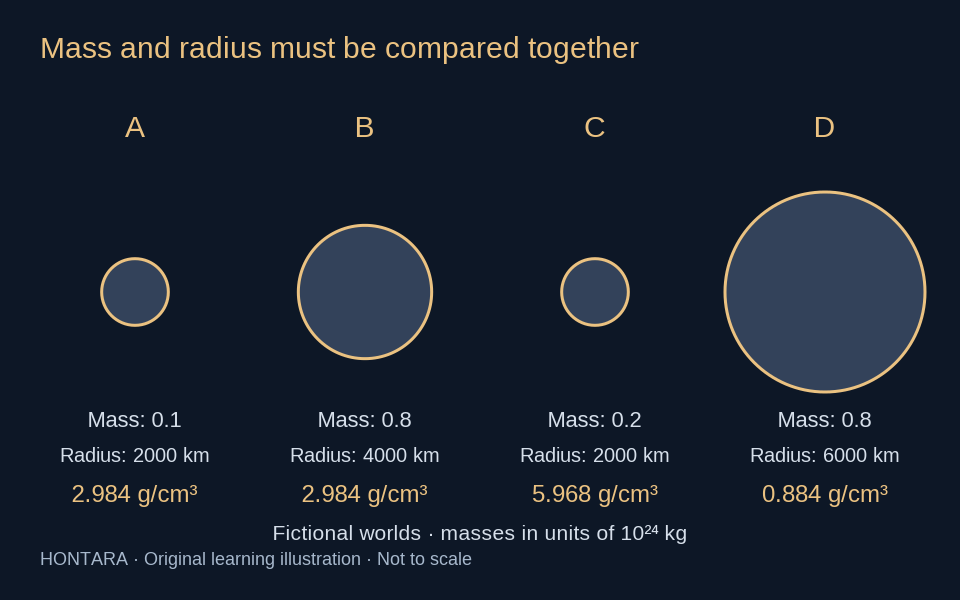
Use four fictional spherical worlds. Their mass inputs are in units of 10²⁴ kg and their radii are in kilometres. A has mass 0.1 and radius 2,000; B has 0.8 and 4,000; C has 0.2 and 2,000; D has 0.8 and 6,000.
Label the units in your own table. These worlds are invented to make comparisons possible. Their values are not observations of named planets. You need paper, pencil and a calculator; the linked mean-density tool can check your arithmetic after you have written a prediction.
Predict from one changed quantity
Compare A with C first. Their radii match while C has twice the mass, so predict how their densities should compare. Next compare B with D, which have equal mass but different radii. State which comparison isolates a change in mass and which isolates a change in volume.
Finally compare A with B. Both mass and radius change. B has eight times A’s mass and twice its radius. Write what happens to spherical volume before deciding whether B must be denser. Keep this prediction visible when checking the calculation.
Calculate with consistent units
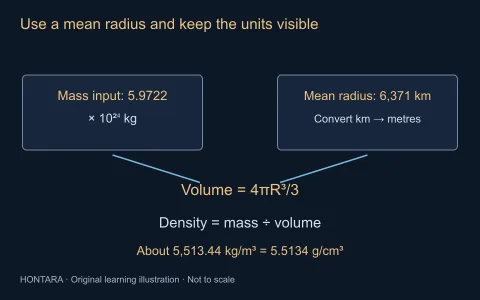
For each world calculate V = 4πR³/3 after converting kilometres to metres. Convert the mass input to kg by multiplying by 10²⁴. Divide mass by volume to get kg/m³, then divide by 1,000 to express g/cm³.
The model answers are approximately A=2.984, B=2.984, C=5.968 and D=0.884 g/cm³. Minor last-digit differences can result from rounding π or intermediate values. Check whether your input was a radius: using a diameter as the radius would make the calculated volume eight times too large.
Explain the comparisons
A and B have the same bulk density because both mass and volume increase eightfold. C has twice A’s density because its volume is unchanged. D has B’s mass spread through a larger spherical volume; its density is about 0.296 times B’s.
Use a named pair to support each explanation rather than saying larger worlds are always lighter or denser. Note that the model treats the given radius as volume-equivalent and does not simulate compression, rotation or layered interiors.
Stop before an unsupported composition claim
Write one supported claim about a density ratio and one unanswered question about a world’s interior. Equal bulk density does not establish equal chemical composition, identical layers or similar surface conditions.
To connect the activity with planetary research, identify what a measured mass and radius would constrain and what further observations or modelling would be needed. Preserve the distinction between a calculated average and an explanation of the materials and conditions producing it.
PAUSE AND THINK
If B has twice A’s radius, why is B not less dense in the stated table?
Explore the answer
B also has eight times A’s mass. Its volume increases eightfold, so mass and volume scale together and the mean density remains the same.
RECORD YOUR OWN EVIDENCE
Your activity sheet
You need: Paper, pencil, calculator and the stated fictional mass/radius table. The linked density calculator is optional.
For invented worlds A=(0.1,2000), B=(0.8,4000), C=(0.2,2000) and D=(0.8,6000), use mass in units of 10²⁴ kg and radius in km. Predict relative density, calculate mean density and state one inference the average does not justify.
Name or group: Date:
| World | Mass (10²⁴ kg) | Radius (km) | Density (g/cm³) |
|---|---|---|---|
| A | 0.1 | 2000 | |
| B | 0.8 | 4000 | |
| C | 0.2 | 2000 | |
| D | 0.8 | 6000 |
Why do A and B have the same mean density in the model?
Compare B and D: which input is fixed and which changes?
Can equal bulk densities establish identical interiors? Explain.
Fictional spherical worlds. These are model calculations, not measured exoplanets or unique composition estimates.