On this page
THE BIG IDEAS
- Assess unit interpretation before repetitive calculation.
- Use error factors to locate the missing reasoning step.
- Keep numerical density separate from a unique composition story.
Specify the outcome and assumptions
Learners should explain how mean density changes when mass or radius changes, then identify an inference that density alone cannot justify. Assess both the calculation and the explanation. The lesson uses spherical model worlds rather than a reconstruction of real planetary interiors.
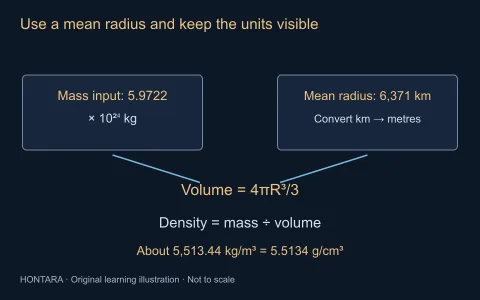
Prepare the paired four-world table, calculators and space for predictions. Ensure every learner can read the mass scaling of 10²⁴ kg and distinguish a radius from a diameter. Provide a worked unit-conversion line rather than relying on learners to infer the units from a column of bare numbers.
Run a 45-minute sequence
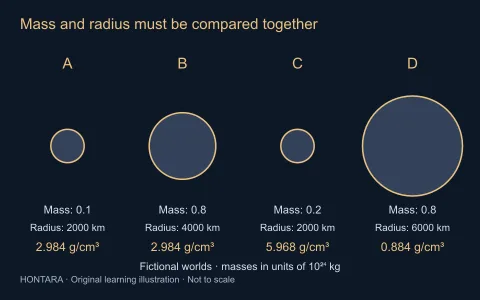
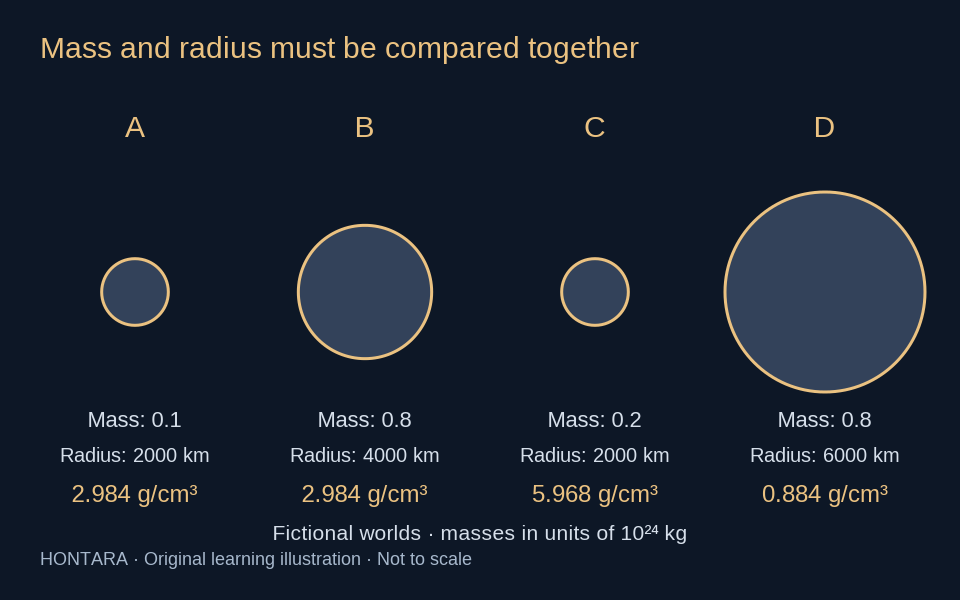
Use five minutes for a mass/volume distinction, ten for pairwise predictions, fifteen for calculations, ten for evaluating claims and five for an exit explanation. Ask learners to predict A versus C and B versus D before considering the two-variable A-versus-B comparison.
Offer a ratio-first route for learners who find large powers of ten distracting. Once one reference density is established, mass ratios and cubed radius ratios give the remaining comparisons. This preserves the physics while reducing repetitive arithmetic.
Check results and diagnose errors
The fictional-world answers are approximately 2.984, 2.984, 5.968 and 0.884 g/cm³ for A through D. A and B agree because B’s mass and volume are each eight times A’s. A/C isolates mass, while B/D isolates the radius effect at fixed mass.
A factor-of-eight discrepancy often indicates a radius/diameter confusion. A factor of 1,000 may indicate a kg/m³ to g/cm³ conversion mistake. Have learners show the relevant conversion or volume step rather than correcting the final number without explaining its origin.
Assess a tempting overclaim
Present the claim that A and B must contain the same materials because their bulk densities agree. Ask what the calculation actually establishes. The supported result is a shared whole-body average within the spherical model; a unique composition or identical layering does not follow.
Connect this limit with real planetary work: pressure, compression, temperature and internal structure can affect the relation between composition and mean density. Do not turn this introductory exercise into a rule assigning each density value to one exact rock, ice or gas mixture.
Use an unfamiliar transfer case
For the exit task keep mass fixed and double radius. Expect a volume factor of eight and density factor of one eighth. Ask for a sentence naming the fixed quantity and the spherical-volume assumption.
As an extension, halve radius while keeping mass fixed and discuss why the mathematical eightfold density increase is not itself a recipe for physically compressing a real planet. Equations describe the specified model; a physically possible interior requires additional evidence and a more complete model.
PAUSE AND THINK
A learner enters 12,742 km as Earth’s radius instead of 6,371 km. What factor error follows?
Explore the answer
The entered radius is twice the intended value, so the spherical volume is eight times too large and the calculated mean density is one eighth of the intended result.
RECORD YOUR OWN EVIDENCE
Your activity sheet
You need: Paper, pencil, calculator and the stated fictional mass/radius table. The linked density calculator is optional.
Predict and check the four fictional-world densities. Record which comparison changes mass alone, which changes radius alone and which scales both.
Name or group: Date:
| World | Mass (10²⁴ kg) | Radius (km) | Density (g/cm³) |
|---|---|---|---|
| A | 0.1 | 2000 | |
| B | 0.8 | 4000 | |
| C | 0.2 | 2000 | |
| D | 0.8 | 6000 |
Explain A/B with mass and volume factors rather than just matching rounded answers.
Show the unit conversion from kg/m³ to g/cm³.
Write one supported inference and one unjustified claim about a world’s interior.
Fictional spherical worlds. These are model calculations, not measured exoplanets or unique composition estimates.