TRY IT YOURSELF
Mean density from mass and radius
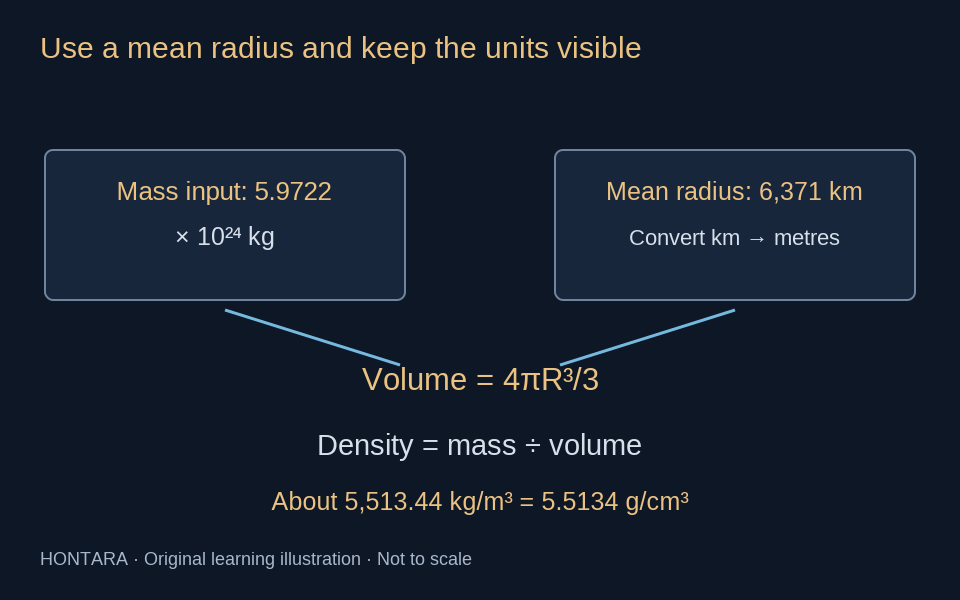
Earth example: mass 5.9722 × 10²⁴ kg and mean radius 6,371 km give about 5.5134 g/cm³. Enter radius, not diameter.
On this page
THE BIG IDEAS
- Mass is entered in units of 10²⁴ kg.
- Use the volume-equivalent mean radius rather than diameter.
- The result does not identify a unique planetary composition.
Enter a mass and a mean radius
Enter mass in units of 10²⁴ kg. For example, an input of 5.9722 means 5.9722 × 10²⁴ kg, not 5.9722 kg. Enter a volume-equivalent mean radius in kilometres. Both inputs must be positive.
For a spherical body this is the ordinary radius. For a flattened planet the volume-equivalent radius describes a sphere with the same volume as the actual body. An equatorial radius or a diameter can give a different result and should not be substituted without saying so.
Follow the unit conversion
The model converts radius from km to metres and calculates V = 4πR³/3. It divides the mass in kg by that volume to obtain mean density in kg/m³. Dividing by 1,000 expresses the same density in g/cm³.
The output includes both units and the model volume. This makes a scale error easier to trace than a bare final value. The result is a whole-body average, not a measurement of surface material or a density profile through the interior.
Check a known input pair
With mass input 5.9722 and mean radius 6,371 km, the Earth example gives about 5,513.44 kg/m³, or 5.5134 g/cm³. The physical inputs are rounded, so the displayed digits do not imply that Earth’s properties are known exactly.
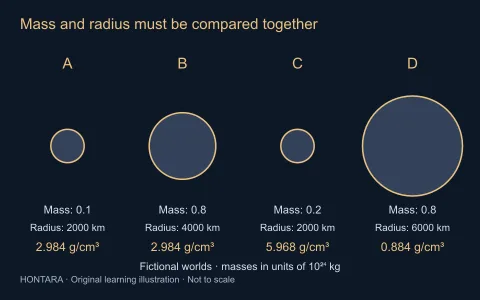
For a controlled model comparison, use mass 0.1 and radius 2,000 km, then mass 0.8 and radius 4,000 km. The radius doubles and volume increases eightfold while mass also increases eightfold. Both answers are about 2.9842 g/cm³.
Interpret the average conservatively
At fixed mass, doubling radius reduces this model density by eight. At fixed radius, doubling mass doubles it. These checks help identify radius/diameter and unit mistakes before discussing what a world might contain.
Real planets can have layered interiors and material densities affected by pressure and temperature. The same average can be produced by different structures or compositions. Use the calculator to explore mass-volume relations, then use additional evidence and appropriate interior models for a composition claim.
PAUSE AND THINK
Why can using a published equatorial radius give a different density than a volume-equivalent mean radius?
Explore the answer
A flattened body’s equatorial radius is not the radius of a sphere with its total volume. Applying the spherical formula to those different radii gives different model volumes.